
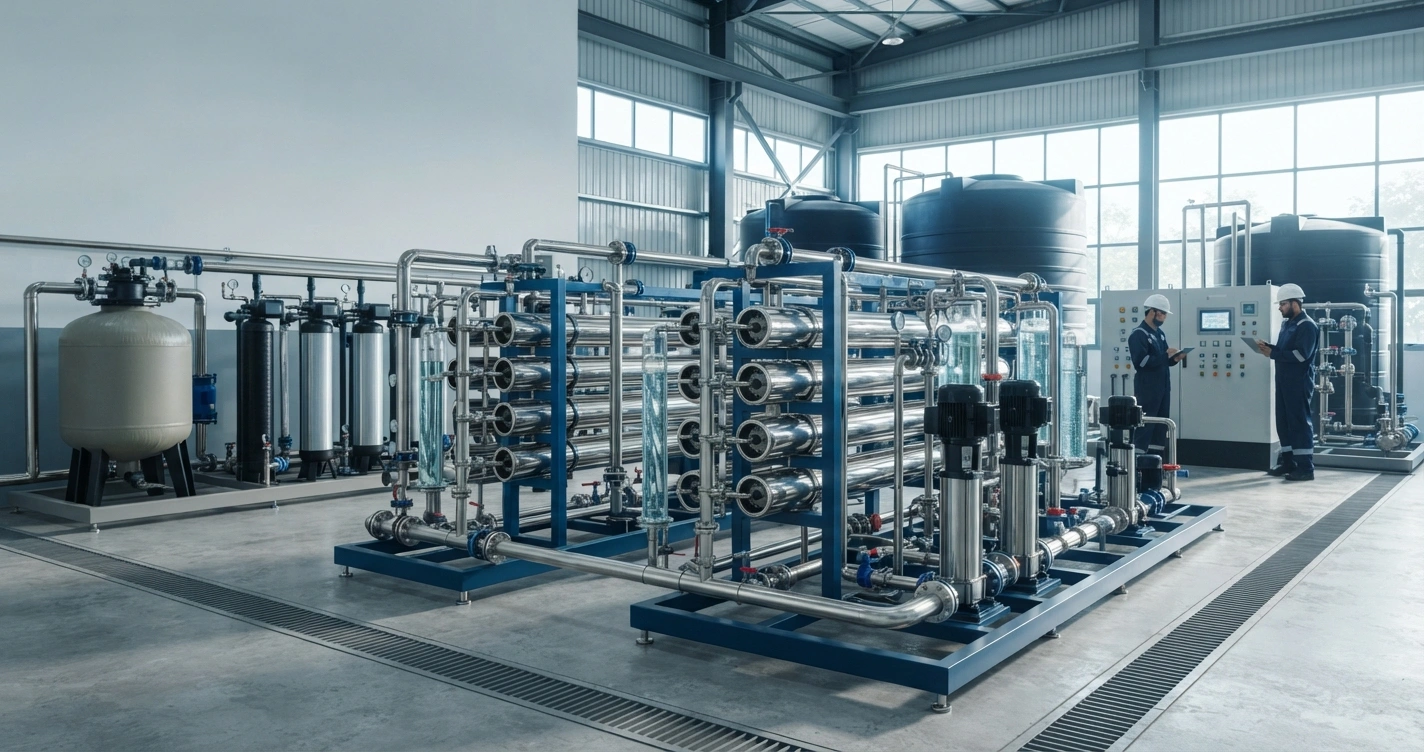
If you’ve asked three different suppliers for a water treatment plant quote and gotten three wildly different numbers, you’re not alone. Water treatment plant cost in Pakistan can range from a few lakh rupees for a small domestic RO unit to tens of millions for an industrial-scale effluent treatment system — and the gap between those numbers isn’t random. It comes down to a handful of factors that most buyers never get a straight answer on: raw water quality, required capacity, technology type, and what “installation” actually includes.
This guide breaks down exactly what drives RO plant installation price and other treatment technologies in Pakistan, so you can budget realistically and ask suppliers the right questions before signing a contract.
What Actually Determines Water Treatment Plant Cost
Before comparing numbers, it helps to understand why two plants that look similar on paper can have very different price tags. Five variables do most of the work:
- Raw water source and quality — Borewell water with high TDS or hardness needs more pre-treatment (softening, sediment filtration, iron removal) than municipal supply, which adds cost before the water even reaches the main treatment stage.
- Required capacity (flow rate) — Measured in GPD (gallons per day) for smaller systems or m³/hr for industrial plants. Cost doesn’t scale linearly — a 5,000 GPD system isn’t 5x the price of a 1,000 GPD system, because fixed costs like control panels, pumps, and civil work don’t grow at the same rate as membrane area.
- Treatment technology — A simple sand-and-carbon filtration system costs far less than a Reverse Osmosis (RO) system, which in turn costs less than a biological treatment process like MBBR or MBR designed for industrial effluent.
- End use and compliance requirement — Drinking water for a household has different (and generally simpler) requirements than industrial effluent that must meet NEQS (National Environmental Quality Standards) discharge limits before release.
- Scope of installation — Whether the quote includes just equipment, or also civil work, electrical wiring, commissioning, staff training, and after-sales support, changes the final number significantly.
Domestic, Commercial, and Industrial RO Plant Installation Price
RO plant installation price in Pakistan is typically discussed in three broad tiers. These are indicative ranges based on typical market conditions — actual quotes will vary by city, brand of components, and water quality, so treat these as a starting point for budgeting conversations, not a fixed price list.
Plant Type | Typical Capacity | Primary Use | Relative Cost |
|---|---|---|---|
| Domestic RO | 50–200 GPD | Home drinking water | Lowest — a few tens of thousands of rupees |
| Commercial RO | 500–5,000 GPD | Offices, restaurants, small water shops, schools, mosques | Moderate — low to mid lakhs of rupees |
| Industrial RO | 10,000+ GPD | Textile, pharmaceutical, food & beverage, boiler feed water | Highest — several lakhs to multiple millions, scaling with capacity |
The jump from commercial to industrial isn’t just about size. Industrial RO systems usually need multi-stage pre-treatment (multimedia filters, ultrafiltration, antiscalant dosing), stainless steel or FRP pressure vessels rated for continuous operation, and automated control panels — all of which add cost but also extend membrane life and reduce downtime.
Beyond RO: Cost Ranges for Other Treatment Technologies
Many industrial buyers in Pakistan — particularly in textile, food processing, and pharmaceutical sectors — need more than an RO plant. Effluent treatment technologies come with their own cost logic:
Moving Bed Biofilm Reactor (MBBR) systems use biofilm carriers to house bacteria that break down organic pollutants. They generally cost more upfront than a conventional activated sludge system of the same capacity, but require a smaller footprint and produce less excess sludge — which lowers long-term disposal costs.
Membrane Bioreactor (MBR) combines biological treatment with membrane filtration, producing higher-quality effluent (often good enough for reuse) but at a higher capital cost than MBBR, largely due to the membrane modules themselves.
Zero Liquid Discharge (ZLD) is the most capital-intensive option, since it requires evaporation and crystallization stages to eliminate liquid discharge entirely. It’s typically reserved for industries facing strict discharge restrictions or operating in water-stressed areas where reuse is a priority, not a nice-to-have.
Electrocoagulation and Fenton Process systems tend to sit in a more moderate cost bracket and are often used as pre-treatment or for specific pollutant types (heavy metals, high-COD wastewater) rather than as a complete standalone solution.
A Quick Comparison: MBBR vs Conventional Activated Sludge
| Factor | MBBR | Activated Sludge |
|---|---|---|
| Footprint | Smaller (compact biofilm carriers) | Larger (needs bigger aeration tanks) |
| Sludge output | Lower | Higher — more disposal cost over time |
| Capital cost | Higher upfront | Lower upfront |
| Operating stability | More resilient to load fluctuations | More sensitive to shock loads |
| Best suited for | Textile, industries with variable flow | Municipal or steady-flow industrial use |
For a mid-sized textile unit in Faisalabad discharging around 200 m³/day of dyeing effluent, this trade-off often comes down to available land. A unit with limited plot space frequently finds that MBBR‘s smaller footprint offsets its higher initial cost within a few years, once reduced sludge handling and disposal expenses are factored in.
Capital Cost vs Operating Cost — Don’t Budget for Only One
A common mistake is comparing suppliers purely on the upfront quote. The real cost of ownership includes:
- Capital expenditure (CapEx) — equipment, civil work, electrical installation, and commissioning.
- Operating expenditure (OpEx) — electricity consumption, membrane replacement, chemical dosing (antiscalants, coagulants, disinfectants), sludge disposal, and routine maintenance.
- Annual Maintenance Contract (AMC) — many suppliers offer service contracts covering scheduled maintenance, membrane cleaning, and emergency support; this is often optional but worth pricing in from day one.
A plant with a lower installation price but high energy consumption or frequent membrane replacement can end up costing more over five years than a slightly pricier system built with energy-efficient pumps and better pre-treatment. When comparing quotes, always ask for an estimated OpEx figure, not just the CapEx number.
Hidden Costs That Change the Final Number
Buyers are often surprised by line items that weren’t in the initial quote:
- Civil work — foundation, plant room construction, and plumbing are sometimes quoted separately from the treatment equipment itself.
- Electrical infrastructure — if your site doesn’t have adequate power supply or needs a dedicated transformer/panel upgrade, this adds real cost.
- Water testing and lab analysis — a proper raw water and (for industrial plants) effluent characterization study should happen before design, not after installation.
- Transportation and site access — remote or difficult-access sites in areas like interior Sindh or northern Punjab can add logistics costs.
- Staff training — proper operator training reduces breakdowns and extends equipment life, and should be part of any serious installation, not an afterthought.
How to Get an Accurate Quote
To get comparable quotes from multiple suppliers, provide the same information to each one:
- Raw water source and, ideally, a recent water test report
- Required daily capacity and peak flow if it varies
- End use (drinking water, process water, boiler feed, effluent discharge, reuse)
- Any regulatory requirement you need to meet (e.g., NEQS parameters for industrial discharge)
- Available space and existing electrical capacity at the site
A supplier that asks these questions before quoting a number is generally giving you a more accurate estimate than one that quotes off a phone call alone.
Conclusion
Water treatment plant cost in Pakistan isn’t a single number — it’s a function of your raw water quality, required capacity, chosen technology, and how much of the installation scope (civil, electrical, commissioning, training) is included in the quote. Comparing suppliers on CapEx alone, without factoring in OpEx and maintenance, is one of the most common and costly mistakes buyers make. Water Care Services Pakistan (WCSP) has been designing and installing water and wastewater treatment systems for industrial, municipal, and commercial clients across Pakistan since 2007, and can help you work through these variables with a proper site assessment before you commit to a number.
FAQ
Q1: What is the average cost of a domestic RO plant in Pakistan? Domestic RO systems for home use are the most affordable category, typically priced in the tens of thousands of rupees depending on capacity, filtration stages, and brand of membrane. Exact pricing depends on your local water quality and the retailer, so it’s worth getting a quote based on a water test rather than assuming a fixed price.
Q2: Is RO the right choice for industrial wastewater treatment? Not always. RO is excellent for producing high-purity water (drinking water, boiler feed, process water) but isn’t typically used as a standalone solution for treating industrial effluent with high organic load — that’s usually where biological systems like MBBR or MBR come in, sometimes combined with RO for polishing or reuse.
Q3: How long does it take to install a water treatment plant in Pakistan? Timelines vary by scale and complexity. A domestic or small commercial RO system can often be installed within days to a couple of weeks. Industrial systems involving civil work, custom fabrication, and multi-stage treatment typically take several weeks to a few months from design approval to commissioning.
Q4: Do I need government approval to install an industrial effluent treatment plant? Industries discharging wastewater are generally required to comply with NEQS standards and register with their provincial Environmental Protection Agency (EPA), such as Punjab EPA or Sindh EPA. Requirements vary by industry type and location, so it’s best to confirm specific obligations with your provincial EPA or an environmental compliance consultant.
Q5: What ongoing costs should I expect after installation? Beyond electricity, expect periodic membrane or media replacement, chemical dosing (antiscalants, coagulants, disinfectants), and routine maintenance. Many suppliers offer Annual Maintenance Contracts (AMC) that bundle these into a predictable yearly cost — worth comparing against pay-as-you-go maintenance.