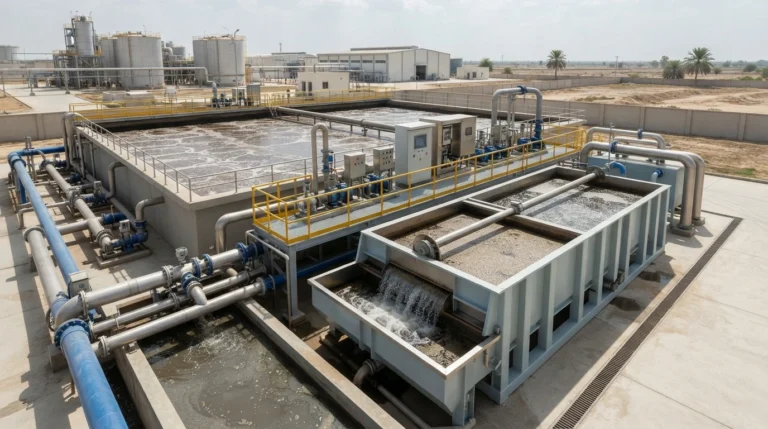
On a flow sheet, edible oil refinery wastewater treatment looks simple: take the oil out, then let bacteria digest what is left. In practice, most failures happen at the handoff between those two steps. Oil that slips past the first stage coats the biomass in the second, settling gets worse, and the final effluent drifts out of limits.
That is why a dissolved air flotation (DAF) unit and a biological stage are normally designed as a pair rather than as separate purchases. This article explains what oil refineries and ghee plants actually discharge, what each stage is responsible for, where the two depend on each other, and what plant managers in Pakistan should settle before they approve a design.
What an oil refinery and a ghee plant actually discharge
A refinery does not produce one wastewater. In chemical refining, the effluent is usually described as two streams: acid wastewater from soap splitting, and general process wastewater from oil washing and deodorising. Where a plant uses physical refining, the general stream comes from distillation instead. Whether the two are kept separate or combined changes how the treatment plant has to be built.
The acid stream deserves attention because the sulfuric acid used in soap splitting can leave high sulfate in the effluent, and the stream itself is far from neutral. Neither condition suits a biological reactor without preparation.
Ghee plants add their own variables. Vanaspati ghee is hydrogenated vegetable oil, so a mill that makes it often runs refining, hydrogenation and packing under one roof, with equipment washing and floor cleaning on top. The result is a stream that changes with the product schedule, the shift, and even the day of the week.
There is no fixed “typical” composition worth quoting, because washing practices differ even between refineries running the same oil. The first task of any design is measurement, not equipment selection.
Why biological treatment alone struggles with oil
Fats and oils are hydrophobic. Published work on edible oil refinery wastewater notes that conventional technologies handle this stream poorly precisely because the lipids resist dissolving into water. Bacteria can digest fats, but only in manageable amounts.
When oil reaches an aeration tank in bulk, three things tend to happen. A film of fat coats the sludge flocs, so they settle poorly in the secondary clarifier. The coating also slows oxygen transfer, so the tank needs more air for the same job. And fatty acids released as the oil breaks down can stress the microorganisms, especially when the load arrives as a sudden surge instead of a steady feed.
The practical consequence is simple. Biology is excellent at dissolved organic matter and poor at free or emulsified oil. Something has to remove the oil first.
Pretreatment: the unglamorous stages that decide whether DAF works
A DAF unit is not a substitute for oil separation upstream. Typical treatment trains described in the literature for edible oil refineries put equalisation, neutralisation, a clariflocculator or primary clarifier, an aeration basin, a secondary clarifier and sludge dewatering in sequence. The DAF stage sits where emulsified oil needs to be removed before the aeration basin.
Before that point, three jobs matter.
Screening and free-oil removal. Large solids and layers of free oil are cheaper to skim or trap than to float. If a DAF unit receives a thick oil layer, it spends its capacity on work a simple separator could have done.
Equalisation. Washing is a batch activity. An equalisation tank turns spikes into something closer to a steady flow, and it lets acidic and alkaline streams partly offset one another. Without it, even a well-designed DAF unit struggles.
pH control. Coagulation depends on pH, so neutralisation ahead of the DAF is part of the oil-removal process, not a separate housekeeping step. Biological stages also need their pH held within a workable range, which makes neutralisation relevant twice.
Is Oil Slipping Past Your DAF Into the Biological Stage?
Send us your flow, pH, COD and oil and grease readings, plus a note on whether your acid and general streams are mixed. We will look at where oil could be reaching the aeration tank and suggest what to test on a real effluent sample before any sizing is done. You can also read how we approach wastewater treatment systems or set up water quality monitoring to track both stages together.
How a DAF unit handles edible oil refinery wastewater
The principle behind DAF unit wastewater treatment is straightforward. Part of the clarified effluent is pumped into a pressure vessel where it is saturated with compressed air. When that pressurised water is released into the flotation tank, the air comes out of solution as very fine bubbles. The bubbles attach to oil droplets and flocculated solids and carry them to the surface, where a skimmer removes the float. Clarified water leaves from the bottom of the tank.
The catch with edible oil is that the droplets are rarely free. Soaps and fatty acids stabilise them as emulsions, so bubbles alone do not grab them reliably. The feed is usually conditioned with a coagulant and often a polymer so that the droplets destabilise and bind into flocs the bubbles can lift. This is chemistry that has to match the effluent, which is why jar testing on real samples comes before sizing.
Several mistakes show up repeatedly in the field:
- Dosing set once and never revisited. If the influent changes with the product schedule, a fixed coagulant dose will be too high for one shift and too low for the next.
- Hot effluent sent straight to the unit. Gases dissolve less readily as water warms, so air saturation becomes less effective, and warm fat behaves differently from cool fat.
- Infrequent skimming. Float that sits too long can break up and return solids to the clarified water.
- No plan for the float sludge. It is oily and bulky, and it needs a defined route for dewatering and disposal.
DAF has limits. It removes oil and suspended solids, but it does not remove much of the dissolved organic load. A clear-looking DAF outlet can still carry a high COD, and that is the biological stage’s job.
Some plants evaluate electrocoagulation as an alternative or supplement for emulsified fats, since the process generates coagulant in place and lifts fine oil through electro-flotation. Whether it makes sense depends on the effluent and the power cost at the site, so it belongs in the pilot-testing conversation rather than a default specification.
What the biological stage is there to do
Once the oil load is under control, the biological stage handles what remains: dissolved organics that show up as BOD and COD. The established options for refinery effluent are the conventional activated sludge process and the sequencing batch reactor, which is a variant of activated sludge that treats the water in batches.
There is published evidence that the combination works. A review in Water Science and Technology summarises full-scale refinery plants using chemical coagulation, DAF and activated sludge, with reported COD removal in the range of 92–96% in one study. Treat this as proof that the train is sound, not as a performance guarantee. Results depend on influent strength, temperature, sludge age and how well the upstream stages protect the biology.
Compact alternatives are available where land is tight. A moving bed biofilm reactor (MBBR) grows biomass on carriers instead of relying only on suspended sludge, and a membrane bioreactor (MBR) replaces the secondary clarifier with membranes. Both perform best when oil is removed first, and membranes in particular are not forgiving of fats.
One more point is easy to miss. Oil-heavy effluent is carbon-rich, and biological treatment needs a balanced supply of nutrients. Checking nitrogen and phosphorus availability during commissioning saves trouble later.
How the two stages depend on each other
It helps to think of the DAF as a protection device for the biology. When the DAF drifts, the damage does not appear in the DAF outlet first. It appears days later as poor settling, foaming, or a sludge that looks different.
| DAF stage | Biological stage | |
| Main target | Emulsified oil, suspended solids | Dissolved organic matter (BOD/COD) |
| Works through | Fine air bubbles plus coagulation | Microorganisms |
| Cannot do well | Remove dissolved organics | Tolerate heavy oil or sudden shock loads |
| Typical upset | Wrong dosing, pH drift, hot feed | Oil carry-over, acidic shock, low oxygen |
| Worth monitoring | pH, coagulant response, float quality, oil at outlet | Dissolved oxygen, sludge condition, settleability, COD at outlet |
Log both stages together. If settleability falls, check the DAF records for the preceding days before touching the aeration tank.
Ghee plants and mixed operations in Pakistan
Ghee plant effluent treatment is complicated by the mix of operations. A single site may refine, hydrogenate, and pack, and it may also run soap or other products from the same utilities. The wastewater is then a blend whose character depends on what was running, and a design based on a single sample will not hold up.
Pakistani plants also face a compliance question that the textbooks do not answer: what limit applies at your discharge point. Requirements depend on where the water goes, and provincial environmental agencies apply the National Environmental Quality Standards in their own way. Confirm the applicable limits with the relevant agency before design starts, rather than copying a number from a foreign source.
Seasonal production matters too. A mill that runs flat out for part of the year and at partial load for the rest needs a biological stage that tolerates low-load periods. WCSP covers this in its guide to modular packaged plants for food processing, and its team carries out jar testing and effluent analysis to evaluate treatment performance before recommending a process.
Questions to settle before you choose a design
What are the flow and strength over a full production cycle?
One grab sample is not enough. Collect composite samples across shifts and across product changes.
Is the acid stream kept separate or mixed?
This decides the neutralisation design and the sulfate question.
How will oil be recovered upstream?
Free oil removed early is oil the DAF never has to treat.
What coagulant and polymer program works in jar tests?
Ask for the test results, not just the recommendation.
Where does the float sludge and the biological sludge go?
Dewatering and disposal costs are part of the plant’s real operating cost.
How will the two stages be monitored together?
Even a simple daily log of pH, dosing, settleability and COD gives early warning.
What is the discharge limit, and where is the discharge point?
Settle this with the environmental agency first.
Frequently Asked Questions
Q1. What is the difference between a DAF unit and a biological treatment stage?
A DAF unit removes emulsified oil and suspended solids by attaching fine air bubbles to them and floating them off. A biological stage uses microorganisms to digest dissolved organic matter, measured as BOD and COD. They target different pollutants, which is why edible oil plants normally need both, in that order.
Q2. Can a ghee plant skip the DAF and rely on biological treatment alone?
It is risky. Fat coats the biomass, hurts settling and slows oxygen transfer, so biology alone tends to be unstable unless oil loads are very low. A good oil trap and equalisation tank help, but most plants with emulsified oil still need a DAF or an equivalent. A trial on real effluent should decide.
Q3. Why does DAF need a coagulant for edible oil wastewater?
Oil droplets in refinery effluent are stabilised by soaps and fatty acids, so they stay emulsified. A coagulant, and often a polymer, destabilises the droplets so they bind into flocs that air bubbles can lift. The right dose depends on the effluent, so set it through jar testing and recheck it when production changes.
Q4. What should I test before designing an edible oil refinery effluent plant?
Measure flow, pH, COD, BOD, oil and grease, and suspended solids across a full production cycle, including washing and product changes. Record temperature and note whether acid streams are separate. Then run jar tests for the DAF stage. A single grab sample will mislead the design.