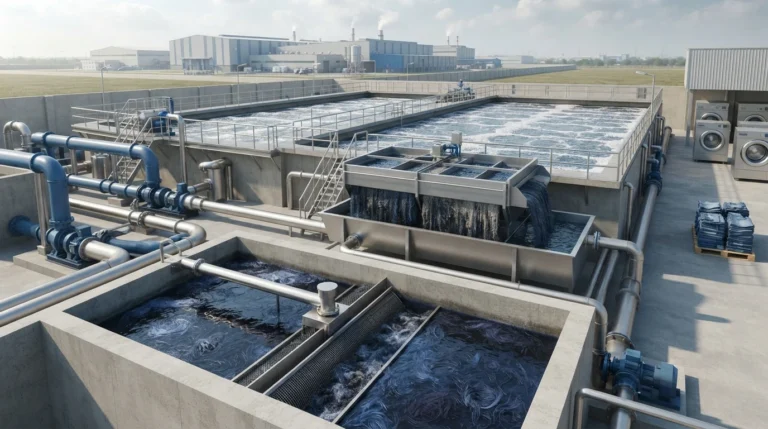
A denim washing unit rarely produces one kind of wastewater. In a single shift the same machines can discharge a pumice-laden stone wash, a hypochlorite bleach bath, an acidic neutraliser and a detergent soap, one after another, and the drain carries the average of all of them. That average is what most ETPs are asked to treat, which is why denim washing wastewater treatment so often disappoints: the plant is designed for a blend that no single machine ever produces.
This article looks at what each wash stage adds to the water, how garment laundry effluent in Pakistan creates its own physical problems, which streams can realistically be reused, and how to build a treatment train around the real load.
Why denim washing wastewater treatment starts at the machine
Textile dyeing usually runs in long, steady batches. Denim washing does not. A washing unit pushes a changing mix of recipes through the same machines, and every recipe empties its bath at once. The drain sees sharp peaks on top of a messy average.
That matters because the streams are not equally bad. A 2026 study in Scientific Reports sampled effluent stage by stage over seven weeks at a Tunisian denim finishing plant and found large differences. Stone washing, bleaching, neutralisation and soaping were the most polluting, while effluent from dyeing preparation was clean enough to consider for reuse or direct discharge. Tunisian limits applied there, not Pakistani ones, but the pattern is what any washing unit should expect: a few streams carry most of the problem.
The first design question is therefore not which technology to buy. It is which streams you have and how much of the total load each one contributes.
What each wash puts into the water
Stage | What goes into the water | What to expect |
Desize and enzyme wash | Starch size, cellulase enzymes, detergent, loose fibre | Mostly biodegradable organics; usually the easier stream |
Stone or pumice wash | Pumice fines, fibre, indigo, enzymes, surfactants | Heaviest solids, COD and colour |
Hypochlorite bleach | Oxidant residue, chloride, dye breakdown products | High chloride; can upset COD testing and harm biology |
Neutralisation | Reaction products of the reducing agent, sulphates, chlorides | Acidic and salty, with its own oxygen demand |
Soaping and softening | Detergents, softeners, unfixed dye | Surfactant-rich, moderate colour |
The Tunisian figures show how uneven this is. Stone washing peaked at roughly 4,500 mg/L COD, and suspended solids in the stone-wash bath reached 1,290 mg/L before rinsing, because abrasion strips fibre and pumice fines off the fabric while enzymes and surfactants add organic load. Neutralisation stood out for salts: the reducing agent reacts with residual chlorine to form dissolved sulphates and chlorides, raising conductivity and leaving an acidic stream. Treat these as one plant’s results, not Pakistani benchmarks, since recipes, liquor ratios and chemicals move every figure.
A study from National Textile University, Faisalabad, which compared six denim washes, likewise found that each method produces a different kind of effluent.
Garment laundry effluent in Pakistan: lint, pumice and batch shocks
In a washing unit the physical problems arrive before the chemical ones. Denim sheds lint and fibre in quantity, pumice breaks down into fines that behave like fine sand, and machines drain entire baths at once. A plant sized for the daily average is overwhelmed for the minutes each batch drains, and that is when screens clog, pumice settles in channels and sumps, and the biological tank takes a slug of bleach or soap.
Pre-treatment does most of the protecting. Fine screening for lint, a settling stage built for pumice and an equalisation tank sized from real batch volumes should all come before any chemical or biological unit. Plan for pumice sludge as well. It is abrasive, it accumulates quickly, and it needs a disposal route agreed in advance.
What Is Each Wash Recipe Really Sending to Your ETP?
Send us your list of wash recipes, your largest batch discharge volume, and any pH, COD or suspended solids readings you have, ideally stream by stream. We will go through them and tell you which streams to split, what to sample next and where batch peaks could overload a plant. Whether you need a wastewater treatment system built around your real load, or zero liquid discharge planning for full reuse, we can start from the same data.
Keep the cleaner streams out of the ETP
Segregation is the cheapest treatment step available. Low-load streams such as preparation baths and second rinses are often clean enough that sending them through the ETP only dilutes the stronger streams and makes every tank bigger. Where the drainage layout allows, give them their own drain.
Treat the bleach stream separately too. Hypochlorite liquor carries residual oxidant that can kill biomass, and the metabisulphite used to neutralise it adds oxygen demand and salts. Quench these streams under control before they reach any biological stage.
One measurement trap deserves attention. The Tunisian study found chloride above 3 g/L in bleaching effluent, which made the standard dichromate COD method unusable for those samples. If your lab reports odd COD figures on bleach-wash samples, suspect chloride interference and ask for TOC or a chloride-tolerant method. A design built on unreliable numbers will be wrong in both directions.
A treatment train that matches denim effluent
A workable train usually follows this order, though the details change with your recipes:
- Fine screening and pumice settling. Remove lint and abrasive solids first so pumps, screens and downstream tanks survive.
- Equalisation with pH correction. Blend batch peaks into a steady flow and bring acidic neutraliser baths and alkaline washes toward each other.
- Coagulation with flotation or clarification. Capture suspended fibre, fines and particulate indigo. Set the chemistry by jar test on real samples from several recipes, because dosages borrowed from another unit seldom transfer.
- Biological treatment, if the organic load justifies it. An MBBR or activated sludge stage handles biodegradable COD from enzymes, detergents and size. High salts, foaming surfactants and residual oxidants are the usual causes of poor performance, so protect it with the steps above.
- Polishing for colour and stubborn COD. Where colour or residual COD is still above target, the Fenton process or electrocoagulation can be applied to a smaller, pre-treated flow. WCSP’s Fenton page notes that pH is among the most influential variables, so plan for tight pH control.
Not every unit needs all five stages. The Tunisian plant in the study used a physico-chemical process aimed mainly at suspended solids, colour and part of the organic load, which suits washing operations where solids and colour dominate. Whether you need biology depends on your COD after coagulation and on where the water goes next.
Denim wastewater reuse: start with the rinses
The easiest water to reuse is the water that is already nearly clean, and rinses are the obvious candidate. In the Tunisian plant each stage was followed by two short rinses, and quality improved sharply from bath to bath. After the first rinse COD fell to roughly 400 to 600 mg/L depending on the stage, and after the second, COD and suspended solids were generally below the plant’s limits.
The authors proposed a cascade: the first rinse of each operation goes back into the main bath of the next cycle, the second rinse becomes the next first rinse, and only the last rinse is topped up with fresh water. Bleach rinses are stored separately and checked for chloride, soap rinses can serve stone washing because the surfactants are similar, and neutraliser rinses can be reused if the reducing agent dosing is adjusted. They estimated that freshwater use could fall by nearly two thirds, but stated clearly that this is a conceptual estimate, with no plant-wide water balance, no repeated-cycle trials and no check on shade or fabric quality.
Two limits deserve respect. Dyeing rinses were kept out of reuse because trace dye alters garment shade, and the neutralisation stream stayed poor even after rinsing. Salts also build up with every cycle, so a cascade needs a purge or a salt-removal step rather than endless recycling.
Pakistani research points the same way. A University of the Punjab study decolourised dye wash-off liquor with alum and chitosan, followed by electrocoagulation, and concluded the treated water was suitable for reuse in wash-off. That was a dyeing process, not denim washing, but it shows that colour removal is what makes reuse possible.
Reusing treated effluent: where salts and membranes come in
Once the ETP works, the next question is whether treated water can return to the washing machines. Sometimes, but not without more treatment. Residual surfactants, suspended solids, colour and dissolved salts all affect wash quality, and a review of laundry water recovery notes that effluent is often inadequate for reuse in laundry operations for exactly these reasons. In practice, reuse of treated effluent means ultrafiltration followed by reverse osmosis, or RO permeate blended with fresh water, with salinity and hardness checked against what each recipe tolerates.
Membranes bring their own problem. RO concentrates the salts into a reject stream that still needs a destination, which is why reuse planning and zero liquid discharge planning end up as the same conversation. Decide how far you want to go before ordering equipment, because a plant built only for discharge is rarely easy to stretch into full reuse.
Questions to settle before you design or buy
Get clear answers to these before accepting a proposal:
- Which recipes do you run (stone, bleach, enzyme, acid, soap), and in what proportion over a typical month?
- Have the streams been sampled separately, including peak discharges, rather than only the combined drain?
- How large is the peak batch discharge compared with the daily average, and does the equalisation volume reflect it?
- Where does the treated water go, and which standard applies at your site? Confirm this with your provincial EPA rather than relying on a vendor’s summary.
- Where do pumice and chemical sludge go, and who pays for it?
- What is the reuse target: rinses only, or treated effluent through membranes, and how will salts be purged?
WCSP’s published delivery process begins with site analysis and wastewater testing, and its textile ETP cost guide makes the same point that quotes should rest on an effluent characteristics report. A proposal that arrives before your streams have been analysed is a rough estimate at best.
Conclusion
Denim washing wastewater looks like one problem at the drain, but it is really several streams with different chemistry. Understanding them separately is what makes the ETP smaller, reuse realistic and sludge manageable. Start with pre-treatment for lint and pumice, keep the cleaner rinses out of the heavy load, polish colour only where it is still above target, and test reuse on real garment lots before committing. Confirm discharge requirements with your provincial EPA before finalising a design. If you are planning an ETP for a washing unit, WCSP can start from a site visit and effluent testing, which is the right foundation for any design.
Frequently Asked Questions
Q1. What is the best way to treat denim washing wastewater?
There is no single best method. Most units combine screening, pumice settling and equalisation with coagulation and flotation, add biological treatment where the organic load justifies it, and polish colour with oxidation or electrocoagulation. The right mix depends on your recipes, peak flows and whether the target is discharge or reuse.
Q2. Why does stone wash effluent have such high COD and suspended solids?
Abrasion strips fibre and pumice fines from the garments, adding suspended solids, while enzymes and surfactants add biodegradable organic load. In a Tunisian plant study, stone washing was the most heavily loaded stage, with COD peaking around 4,500 mg/L. Your own figures will vary with recipe and liquor ratio.
Q3. Can denim washing wastewater be reused?
Rinse water is the realistic starting point. A 2026 study proposed cascading rinses into later baths, estimating a freshwater saving of nearly two thirds, though it was not validated in practice. Dyeing rinses and neutralisation streams are harder. Trial any reuse on sample lots and watch shade, hand feel and salt build-up.
Q4. What should we test before choosing an ETP?
Test each stream separately, not just the combined drain: flow, pH, COD or TOC, suspended solids, colour, conductivity and chloride. Capture peak discharges for each recipe over several weeks. Chloride matters because bleach effluent can interfere with standard COD tests and produce misleading results.