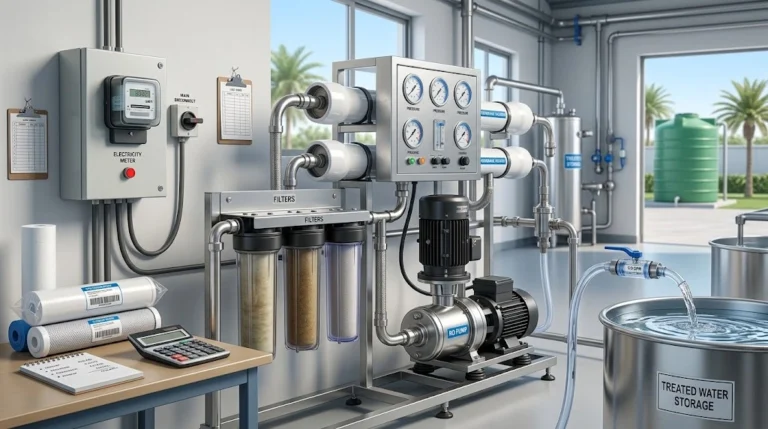
The Three Main Ongoing Cost Categories
- Pre-filters (sediment and carbon): these need periodic replacement to protect the membrane and maintain taste/odor removal, with frequency depending on source water quality.
- RO membrane replacement: the single most expensive recurring component, with lifespan depending heavily on feed water quality and how well the system is maintained.
- Electricity: booster pumps (especially in larger or higher-pressure systems) consume power continuously during operation, and this becomes a more meaningful cost at commercial and industrial scale.
Filter Replacement Costs
Sediment and carbon pre-filters are relatively inexpensive individually, but they need regular replacement — more frequently if your source water is turbid or has high chlorine/organic content, since these filters protect the membrane by capturing what would otherwise foul it. Skipping or delaying filter changes to save money is a false economy: a clogged or exhausted pre-filter shortens membrane life significantly, turning a small filter-replacement saving into a much larger membrane-replacement cost.Want to Know What Your RO Plant Will Really Cost to Run?
Send us your feed water test and plant size, and our engineers will estimate your filter, membrane and electricity costs. We supply and maintain RO systems under a predictable Service Level Agreement.
Membrane Replacement: The Biggest Ongoing Expense
RO membranes don’t last forever, and their lifespan varies significantly based on feed water quality, pretreatment effectiveness, and maintenance consistency. Membranes exposed to poorly pretreated water, high hardness, or infrequent cleaning wear out considerably faster than those protected by proper pre-filtration and periodic cleaning. This is why running cost isn’t purely about the membrane’s price tag — it’s also about how much pretreatment quality extends or shortens the interval between replacements.Electricity Cost Considerations
| System Type | Typical Power Draw | Cost Impact |
| Basic residential undersink RO | Low, often minimal or booster-pump-free on municipal pressure | Negligible electricity cost in most cases |
| Residential RO with booster pump | Moderate, continuous during operation | Small but measurable addition to household electricity use |
| Commercial/Industrial RO system | Higher, scales with flow rate and required pressure | A meaningful line item in overall operating cost, especially for high-TDS feed water needing higher pressure |
How to Reduce RO Running Costs Without Cutting Corners
- Choose quality pre-filtration upfront — spending slightly more on better sediment/carbon filtration reduces membrane fouling and extends membrane life.
- Follow the manufacturer’s recommended filter replacement schedule rather than replacing reactively after quality issues appear.
- For commercial systems, ask about energy-efficient pump options, since pump efficiency directly affects electricity cost over the system’s lifetime.
- Maintain proper recovery rate settings (see our guide on RO water wastage) since inefficient recovery increases both water waste and the energy needed per liter of usable output.
- Get feed water tested periodically — changes in source water quality can shift running costs over time, and catching this early helps you adjust pretreatment before it shortens membrane life unexpectedly.
Budgeting: What to Ask a Vendor Before Buying
- What is the expected membrane lifespan for my specific feed water, not a generic industry figure?
- What is the recommended filter replacement schedule and approximate ongoing cost per year?
- What is the expected power draw for the pump, especially for commercial-scale systems?
- Is there a maintenance contract available that bundles filter and membrane costs into a predictable schedule?
Conclusion
The real cost of an RO plant shows up over its operating life, not just on the invoice at installation. Filters, membrane replacement, and electricity together determine your actual RO plant cost per gallon in Pakistan, and skimping on pretreatment quality to save upfront almost always costs more in accelerated membrane replacement. WCSP has supplied and maintained RO systems for residential, commercial, and industrial clients across Pakistan and can help estimate realistic running costs based on your specific feed water quality.Frequently Asked Questions
Q1. Why do two RO systems with similar upfront prices have such different running costs?
The difference usually comes down to membrane and filter quality, and how well the system is designed for your specific feed water. A cheaper system with lower-grade components often needs more frequent filter and membrane replacement, which erases the initial price advantage within a year or two.
Q2. How much does electricity actually add to RO plant running cost?
For basic residential systems on municipal pressure, it’s often minimal. For systems with booster pumps, and especially commercial or industrial systems treating higher-TDS water at higher pressure, electricity becomes a more significant and worth-budgeting-for part of ongoing cost.
Q3. Can I extend membrane life to reduce running costs?
Yes — proper pre-filtration, timely filter changes, and periodic membrane cleaning are the main levers for extending membrane life. Neglecting any of these typically shortens membrane lifespan and increases your effective running cost per gallon over time.
Q4. Is it worth paying more upfront for a higher-quality membrane?
Often yes, particularly for commercial or industrial use, since a higher-quality membrane paired with good pretreatment can meaningfully extend replacement intervals, reducing total cost of ownership even though the initial price is higher.