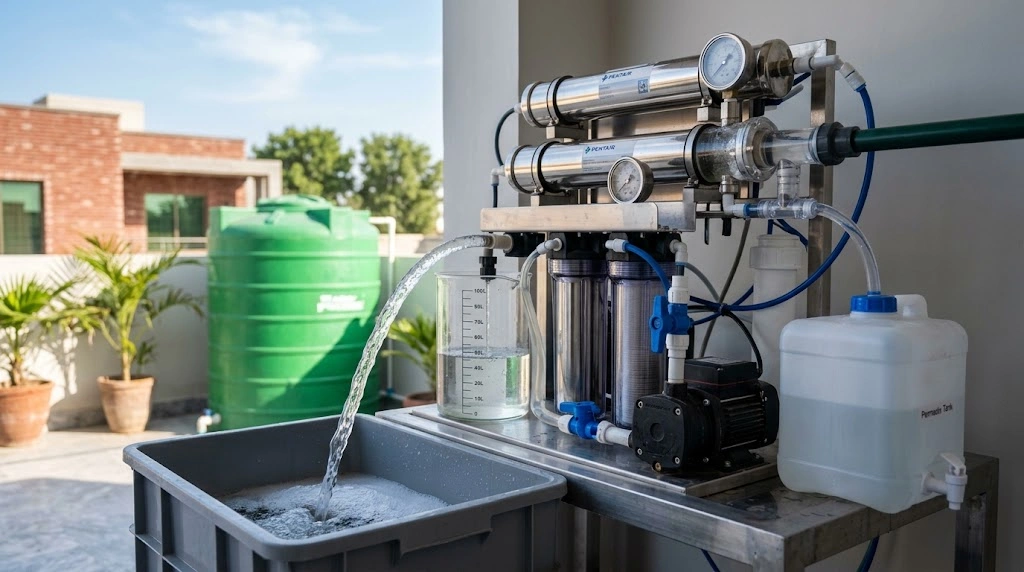
Every reverse osmosis system produces two water streams: the clean permeate that is collected for use and a reject stream containing the concentrated impurities removed by the membrane. RO water wastage in Pakistan is often greater than buyers expect when installing an RO system, as a poorly configured unit can send more water to waste than it delivers to the tap. With Pakistan already facing water scarcity, understanding why RO systems waste water, how much wastage is normal, and what practical steps can reduce it is important for both controlling water costs and promoting responsible water use.
Why RO Systems Waste Water in the First Place
Reverse osmosis works by pushing feed water through a semi-permeable membrane under pressure, allowing clean water through while rejecting dissolved salts, minerals, and contaminants. That rejected material has to go somewhere, and it leaves the system as a concentrated reject (or ‘reject water’ / ‘concentrate’) stream. The ratio between usable permeate and rejected concentrate is called the recovery rate, and it’s the single biggest factor determining how much water an RO system actually wastes for every liter of clean water it produces.Typical Recovery Rates and What They Mean
| System Type | Typical Recovery Rate | What It Means |
| Basic Residential RO (undersink) | Lower recovery, often well under 50% | Can produce more reject water than usable water for every liter treated |
| Improved Residential RO (with permeate pump or booster) | Moderate recovery, meaningfully better than basic units | Reduces wastage compared to basic gravity-fed configurations |
| Commercial/Industrial RO Systems | Higher recovery, often 60-80% depending on feed water quality | Designed and tuned for efficiency at scale, with recovery limited mainly by feed water TDS and scaling risk |
Is Your RO System Wasting More Water Than It Should?
Share your feed water TDS and system details, and our engineers will check your recovery rate and suggest ways to cut reject water. We design and tune reverse osmosis systems for homes, businesses and industry across Pakistan.
Factors That Push Wastage Higher
- High feed water TDS or hardness: harder, more mineral-laden source water generally needs a lower recovery rate to avoid scaling the membrane, which increases reject water proportionally.
- Old or poorly maintained membranes: a fouled or scaled membrane often needs to run at lower recovery to maintain water quality, increasing wastage over the system’s life.
- Undersized or basic system design: many entry-level residential units use a simple flow restrictor rather than an optimized reject ratio, wasting more water than necessary for the same output.
- No permeate pump: basic gravity-fed residential systems without a permeate pump generally waste significantly more water than systems designed with one.
Practical Ways to Reduce RO Water Wastage
- Add a permeate pump to a basic residential system — this uses the pressure of the reject stream itself to boost production efficiency, meaningfully improving recovery without a new membrane.
- Ensure proper membrane maintenance and timely replacement, since a fouled membrane often needs to run less efficiently to maintain water quality.
- Consider a booster pump for source water with lower incoming pressure, which allows the system to operate at a more efficient recovery rate.
- Repurpose reject water for non-drinking uses (plant watering, floor cleaning, car washing) rather than letting it go entirely to waste, where household plumbing allows.
- For commercial/industrial systems, work with a vendor who tunes recovery rate to your specific feed water TDS rather than applying a generic default setting.
Reject Water: Is It Safe to Reuse?
RO Reject Water is not purified water, but it is not wastewater in the sense of being polluted either. It is essentially the original source water with a higher concentration of the minerals rejected by the RO membrane. For most residential applications, it can be reused for non-potable purposes such as watering plants, mopping floors, or washing cars. However, it should not be used for drinking or for watering salt-sensitive plants when the source water contains particularly high mineral levels. Reusing it in this way is one of the easiest methods for households to reduce the amount of water wasted by an RO system without making any equipment changes.What to Check When Buying a More Water-Efficient RO System
- Ask the vendor directly for the expected recovery rate — a specific number, not a vague ‘efficient’ claim.
- Confirm whether a permeate pump is included or available as an add-on for residential systems.
- For commercial/industrial systems, ask whether recovery rate has been calculated against your actual feed water TDS report.
- Ask about reject water routing — some system designs make it easier to redirect reject water for reuse than others.
Conclusion
RO water wastage isn’t an unavoidable cost of clean water — it’s largely a function of system design, maintenance, and how the recovery rate is tuned to your specific feed water. Households and businesses that add a permeate pump, maintain their membranes properly, and consider reusing reject water for non-potable purposes can meaningfully cut how much water an RO system sends down the drain. WCSP has designed and serviced residential and commercial RO systems across Pakistan and can help assess whether your current system is wasting more water than it should.Frequently Asked Questions
Q1. Is it normal for an RO system to waste this much water?
To some degree, yes — all RO systems produce a reject stream by design. However, basic residential units without a permeate pump often waste considerably more than necessary compared to systems designed for better recovery, so ‘normal’ for a basic unit isn’t the same as ‘efficient.’
Q2. Does adding a permeate pump really make a noticeable difference?
Yes, a permeate pump is one of the most cost-effective upgrades for reducing wastage on an existing residential RO system, since it improves recovery using the pressure already present in the reject stream rather than requiring a completely new system.
Q3. Can I drink RO reject water in an emergency?
It’s not recommended as a routine practice since it contains the concentrated minerals and contaminants the RO system was specifically designed to remove, though it’s generally safe for non-potable household uses like cleaning or watering plants.
Q4. Do commercial RO systems waste less water than home units?
Generally yes, proportionally — commercial and industrial systems are typically engineered and tuned for higher recovery rates than basic residential units, since operating efficiency matters more at larger scale and higher water costs.