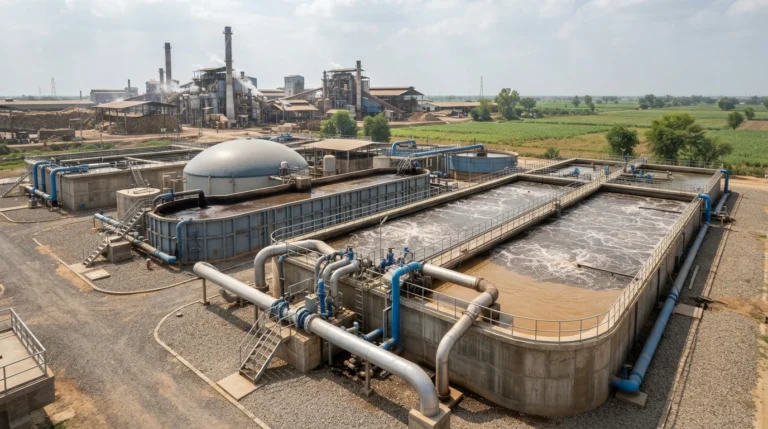
A sugar mill’s effluent plant has an unusual job. It sits idle for months, then within days of crushing starting it must handle hot, sugar-rich wastewater that is highly biodegradable and very demanding on oxygen. Most problems with sugar mill effluent treatment come from that rhythm, not from the technology itself.
Pakistani studies of sugar industry wastewater keep finding effluent above the National Environmental Quality Standards (NEQS), yet individual mills differ widely. This article explains why loads swing so much, what an anaerobic stage can and cannot do, where aerobic polishing fits, and what mill managers should settle before the next crushing season.
Why sugar industry wastewater in Pakistan is hard to design for
The effluent is not one stream. Water is used to wash the milling house floors, and the boiling house adds wastewater from evaporators, clarifiers, vacuum pumps and centrifuges. Condenser water and spray pond overflow add volume. The combined flow is typically brown, warm, low in pH and high in BOD and COD, with an odour problem if it stands.
That odour tells you something about its chemistry. The organic matter is largely sugars and other readily degradable compounds, so bacteria attack it immediately. Left in a drain or pond, it uses up the dissolved oxygen and then turns anaerobic, which is where the black colour and smell come from. The same property that makes it a nuisance outside the plant makes it treatable inside one.
The numbers vary enormously. A study of mills in the LBOD catchment in Sindh reported BOD5 across mills from 24 to 2,236 mg/L, and COD from 59 to 26,760 mg/L. Another assessment of selected mills found untreated BOD between 612 and 2,362 mg/L. A study at a Mardan mill reported BOD above 4,000 mg/L. These differences reflect water use, recycling of condensate, sampling point and time of season, so a figure from a neighbour’s mill is a poor basis for sizing your plant.
How the crushing season drives the load
Pakistani mills crush for a few months of the year. In 2025–26, the Punjab government set 15 November as the common start date, and start dates have moved from year to year, so treat any fixed calendar with caution.
Within a season, the load is not flat either. One monitoring study reported effluent BOD of about 51 mg/L in November climbing to 167 mg/L in February, which that study described as the on-season peak. Washing practice, cane quality and stoppages all feed into it. A mill that halts for maintenance and restarts sends a shock load into the plant each time.
The off-season is the part designers underestimate. Biological treatment needs food, oxygen or its absence, and a healthy population. Months without feed let the population decline, and the plant restarts from a weak position just when the highest strength effluent arrives. A credible design therefore includes a lay-up and restart procedure, not just a flow diagram. Ask any supplier how the biomass is kept alive between seasons and how quickly the plant reaches stable performance after start-up.
Is Your ETP Ready for the Next Crushing Season?
Send us your mill's latest BOD and COD results, daily flow and planned crushing start date. We will review them and point out where seasonal peaks, off-season lay-up and start-up timing could cause trouble for your wastewater treatment system. No season-long data yet? Start with water quality monitoring so your design rests on real numbers.
Where anaerobic treatment makes sense
Because the effluent is strong and easily degraded, it suits anaerobic treatment as a first biological stage. Research on cane mill wastewater points the same way: aerobic methods alone struggle with the load, while anaerobic treatment with pH control and seeding shows real potential as a first stage.
The attraction is practical. An anaerobic reactor needs no aeration, so it does not carry the power cost of putting oxygen into a strong waste. It also converts organic matter into biogas, which some mills use as a fuel offset. A pilot study of an upflow anaerobic sludge blanket (UASB) reactor on pre-treated cane mill wastewater reported COD removal above 90% at organic loads up to 16 kg COD per cubic metre per day, but also found that removal dropped at higher loads as volatile acids accumulated, and that meeting a tight COD discharge limit needed either a low load or a further biological stage. Treat that as a laboratory result, not a promise for your plant.
The limits matter just as much as the benefits:
- Start-up is slow. A UASB depends on a granular sludge bed. Reviews describe seeding with active granular biomass, and report start-up periods of months, especially when the seed is ordinary activated sludge. A mill that decides in October to have it working by mid-November is setting itself up for disappointment.
- pH and acidity must be controlled. Sugar wastewater acidifies quickly. If acid-forming bacteria outrun the methane-forming ones, the reactor sours.
- The effluent is not discharge-ready. Anaerobic treatment removes organic matter incompletely and does little for nitrogen and phosphorus, so a downstream stage is normally needed.
- Solids matter. The pilot work above used wastewater pre-treated for solids separation. Bagasse fibre and mud in the feed cause blockages and sludge problems.
Aerobic polishing and the nutrient problem
After the anaerobic stage, an aerobic step brings the effluent closer to discharge limits. This can be activated sludge or, where land is tight, a biofilm system such as a moving bed biofilm reactor (MBBR), which holds biomass on carriers and copes reasonably well with load variation.
Two issues catch plants out here. First, sugar effluent is carbon-rich and often short of nitrogen and phosphorus, which bacteria need in a rough balance with the carbon they consume. Without enough, treatment performance suffers, and nutrient supplementation is an item operators often forget to budget. Second, the high sugar content can produce foam in aeration tanks. Both are manageable, but they are easier to plan for than to fix in the middle of a season.
Some mills also run distilleries. The spent wash from a distillery is a different and far stronger stream than the mill effluent, and it should be treated and costed separately instead of being folded into one design.
Compliance: what to check before you design
Pakistan’s discharge requirements are set by the NEQS and applied by the provincial environmental protection agencies, and the limit that binds you depends on where the effluent goes. Several Pakistani studies compare mill effluent with figures such as 80 mg/L BOD and 150 mg/L COD, and find samples far above them. Those values are commonly quoted, but confirm what applies at your discharge point with the relevant agency before design, because standards and permit conditions change.
Not every mill fails every parameter. A study of three mills near Badin found most parameters within NEQS, with COD and mercury exceeding the limits. That is useful to know: the problem parameters differ by site, and heavy metals and dissolved solids need testing alongside BOD and COD.
Monitoring deserves a place in the design. One of the studies cited here recommended that flow be measured with a flow meter. Without flow data, you cannot calculate loads, and without loads, you cannot tell whether a plant is under-designed or simply badly run.
Questions to settle before the next season
- What are your flow and load across the season? Sample the combined effluent weekly through a full season, including stoppages and washdown days, and record flow.
- Which streams can be kept separate or reduced? Condensate recovery and spray pond management reduce volume before any plant is built.
- How will the plant be kept alive in the off-season? Ask for a written lay-up and restart plan.
- How long will start-up take, and when must it begin? Work back from the likely crushing date, not toward it.
- Who supplies nutrients, and who watches pH? Assign it to a person.
- Where does the treated water go? Reuse for washing, irrigation or cooling lowers freshwater demand, but needs its own quality checks.See our guide to spent water management and reuse.
- What are the discharge limits and monitoring requirements? Settle this with the environmental agency first.
WCSP carries out jar testing and effluent analysis before recommending a process, and its wastewater treatment systems for industry include biological systems such as MBBR Whatever route you take, insist on testing real effluent from your own mill in season, not a textbook sample.
Frequently Asked Questions
Usually not on its own. An anaerobic reactor removes a large share of organic matter from strong sugar wastewater and produces biogas, but removal is incomplete and nutrients are barely touched. Most mills need an aerobic or biofilm stage afterwards to approach discharge limits, so plan the two stages as one system.
The plant has been idle, so its bacterial population has shrunk, while the first effluent of the season is strong and arrives suddenly. Anaerobic reactors also need weeks to months to build stable sludge. Restart planning, seeding and a gradual rise in load reduce the problem.
It varies widely. Published Pakistani studies report untreated BOD from a few hundred to several thousand mg/L, and COD higher still, depending on the mill, sampling point and time of season. Measure your own effluent across a full season before sizing any plant.
Often yes, for non-potable uses such as washing or irrigation, if it is treated to a suitable quality and tested for dissolved solids and metals. The right target depends on the use. Check quality against the intended application before committing to reuse.