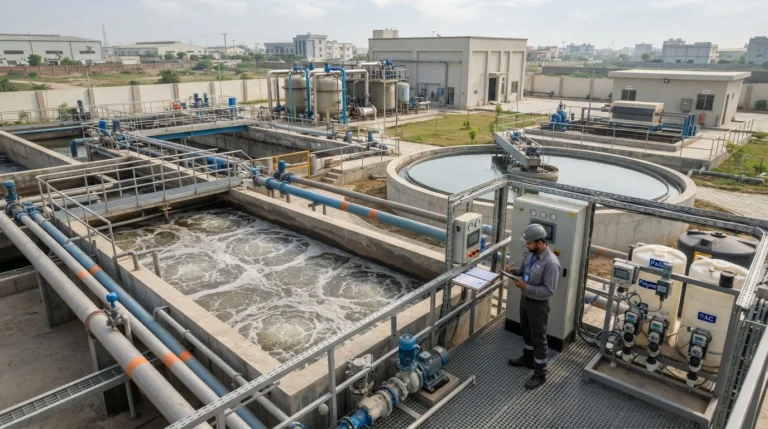
Most effluent treatment plants are bought on design and price, then run on goodwill. The plant is commissioned, the supplier’s engineers leave, and a few operators are left to cope with whatever the factory sends them. That is usually when ETP operation and maintenance contracts come up, often after a failed sample or a notice from the environmental agency.
A contract can fix this, or it can add a monthly invoice and little else. The difference is almost always the scope. This article explains what a wastewater plant O&M contract should spell out: who does what, how performance is measured, how operators are trained, and which questions to ask before you sign.
Operation, maintenance and AMC are three different things
Buyers often use these words interchangeably, and vendors sometimes let them. They describe different services.
| What it means | Who is on site | Typical gap | |
| Operation | Running the plant day to day: adjusting dosing, aeration and sludge wasting, reading the process | Operators, either yours or the contractor’s | Nobody owns process decisions |
| Maintenance | Keeping equipment healthy: pumps, blowers, diffusers, screens, dosing systems | Technicians, planned or on call | Work happens only after a breakdown |
| AMC (annual maintenance contract) | Scheduled visits plus breakdown support | Visiting engineers, often weekly to monthly | Visits without a defined checklist |
Published service descriptions from ETP and STP contractors show the range. A lighter arrangement may involve weekly or fortnightly visits, troubleshooting and a response team. A fuller one places trained operators on site and covers equipment monitoring, aeration and sludge checks, chemical dosing records and preventive maintenance. Neither is wrong. Problems start when the owner expects the second and has bought the first.
What a good scope actually covers
A water-industry paper on plant O&M breaks the work into elements that include a scope of service, an operation plan, an asset and maintenance plan, people, analytical protocols, communication and reporting, and administration. Translated into contract headings for an ETP, a useful scope covers the following.
Process operation. Who decides on dosing, aeration and sludge wasting, and who is on site when those decisions are needed? Define the shift pattern, not just the headcount.
Monitoring and sampling. List what is measured, how often and where. Typical routine checks include flow, pH, dissolved oxygen, MLSS, settleability and the effluent parameters that matter for compliance. A contract that says only “regular monitoring” gives you nothing to enforce.
Laboratory work. Is there an on-site lab? Who supplies reagents and equipment? A guide for contracting water operators asks specifically whether the operator brings testing equipment and reagents or the owner must supply them. The same question belongs in an ETP contract.
Planned maintenance. Ask for an asset list and a schedule for the equipment that would stop the plant if it failed. Routine tasks include cleaning screens and pump intakes, checking the air delivery system, and removing sludge on a schedule. Proactive programmes for critical equipment are worth more than a promise to attend breakdowns quickly.
Chemicals and consumables. State who buys polymer, coagulant, nutrients and disinfectant, who controls dosing, and how consumption is recorded. Without a clear rule here, chemical use becomes a quiet source of dispute.
Sludge handling. Dewatering, storage and disposal are operating tasks, and they affect the biology when neglected. Say who does them and who pays.
Records and reporting. Specify the logbook, the monthly report and the format. Records protect you during an inspection, and they are the only way to review a contractor honestly.
Emergency response. Define response times for failures and who authorises emergency spares or repairs.
Not Sure Your ETP Contract Covers Enough?
Send us your plant type, daily flow and latest effluent test result, or a draft of the contract you are considering. We will check it against the scope points above and tell you what is missing, from sampling and chemical duties to a clear service level agreement. This applies whether you already run a wastewater treatment system or are about to sign for one.
ETP operator training: what it should include
ETP operator training is often a single line in a contract, usually promising “training of staff”. That line is worth expanding, because operators decide most days whether a plant stays stable.
A useful programme is built around the tasks the operators perform. A published O&M framework describes training based on a skills matrix and on-the-job instruction, which suits plant staff better than a classroom session alone. Content should include:
- how each unit works and what normal looks like for your plant
- reading and acting on routine tests: pH, dissolved oxygen, settleability, MLSS
- safety procedures, including confined spaces and chemical handling
- recognising early warning signs such as foam, odour and colour change, and knowing who to call
- keeping the logbook so that it can be understood by someone else
Ask how competence will be confirmed. A sign-off sheet showing attendance proves little. Practical tasks, performed on your own plant and observed by the contractor’s engineer, show more. Also ask what happens when an operator leaves, because training is lost with staff turnover. A good contractor will offer refresher sessions and written procedures that the next person can follow.
One review of wastewater treatment in Pakistan describes the shortage of skilled manpower as a recurring constraint on implementation, and notes that many plants are not functional. Treat that as a reason to put training in the contract, not as a statistic about your own site.
Defining performance without creating a trap
Clients often want a guarantee that the contractor keeps the plant compliant. It is a reasonable wish, but a vague clause can create unfair or useless terms.
A guarantee only makes sense if the inputs are controlled. If the factory sends a batch of concentrated effluent or a cleaning chemical the plant was never designed for, the output will not hold. So define:
- The design basis. Flow and load limits within which the plant is expected to perform.
- The sampling point and method. Where samples are taken, by whom, and which laboratory analyses them.
- The parameters and limits. Confirm with the provincial environmental agency which limits apply at your discharge point, instead of copying a figure from another source.
- What happens outside the design basis. An upset caused by an unreported production change should be treated differently from one caused by poor operation.
- Response times and reporting. A service level agreement exists for this purpose: it sets performance benchmarks, response times and responsibilities, and it gives both sides a basis for review.
WCSP describes its own service level agreements as covering drinking water, wastewater and process water, and its methodology includes reporting and review meetings. Whatever the provider, insist on reviews at a fixed interval, not only when something fails.
Who is responsible for what
Many disputes come from gaps, not bad faith. Settle these in writing:
- Capital repairs versus routine maintenance. A guide to hiring contract operators suggests the owner and operator jointly determine which resources the operator provides for routine O&M, repairs and necessary capital improvements. In practice, define a cost limit above which the owner approves spending.
- Spare parts. Who holds critical spares, and who pays for them?
- Power and utilities. If aeration stops because power stops, is that the contractor’s failure?
- Influent information. The owner is responsible for telling the operator about production changes, new chemicals and shutdowns.
- Accountability to the regulator. Do not assume a contract moves your regulatory responsibility to the operator. Check with a legal adviser and the relevant agency how reporting and accountability work for your site.
One environmental assessment document published by the Punjab environment department lists ETP performance monitoring, regular training and reporting to Punjab EPA among a new project’s commitments. If your plant’s approval includes commitments like these, write the contract so they can actually be met.
Questions to ask before you sign
- Who will be on site, how many hours a week, and how will actual time be recorded?
- Can I see a sample monthly report?
- Is the process engineer who designed the plant involved in reviews?
- What happens if the operator on duty resigns?
- How are chemicals purchased, dosed and recorded?
- What is excluded from the price?
- How can either side end the contract?
An O&M contractor should also be willing to prepare or update the plant’s operation manual. The manual is normally written by whoever planned and built the installation, and it should list the maintenance inventory. If it is missing or out of date, ask for it early.
WCSP’s article on water maintenance services describes customised AMCs that begin with a site inspection and water analysis, then set visit frequency, breakdown support and performance monitoring around the results. That sequence, assess first and price second, is a reasonable test for any provider.
Frequently Asked Questions
Q1. What should an ETP operation and maintenance contract include?
It should cover who runs the process, what is sampled and how often, an equipment maintenance schedule, chemical and sludge responsibilities, reporting, response times for failures, operator training, and spare-part rules. It should also define the design basis, so performance is measured against conditions the plant was built to handle.
Q2. What is the difference between an AMC and a full O&M contract?
An AMC usually means scheduled visits plus breakdown support, while a full O&M contract places trained operators on site and takes responsibility for daily running, monitoring and preventive maintenance. Check which one you are buying, because the cost and the level of accountability are very different.
Q3. How should ETP operator training be done?
Training works best when it is task-based and carried out on your own plant: reading tests, adjusting dosing and aeration, recording data, handling chemicals safely and spotting early warning signs. Ask for practical sign-off, refresher sessions and written procedures, so the knowledge survives staff changes.
Q4. Can an O&M contractor guarantee NEQS compliance?
Only within defined limits. A fair guarantee specifies the design flow and load, the sampling point, the parameters and the response when the factory exceeds the design basis. Confirm applicable limits with the provincial environmental agency, and do not assume the contract transfers your regulatory responsibility.