What a Common Effluent Treatment Plant Actually Is
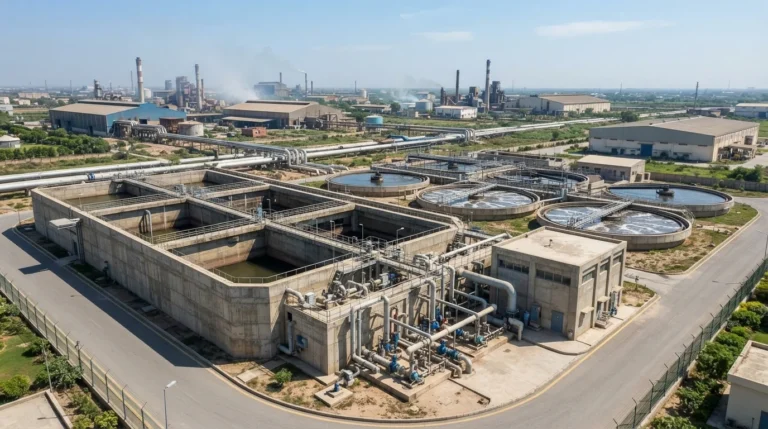
A CETP is a central facility that receives industrial effluent from a cluster of member units and treats it before discharge or reuse. It is the usual answer where industrial estate wastewater treatment cannot be solved factory by factory, either because units are too small to justify their own plant or because there is simply no room on site. It differs from an ordinary effluent treatment plant (ETP) in ownership and in what it must handle. An ETP is designed around one factory’s wastewater, which the designer can test and predict. A CETP receives several streams at once, and the plant’s owner does not control what each member produces. That single difference is behind most of the technical and financial problems discussed below. Some plants also take domestic sewage from the surrounding estate, in which case they are better described as combined effluent treatment plants. Pakistani documents use both terms, sometimes for the same type of facility.How a CETP Works, From the Factory Gate to Discharge
The route the water takes explains why shared plants are harder to run than single-factory ones. Collection. Effluent leaves each member through a drain, a dedicated pipeline or, in some clusters, by tanker. Tannery clusters are the clearest Pakistani example. At Kasur, a UNIDO-supported project built a drainage system and a common pre-treatment plant to replace effluent that had been left standing in pools around the town. Pretreatment at the member’s gate. Good CETPs set inlet limits and expect each unit to remove what the central plant cannot handle, such as oil, coarse solids or concentrated chemical streams. Skipping this step is the most common way for a shared plant to be overloaded. Equalization and neutralization. Mixing streams is not always a drawback. An acidic discharge from one unit and an alkaline one from another can partly offset each other in a balancing tank, which is one of the genuine technical arguments for common treatment. It only works if the streams are compatible. Primary and biological treatment. Chemical dosing and settling remove suspended matter and some pollutants, and a biological stage then breaks down the organic load. The right design depends on the industries connected. Sludge handling and discharge. Every CETP produces sludge, and in a mixed estate it may contain metals or process chemicals that require careful disposal. Treated water is either discharged to a drain or watercourse within the National Environmental Quality Standards (NEQS) or, where the quality allows, reused. The Sialkot Tannery Zone shows what a fully developed version looks like. Its CETP was reported inaugurated in 2026 with pre-treatment, primary, secondary and sludge stages and a design intended to meet NEQS. Work on a chrome recovery plant and an engineered landfill was still continuing at that point, which is a useful reminder that the effluent plant is only one part of managing a cluster’s waste.Not Sure Your Effluent Is Right for a Shared Plant?
Send us your industry type, daily flow and any lab results you have for COD, pH and suspended solids. We will check what your effluent contains, tell you whether it looks suited to a shared plant or needs pretreatment at your own gate, and point you to the right option among our wastewater treatment systems. No results yet? Our water quality monitoring service can help you get them.
Why Industrial Estates Choose a Shared Plant
The reasons are practical rather than ideological.- Treatment equipment, laboratory testing and trained operators cost roughly the same to provide whether they serve one factory or twenty.
- Many older estates were laid out with no thought for on-site treatment.
- A trained operator and a working laboratory are hard for a small unit to justify. A common plant can employ both full time.
- Regulators find it simpler to monitor one outlet than dozens.
Who Pays for a CETP in Pakistan?
This is where the article’s second question becomes uncomfortable, because the polluter-pays idea runs into the reality that the polluters are often small businesses with limited capital. Construction. In Pakistan, capital has typically come from a mix of government money, donors and the industry itself. A published analysis of the polluter-pays principle in Pakistan noted heavy dependence on government and international donors for funding the only two operational CETPs it examined. Sialkot is a public-private partnership run through a non-profit company, the Sialkot Tannery Association (Guarantee) Limited, with Global Environment Facility funds channelled through UNIDO for technical assistance. In Sindh, the provincial government has said it allocated funds for combined effluent treatment plants in industrial areas because individual units lacked the capacity to build their own. Operation. Construction grants do not pay for electricity, chemicals, sludge disposal or staff in year five. That money has to come from members, normally through a service charge. How the charge is set matters more than most boards expect:- A flat fee per unit is simple but unfair to a factory that sends a cleaner effluent than its neighbour.
- A charge by volume is better, but ignores strength. A litre of tannery or dye-house wastewater costs far more to treat than a litre of canteen water.
- A charge by volume and pollutant load, usually measured through COD, is the fairest, but needs flow meters, regular sampling and a laboratory everyone trusts.
Where CETPs Go Wrong
Most failures trace back to people and money rather than chemistry.- Members who do not pretreat. Without enforced inlet limits, the plant receives whatever arrives.
- Incompatible streams. Mixing heavy metals, strong dyes and high-organic food waste in one tank can reduce the performance of a biological stage.
- Weak governance. A plant owned by “the estate” but managed by nobody in particular tends to fall into disrepair.
- Payment gaps. A few non-paying members force the rest to subsidise them or the plant to cut corners.
- No plan for sludge. Sludge that cannot be disposed of safely ends up stored on site, creating a second pollution problem.
What Members Still Have to Do Inside Their Own Gate
Joining a CETP does not end a factory’s environmental responsibility. You still need to keep concentrated or hazardous streams separate, meet the plant’s inlet quality, install a flow meter and sampling point, and keep records. Responsibility between the plant operator and the member can differ by province and by agreement, so confirm it with your provincial EPA and read the membership contract carefully. Our comparison of Punjab EPA and Sindh EPA compliance rules is a good starting point. Tanneries show why separation matters. Keeping chrome tanning liquor away from general wastewater cuts the load that any plant, shared or private, has to treat. We cover that in our guide to leather tannery wastewater treatment.Questions to Ask Before You Join or Build a CETP
- What are the inlet limits, and who tests whether members meet them?
- How is the service charge calculated: flat, by volume or by load?
- Who operates the plant, and who pays if it fails to meet NEQS?
- What happens to sludge, and who bears the disposal cost?
- Is there spare capacity if your production grows?
- What happens to members who do not pay?
Conclusion
A common effluent treatment plant solves a real problem for estates full of small factories, but it moves the difficulty from engineering to organisation. The treatment train matters less than who sets the inlet limits, who measures them and who pays when the bill arrives. Sialkot shows the model can work when it has clear ownership and sustained backing. Kotri shows how quickly it deteriorates when members will not fund operations. Before committing capital or signing a membership contract, test your own effluent, read the tariff and ask who keeps the plant running in year five.Frequently Asked Questions
Q1. Is a CETP better than an individual ETP?
Not always. A CETP suits clusters of small units with similar effluent and no space for on-site plants. A large factory with a distinctive or hazardous effluent may be better served by its own ETP, or by pretreating on site and then sending the stream to a CETP.
Q2.Who owns and operates a CETP?
It varies. Common models include an association of member industries, a non-profit company, a provincial agency, or a public-private partnership. Sialkot uses a non-profit company with government backing. Whatever the model, ownership, operating responsibility and liability for non-compliance should be written down before the plant is built.
Q3. How is a CETP’s running cost shared?
Usually through a service charge per member. A flat fee is simplest, but charging by volume and pollutant load, such as COD, is fairer because it reflects the cost of treating each factory’s effluent. It does require reliable flow measurement and regular sampling.
Q4. Can a CETP treat any industrial effluent?
No. Every CETP is designed for a defined range of effluents and sets inlet limits. Strong chemical streams, high salinity or concentrated metals may need pretreatment or separate handling. Check what your effluent contains before assuming a shared plant can accept it.