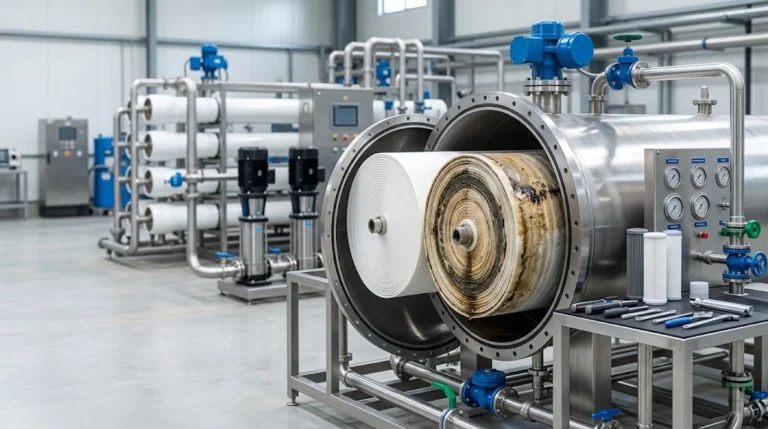
If your reverse osmosis plant is producing less water than usual or needs to operate harder to maintain the same clean-water output, membrane fouling in RO plants may be the underlying issue. Fouling develops gradually rather than happening overnight, building up on the membrane surface and eventually causing noticeable performance losses. This guide explains the common causes of membrane fouling, the early warning signs operators may overlook, and practical ways to prevent it and protect your RO system. It also covers pretreatment, RO membrane cleaning, and routine maintenance practices suited to Pakistan’s typical feed water conditions, helping you detect fouling early and extend the operating life of your membranes.
What Membrane Fouling Actually Is
Fouling is the accumulation of material on or within the membrane surface that blocks water flow and reduces the membrane’s ability to reject dissolved contaminants. It’s different from scaling, though the two are often confused: scaling is specifically mineral precipitation (like calcium carbonate) forming a hard deposit, while fouling is a broader category that includes organic matter, colloidal particles, and biological growth building up on the membrane. In practice, most RO plants deal with some combination of both, which is why a single prevention strategy rarely works — you need to address multiple fouling mechanisms at once.
The Main Types of Membrane Fouling
| Fouling Type | What Causes It | Common Source in Pakistan |
| Scaling | Precipitation of dissolved minerals (calcium, magnesium, silica) as water is concentrated | Hard, high-TDS groundwater and borewell sources |
| Colloidal Fouling | Fine suspended particles (clay, silt, iron colloids) accumulating on the membrane surface | Turbid surface water or poorly filtered borewell water |
| Organic Fouling | Natural organic matter and humic substances adsorbing onto the membrane | Canal or surface water sources with higher organic content |
| Biofouling | Bacterial growth forming a biofilm on the membrane surface | Warm feed water temperatures and inadequate disinfection of pretreatment stages |
Biofouling is particularly common in Pakistan’s climate, since warm ambient temperatures accelerate bacterial growth in pretreatment tanks and piping if disinfection isn’t consistently maintained. Left unchecked, biofouling can be one of the fastest-progressing fouling types, sometimes causing a noticeable performance drop within weeks rather than months.
Early Warning Signs You Shouldn’t Ignore
- Declining permeate flow at the same operating pressure — the clearest early indicator that something is restricting flow through the membrane.
- Rising feed pressure needed to maintain the same output — the system is working harder to push water through a partially blocked membrane.
- Increasing pressure drop across the membrane vessel (differential pressure) — a strong signal of fouling building up on the membrane surface.
- Deteriorating permeate quality (rising TDS in the product water) — can indicate fouling has progressed enough to affect membrane rejection performance, not just flow.
- Shorter intervals between required cleanings — if your cleaning frequency keeps increasing, an upstream pretreatment issue is likely the real cause, not the membrane itself.
Seeing These Warning Signs in Your RO Plant?
Send us your permeate flow, feed pressure and differential pressure readings, and our engineers will identify the fouling type and recommend the right fix, from Cleaning In Place (CIP) to a pretreatment upgrade, with ongoing support under a Service Level Agreement.
Prevention Checklist: Pretreatment Comes First
Most membrane fouling problems are actually pretreatment problems in disguise — a membrane that’s fouling quickly is very often being fed water that isn’t adequately conditioned before it reaches the membrane. A solid prevention approach covers:
- Adequate multimedia or sediment filtration ahead of the RO membrane to remove suspended solids and turbidity.
- Antiscalant dosing sized correctly for your feed water hardness, to keep dissolved minerals from precipitating as scale.
- Consistent disinfection of pretreatment tanks and piping to control bacterial growth before it reaches the membrane.
- Monitoring Silt Density Index (SDI) regularly, especially for canal or surface water. Most spiral-wound RO membrane manufacturers recommend an SDI₁₅ below 5, and below 3 is ideal for stable long-term operation. SDI is measured with a standard 0.45-micron filter over 15 minutes at constant pressure (ASTM D4189). A rising SDI means your pretreatment is letting colloidal matter through before it reaches the membrane.
- Maintaining correct recovery rate — running an RO system at too high a recovery for the feed water quality concentrates foulants faster than the membrane can handle.
RO Membrane Cleaning: When and How
Even with good pretreatment, periodic cleaning is a normal part of membrane maintenance rather than a sign of failure. A practical RO membrane cleaning guide for Pakistani operating conditions typically follows this logic:
Even with good pretreatment, periodic cleaning is a normal part of membrane maintenance rather than a sign of failure. Instead of cleaning on a fixed calendar, most operators clean when their performance data crosses a defined trigger. These triggers use normalized values, meaning readings corrected for feed temperature, pressure, and salinity so today’s performance can be compared fairly with the plant’s baseline from its first 24–48 hours of stable operation. Typical cleaning triggers are:
- Normalized permeate flow drops by about 10–15% from baseline
- Normalized differential pressure across a stage rises by about 10–15%
- Normalized salt passage increases by about 5–10% (permeate TDS rising)
Cleaning at these points restores performance far more effectively than waiting until output has fallen sharply. Exact limits vary by membrane manufacturer, so always check your membrane’s technical manual.
Membrane Lifespan and Replacement
With good pretreatment and a consistent cleaning regimen, RO membranes commonly last several years before replacement becomes necessary, though this varies significantly with feed water quality and how well fouling is managed. Membranes that foul repeatedly despite proper cleaning are usually signaling an unresolved pretreatment gap rather than simply reaching end-of-life — it’s worth investigating the root cause before assuming replacement is the only fix.
What to Check When Choosing an RO Maintenance Provider
- Do they diagnose fouling type before recommending a cleaning chemical, or use a generic cleaning routine regardless of cause?
- Do they track normalized performance data (flow, pressure, differential pressure) over time, rather than just responding when output visibly drops?
- Can they review and adjust your pretreatment design if fouling keeps recurring, not just clean the membrane repeatedly?
- Do they offer an AMC (Annual Maintenance Contract) that includes performance monitoring, not just reactive cleaning visits?
Conclusion
Membrane fouling is rarely a sudden failure — it’s a gradual process with warning signs that show up in your performance data well before output becomes visibly poor. Catching declining flow, rising pressure, or shrinking cleaning intervals early, and tracing the fouling back to a pretreatment gap rather than just cleaning repeatedly, is what separates an RO plant that runs reliably for years from one that needs constant intervention. WCSP has supported RO plant maintenance and AMC programs for industrial and commercial clients across Pakistan and can help diagnose recurring fouling issues at the pretreatment level
Frequently Asked Questions
Q1. How do I know if it's fouling or scaling causing my RO performance drop?
Scaling typically shows up as a steady decline tied to operating time and recovery rate, often with mineral deposits visible on membrane cleaning. Fouling from organics or biofilm can progress faster and is often linked to feed water source changes, like a switch to a more turbid or warmer water supply.
Q2. How often should RO membranes be cleaned in Pakistan's climate?
There’s no universal fixed interval — cleaning should be triggered by performance data (flow decline, pressure drop) rather than a fixed calendar. That said, Pakistan’s warm climate often means biofouling risk is higher, which can shorten cleaning intervals compared to cooler climates if pretreatment disinfection isn’t consistent.
Q3. Can membrane fouling be completely prevented?
Not entirely — some fouling is a normal part of RO operation. The realistic goal is minimizing its rate through proper pretreatment, so cleanings are needed less often and membranes last their expected working life rather than failing prematurely.
Q4. Does a higher recovery rate always mean more fouling risk?
Generally yes — running at a higher recovery rate concentrates dissolved and suspended contaminants more in the reject stream, increasing the risk of scaling and fouling on the last membrane elements in a series if the feed water quality doesn’t support that recovery level.