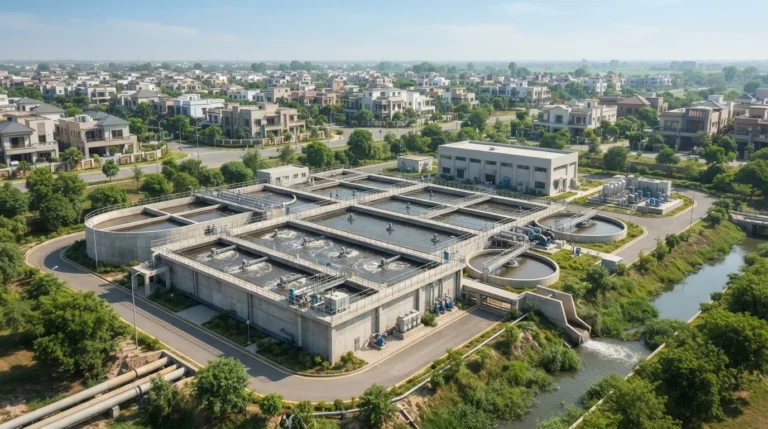
For anyone developing a scheme in Punjab, planning a sewage treatment plant for housing society projects can no longer wait until the roads are laid. Two Punjab EPA orders issued in the second half of 2025 changed the sequence of work. The first requires a three-chamber septic tank at every house and commercial building, with an end-of-pipe treatment facility for the society as a whole. The second says an IEE or EIA will not even be processed unless the layout plan already reserves land for a wastewater treatment plant. Below, we go through what the orders actually say, what they leave open, and how developers can plan land, design and paperwork so approval doesn’t stall.
What the two 2025 orders actually say
People usually talk about “the 2025 EPA order” as if it were one document. There are two, and they do different jobs.
Order No. 335, dated 12 September 2025, deals with septic tanks. Every environmental approval granted to a housing society must now carry a condition requiring a properly designed three-chamber septic tank at each household and commercial building, in addition to an end-of-pipe wastewater treatment facility. The order sets minimum internal dimensions by plot size, from 5 × 4 × 4 feet for plots under 5 marla up to 10 × 6 × 4 feet above 10 marla. Commercial plazas run from 10 × 6 × 5 feet at one kanal up to 16 × 6 × 5 feet above four kanals (length × width × height).
Order No. 377, dated 15 October 2025, is the one that reshapes layout planning. No IEE or EIA for any housing scheme, public or private, will be processed unless a clearly demarcated area is reserved in the layout plan for a wastewater treatment plant (WWTP). That land cannot be used for anything else, disposal stations included, and the plan must mark both separately. Proponents must also submit a detailed engineering design, a treatment capacity plan and an operation and maintenance mechanism as part of the application.
Both orders were forwarded to PHATA and the city development authorities (LDA, FDA, GDA, RDA and others) and to deputy commissioners across Punjab. In practice, the requirement can reach you through the authority that handles your layout approval, not only through EPA.
Why EPA wants septic tanks and a society-level plant
The pairing looks redundant until you consider what each one does. A three-chamber septic tank is pre-treatment at the source: solids settle, grease and scum float, and partly clarified liquid passes from chamber to chamber. Order 335 cites research that such tanks reduce total suspended solids by roughly 70 percent and BOD by around 40 percent. Read those as the order’s reference figures, not guarantees. Real performance depends on how well the tank is built and how often it is desludged.
The logic is load reduction. A plant that receives fewer settleable solids and less organic load is easier and generally less costly to run than one fed raw sewage straight from the plots. The order’s own preamble describes the problem it targets: many societies lack adequate wastewater management, and untreated sewage ends up in open drains, water bodies and agricultural land.
Regulators do follow up on this. In 2021, Pak-EPA’s director general visited a cooperative housing society in Islamabad’s Sector B-17 and found municipal wastewater going straight into natural streams, although the scheme had started in 2007. A legal notice followed.
Is Your Layout Plan Ready to Reserve Land for a Treatment Plant?
Send us your layout plan, the approximate plot count and your phasing schedule. We will go through the land you have set aside, estimate the flow the plant must handle, and suggest whether a phased MBBR design or another approach from our wastewater treatment systems suits your scheme, before the file goes to EPA.
How STP approval from Punjab EPA actually works
Strictly speaking, neither order creates a separate “STP approval.” The plant is reviewed inside the environmental approval for the scheme. Under Section 12 of the Punjab Environmental Protection Act, 1997, construction cannot begin until an IEE or EIA has been filed and approval obtained, and Order 377 now makes the plant’s land and design part of that file.
For a wastewater treatment plant for a housing society in Punjab, expect the reviewer to look for four things: a layout showing the reserved plot, kept apart from any disposal station; an engineering design; a treatment capacity plan; and a credible operation and maintenance arrangement. The orders do not prescribe a technology or the size of the reserved plot, and the only treatment benchmark they mention is the general duty to meet the Punjab Environmental Quality Standards (PEQS). That leaves judgement to you and your engineer, and it is where weak applications show.
A simple test: could a reviewer read your submission and tell what flow the plant is designed for, how that flow was estimated, where the treated water goes, and who will be operating the plant in year five? If not, the submission is thin. Check current requirements with EPA Punjab before filing, because procedures and checklists can change.
Choosing a sewage treatment plant for housing society projects: three layouts
Before technology, decide the layout. Most Punjab schemes end up with one of three arrangements.
| Approach | Where it suits | Main advantage | Main risk |
| Single central plant | Compact schemes with one clear low point | One site to build, staff and monitor | Large upfront build; long trunk sewers; sized for a build-out that may be years away |
| Phased modular plant | Large schemes developed in stages | Capacity follows occupancy, so early phases don’t run oversized | Reserved land must hold the final capacity from day one |
| Cluster of smaller plants | Schemes split by terrain or non-contiguous blocks | Shorter sewers and less pumping | Several plants to operate and several discharge points to manage |
Order 377 pushes you to think about the final footprint from the start, even if you build in phases. Reserve for the end state; install for the present.
On technology, the choice usually narrows to extended aeration, SBR, MBBR or MBR. MBBR (moving bed biofilm reactor) tolerates the daily swings in residential flow and fits a compact footprint, which is why it is common in housing schemes. MBR gives the cleanest effluent, useful if you plan serious reuse, but it brings higher energy use and membrane upkeep. For smaller phases, packaged wastewater treatment systems can be installed quickly and added to as occupancy grows, which is the approach WCSP uses in many of its modular MBBR designs.
Reserving the land: where developers go wrong
The layout designer often settles the plant plot last, and the mistakes follow a pattern:
- Using leftover land. An awkward corner or low-lying parcel looks free. But a plant needs a tanker-accessible road for sludge removal, room to expand, and a position that suits the sewer network.
- Reserving for phase one only. Size the plot for ultimate build-out, including commercial areas, which generate heavier loads than the same area of homes.
- Ignoring the sewer gradient. Gravity sewers run to the lowest point. Put the plant far from it and you pay for deep excavation or pumping for the life of the scheme.
- Overlooking odour and neighbours. Siting downwind of occupied plots and covering the tanks matters far more once residents move in. The orders don’t specify buffer distances, so ask EPA or the development authority.
- Mixing uses. Order 377 forbids using the reserved land for other purposes, including disposal stations. Don’t tuck a pumping station or storage yard onto the same plot.
How septic tanks change what your plant receives
Because of Order 335, the sewage reaching your plant will not be fresh household wastewater. It will have passed through a septic tank, so it carries fewer settleable solids, and it may be partly digested and more septic and odorous than fresh sewage. Two design consequences follow.
First, don’t copy inflow assumptions from a scheme that sends raw sewage to its plant. Ask your engineer to state the assumed inflow quality and, where possible, sample a comparable septic-tank-fed network. Second, a tank that is never desludged stops working and passes solids downstream. That shows up as choked sewers and a struggling plant, and it quietly cancels the benefit Order 335 was written to create.
This points to a gap the orders don’t address: who maintains hundreds or thousands of private septic tanks? Developers who build a desludging arrangement into the society’s bylaws or service agreements are solving a problem that would otherwise land on the plant operator.
Who runs the plant after handover
Order 377 asks for an operation and maintenance mechanism in the submission, which is a quiet acknowledgement of how these plants usually fail. Most don’t fail at commissioning. They fail two or three years later, after the developer has moved on and nobody owns the budget for electricity, blower servicing, sludge removal and lab testing.
Settle four points in writing before you submit:
- Who operates the plant during development.
- How and when it transfers to the residents’ association or another body.
- How running costs will be funded through maintenance charges.
- Who tests the effluent and keeps the records.
Plan sludge too. The plant produces it continuously, and it needs a drying and disposal route that is legal and affordable. Standby power matters as well: aeration keeps biological treatment alive, and if blowers stop for long, the biology deteriorates and odour follows.
Conclusion
The 2025 orders turn the sewage treatment plant for housing society schemes in Punjab from a late-stage engineering item into a first-stage planning decision. Reserve enough land for the final build-out, design for septic-tank-fed sewage, and put the design, capacity and operating arrangements in the submission rather than promising them later. Done early, the plant becomes a manageable utility instead of an approval obstacle. If you are at layout stage and want a second opinion on plot size, capacity or technology, Water Care Services Pakistan (WCSP) has worked with housing developers and wastewater projects across Pakistan since 2007 and can review your plan before it goes to EPA.
Frequently Asked Questions
Q1. Do the 2025 orders apply to housing societies that are already approved?
Order 377 stops IEE/EIA processing without reserved WWTP land, and Order 335 applies to environmental approvals granted from its date. Neither text clearly addresses schemes approved earlier. Section 11 of the Act, as recited in Order 377, still requires societies to treat wastewater before discharge in line with PEQS. If you hold an older approval, ask EPA Punjab or a legal adviser how your scheme is treated.
Q2. Is a septic tank at each plot enough instead of a society plant?
No. Order 335 asks for both: a three-chamber septic tank at each household and commercial building, and an end-of-pipe treatment facility for the society. The tank is pre-treatment only. Its effluent is still sewage, so the society-level plant remains the step that brings discharge in line with PEQS.
Q3. What must a developer submit about the plant to EPA Punjab?
Order 377 requires a detailed engineering design, a treatment capacity plan and an operation and maintenance mechanism as part of the IEE or EIA submission. The layout plan must also mark the reserved treatment plant area separately from any disposal station, and that land cannot be put to other uses.
Q4. Which technology suits a housing society?
The orders don’t prescribe one. MBBR is a common choice because it handles variable residential flows in a compact footprint. MBR suits schemes planning significant reuse. Sites with ample land may consider conventional options. The right answer depends on flow, land, power reliability and operator capacity, so ask your engineer to justify the choice.