Where the Load Comes From
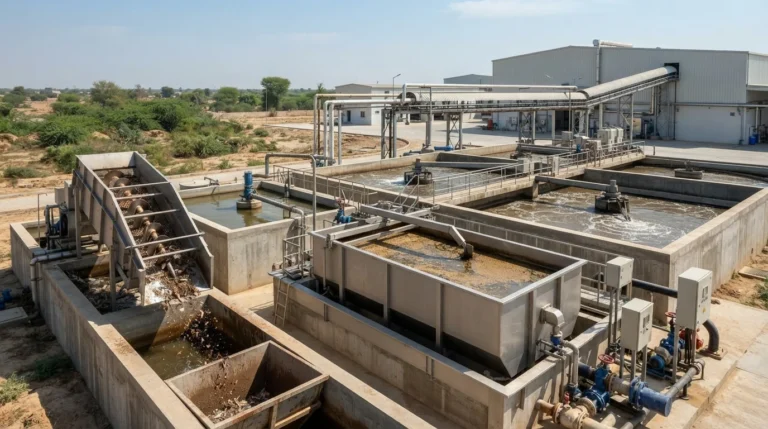
Most of the pollution is not produced by the birds or animals themselves but by the water used to move and clean things. In a poultry line the main streams are scald tank overflow, feather transport water, viscera transport water, chiller overflow, and general wash-down of floors, knives and conveyors. Lairage or live-bird holding areas add faeces and urine. In a red-meat abattoir the picture is similar, with paunch contents and hide-related dirt added. Each stream behaves differently. Feather and viscera transport water carries solids and soluble protein. Chiller overflow is relatively clean but large in volume. Wash-down water is the wildcard: it is intermittent, hot, loaded with detergent, and it is where most of the fat ends up. If you mix everything into one drain at the start, you get a single stream that is both high in load and hard to predict, and every treatment stage downstream pays for that.Start at the Source: Blood, Feathers and Offal
The cheapest pollutant to treat is the one that never reaches the effluent plant. Blood is the clearest example. Its oxygen demand is far higher than that of almost anything else in the plant, so even small amounts lost to the drain have an outsized effect on BOD and COD. Because halal slaughter relies on full bleeding, a large share of blood is released in one place on the line, which makes capture practical: a proper bleeding trough or tunnel, a collection tank, and a route to rendering or protein recovery rather than the sewer. The same logic applies to other solids:- Fit screens at the point of use, not only at the effluent plant. Coarse feather and offal screening at each line removes material before it breaks down and dissolves.
- Keep dry cleaning first. Sweeping or shovelling solids before washing down prevents a large pulse of load.
- Keep offal and paunch contents out of the drains entirely.
- Separate relatively clean streams, such as chiller overflow, from dirty ones so they do not dilute high-load flows into a larger volume that needs full treatment.
Fat Oil Grease Removal: Why It Fails
Fat is where many meat-plant effluent systems quietly go wrong. In hot scald and wash-down water, fat is liquid and often emulsified, helped along by detergents and alkaline cleaners. It looks harmless leaving the processing hall. As the water cools in pipes and channels, the fat solidifies, coats surfaces and clogs lines. If it reaches the biological stage, it coats biomass, reduces oxygen transfer and can cause foaming and sludge problems. Effective fat oil grease removal usually has two layers. The first is a properly sized grease trap or gravity separator close to the source, where retention time lets free fat rise and be skimmed. The second is dissolved air flotation (DAF), which injects very fine bubbles that attach to fat and fine solids and float them to the surface for removal. DAF works best when the wastewater is conditioned first, with pH adjustment and a coagulant or flocculant matched to the effluent. Dosing should be set through jar testing on real samples, not copied from another site, because the right chemistry depends on how much of the fat is emulsified. Two common mistakes: sending hot water straight to a DAF or trap, which keeps fat in solution, and letting caustic cleaning-in-place drains discharge without equalization, which can break DAF flocs and shift pH. Blending cooled, equalized flow into the DAF, and controlling what the sanitation crew sends down the drain, often improves FOG performance more than adding equipment. WCSP’s article on dairy wastewater treatment covers fat pretreatment for another fat-heavy food effluent and is a useful comparison.Is Fat Reaching Your Biological Stage Untreated?
Send us your daily flow, the number of birds or animals processed per day, and any BOD, COD, fat and pH results you have, plus a photo of your grease trap or drain outlet. We will check where the fat and blood load is entering and tell you whether screening, equalization and DAF suit your site, as part of our wastewater treatment systems. We will also outline the coagulant and flocculant dosing to confirm by jar test, using our industrial water treatment chemicals.
Primary Treatment: Screening, Equalization and DAF
Primary treatment protects everything that follows, so it is worth getting right.| Stage | Purpose | What goes wrong if skipped or undersized |
| Fine screening (rotary or static) | Removes feathers, fibres, scraps | Blocked pumps, floating mats, sludge buildup |
| Equalization tank with mixing | Smooths flow and load across the shift | Shock loads reach the biological stage |
| pH correction | Brings the effluent into a range both flocculation and biology tolerate | Poor floc formation, biological upsets |
| DAF with coagulant or flocculant | Removes fat, fine solids, some protein | Fat carries through and fouls the biology |
Poultry Processing Wastewater Treatment: Choosing a Biological Route
After DAF the effluent is still rich in dissolved organics and nitrogen. Protein breaks down into ammonia, so a plant that only reduces BOD may still discharge high ammonia. Biological design has to deal with both carbon and nitrogen. Anaerobic treatment, such as a UASB reactor, is attractive for strong effluent because it cuts the organic load without aeration energy and produces biogas. Some full-scale poultry plants run rotary and static screens, then DAF, then an anaerobic reactor. It is not a standalone solution: anaerobic effluent still needs aerobic polishing, and the reactor must be protected from fat carryover and sudden pH swings. Aerobic and hybrid options include activated sludge, sequencing batch reactors, moving bed biofilm reactors and membrane bioreactors. Moving bed biofilm reactor systems are compact and tolerate load swings relatively well, which suits space-constrained sites. SBRs handle variable production schedules because they treat in batches. Membrane bioreactors give the highest effluent quality and compact footprint but demand good pretreatment, since fat and proteins foul membranes quickly. There is no single best answer. The right route depends on effluent strength, available land, how consistent production is, whether the water will be reused, and who will operate the plant. Anaerobic followed by aerobic polishing suits large, strong flows. MBBR or SBR suits mid-sized plants with limited space. MBR makes sense where reuse or very tight discharge conditions apply.Slaughterhouse Wastewater Treatment in Pakistan: Compliance and Practical Realities
Slaughterhouse wastewater treatment in Pakistan sits under the National Environmental Quality Standards, with enforcement by provincial environmental agencies. Requirements and inspection practice differ by province, which WCSP has compared in its article on Punjab EPA and Sindh EPA compliance. Check the current standard and your provincial agency’s expectations before finalizing a design, because discharge conditions depend on where the water goes: sewer, drain, or surface water. A few practical points apply to Pakistani sites in particular:- Where wash water leaves through open drains toward a nullah or canal, the receiving water is exposed to blood, fat and pathogens. Treatment before discharge is a public health matter as well as a regulatory one.
- Small and medium plants often have limited space and operator experience. A packaged or compact system with automated dosing and a simple monitoring routine is usually more realistic than a large civil works scheme.
- Sludge from DAF and biological stages contains fat, protein and pathogens. Stabilize it, handle it safely and plan its disposal route early, because it is often left out of the budget.
- Disinfection of the final effluent is typically needed because poultry and meat effluent can carry bacteria such as Salmonella and Campylobacter.
Mistakes That Cause Failures
Most failing meat-plant effluent systems share the same patterns. The design was based on a single day’s sample instead of a characterization across shifts. Pretreatment was cut to save cost. Equalization was too small. Hot and caustic discharges were allowed to hit the DAF and biology directly. Sludge handling was left out. And nobody was assigned to run daily checks of pH, DAF performance and effluent clarity. Before any design starts, collect composite samples across production shifts and cleaning periods, and test them for BOD, COD, suspended solids, fat, oil and grease, nitrogen, and pH. WCSP’s team uses jar testing and effluent analysis to match treatment to the actual wastewater, which is the sensible starting point regardless of who builds the plant.Conclusion
Poultry processing wastewater treatment works when the plant is designed around the real character of the effluent: variable flow, high protein, blood and fat. Capture blood and solids at the source, remove fat before it reaches the biology, equalize flow, and choose a biological route that fits your size, space and operating skills. Treat sludge and disinfection as part of the design, not afterthoughts. If you are planning a new plant or fixing a struggling one, start with proper sampling across shifts. WCSP can review your effluent data and help match a treatment train to your site.Frequently Asked Questions
Q1. What is the biggest pollutant in poultry processing wastewater?
There is no single answer, but blood, soluble protein and fat dominate the organic load. Blood has an especially high oxygen demand, so capturing it before it reaches the drain makes a big difference. Fat causes many of the operating problems, from clogged lines to disrupted biological treatment.
Q2. Can poultry processing wastewater be treated biologically without DAF?
Usually not reliably. Without fat and fine solids removal first, fat coats biomass, blocks oxygen transfer and causes foaming and sludge problems. Some plants with very low fat loads use only a grease trap, but most need DAF or an equivalent step ahead of biological treatment.
Q3. Is anaerobic treatment suitable for slaughterhouse wastewater?
Yes, for strong effluent. It reduces organic load without aeration energy and produces biogas. It still needs aerobic polishing for ammonia and remaining organics, and the reactor must be protected from fat carryover, so effective pretreatment and equalization come first.
Q4. Can treated slaughterhouse water be reused?
Sometimes, for non-contact uses such as washing yards or irrigation, subject to regulatory requirements and a proper risk assessment. Reuse in processing areas that touch meat or food needs a much higher level of treatment and compliance with food safety rules, so seek expert advice before planning it.