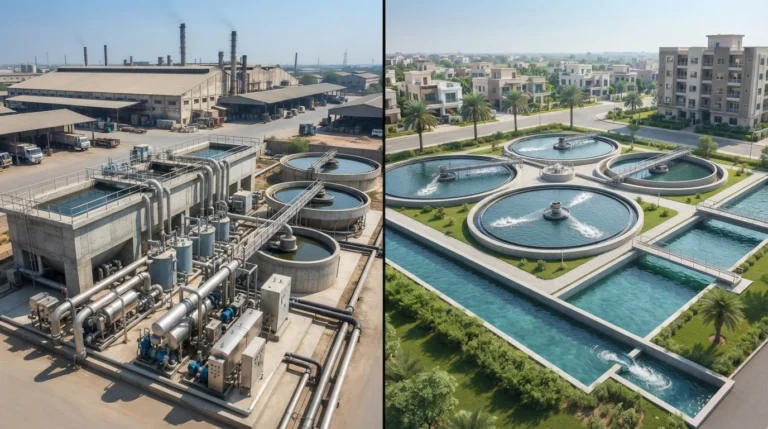
The difference between ETP and STP comes down to what goes into the plant, not what the plant looks like. An effluent treatment plant (ETP) handles wastewater from industrial processes. A sewage treatment plant (STP) handles the toilet, kitchen and washroom water that people generate. Both use tanks, pumps and biology, which is why they get confused, and why facilities sometimes buy the wrong one.
In Pakistan that mistake is expensive. A factory that sends everything to an STP can poison its own biological stage, and a housing society that buys an industrial-grade ETP pays for chemistry it never uses. This article explains how the two plants differ, how to tell which one your site needs, and where the honest answer is “both”.
What an ETP Is Built to Deal With
Factory wastewater is not one thing. A textile mill’s dye bath, a tannery’s chrome liquor, a dairy’s wash-down water and a pharmaceutical plant’s solvent-laden rinse have almost nothing in common except that they all leave through a drain. So an ETP is designed around the specific effluent in front of it, usually after that effluent has been sampled and tested.
The treatment train often starts with steps an STP rarely needs: equalization to smooth out slugs of flow, pH correction, then coagulation and flocculation to pull out colour, oils or metals, followed by clarification or flotation. Biological treatment typically comes after that, once the water has become something microbes can live in. Where the effluent carries stubborn organics, advanced oxidation, membranes or evaporation may be added. This is why two ETPs of similar capacity can look, and cost, very different.
What an STP Is Built to Deal With
Sewage is more forgiving. It is mostly human waste, wash water and food residue: organic matter, nutrients such as nitrogen and phosphorus, grease and pathogens. The flow rises and falls through the day, with a morning peak and a quiet night, but its character does not change much from month to month.
That predictability is why STP design is more standardized. Screening and grit removal come first, then a biological stage (activated sludge, MBBR, SBR or MBR, depending on available space and the quality you need), then settling and disinfection. The real design questions are how many people the plant serves, how much flow that produces, and how clean the treated water must be if you plan to reuse it for flushing, gardens or irrigation.
The Difference Between ETP and STP at a Glance
ETP | STP | |
Wastewater source | Manufacturing processes, equipment cleaning, utilities | Toilets, kitchens, bathrooms, laundry |
Typical pollutants | Depends on the industry: dyes, oils, solvents, metals, salts, extreme pH | Organic matter, nutrients, grease, pathogens |
Variability | High; changes with product, shift and batch | Moderate; follows occupancy |
Core treatment | Chemical and physical steps first, then biological or advanced stages as needed | Mostly physical and biological, then disinfection |
Design basis | Laboratory testing of the actual effluent | Occupancy-based flow and load |
Common users | Textile, tannery, pharmaceutical, food, chemical plants | Housing societies, hotels, offices, campuses |
Why Industrial Wastewater Cannot Simply Go Through an STP
An STP’s biological stage is a living population of microorganisms, and they are sensitive. Heavy metals, biocides, strong acids or alkalis, high salinity and some solvents can suppress or kill them. When that happens the plant does not fail gracefully. Effluent quality drops, and recovery can take weeks while the culture rebuilds.
Even without outright toxicity, industrial streams can carry organic loads far above what an STP was sized for, or colour and persistent compounds that ordinary biology will not break down. Sludge is another difference: sludge from an ETP may contain metals or process chemicals and need different handling and disposal from ordinary sewage sludge.
The reverse error is just as common. Offices and housing societies sometimes end up paying for chemical dosing, flotation units and sludge handling suited to factory discharge, when a well-run biological STP would have done the job.
Not Sure Whether Your Site Needs an ETP, an STP or Both?
Send us your process wastewater test results (pH, COD, BOD, oil and grease), your daily flow and where the treated water will go. We will review them and tell you whether your site needs an ETP, an STP or a combined setup. No lab report yet? See our water quality monitoring service, or explore our wastewater treatment systems.
Effluent Treatment Plant vs Sewage Treatment Plant: How Pakistani Rules Treat Them
Discharge in Pakistan is governed by the National Environmental Quality Standards (NEQS) for municipal and liquid industrial effluents. Under Section 11 of the Pakistan Environmental Protection Act, 1997, no one may discharge effluent at a concentration above the NEQS. The standards set limits for parameters such as BOD, COD and suspended solids, and the applicable limits depend on where the water ends up: inland waters, a sewer or land.
Two practical points follow. First, the NEQS were written as a general framework covering both industrial and municipal wastewater, so regulators care about what your effluent actually contains, not whether the plant is labelled ETP or STP. Second, diluting effluent with fresh water to meet the limits is not an accepted route to compliance.
Enforcement and expectations also differ between provinces. If you operate in more than one, our comparison of Punjab EPA and Sindh EPA compliance requirements is a useful starting point.
When the Answer Is Both
Many sites produce two very different wastewaters, and treating them together is where trouble starts.
A factory with a canteen, washrooms and staff housing generates sewage from people and effluent from production. The sanitary flow suits an STP; the process flow needs an ETP. A hospital is similar: ward and washroom wastewater behaves like sewage, but laboratory, pharmacy, imaging and disinfectant streams carry a chemical load that biological treatment alone is not designed for. We cover that case in detail in our guide to hospital wastewater treatment in Pakistan. Hotels and resorts with heavy laundry and kitchen operations can face something comparable.
The usual best practice is to keep the streams separate at source, treat each properly, and only combine them where the industrial stream has been pretreated. Where many small factories share an industrial area, a common effluent treatment plant (CETP) is another route. A report submitted to the Sindh High Court recommended exactly this for Karachi’s industrial areas.
Mistakes We See When Facilities Choose a Plant
- Buying on capacity alone. Litres per day says little. Two factories discharging the same volume can need entirely different plants.
- Assuming the existing plant covers a new production line. A new product can change the effluent completely.
- Collecting everything in one sump. Once streams are mixed, treating them separately is no longer possible.
- Ignoring the destination. Whether treated water goes to a drain, a sewer, irrigation or back into the process changes how clean it must be.
How to Decide Before You Call a Vendor
- Map every wastewater stream and separate sanitary flows from process flows.
- Get the process streams tested. Typical checks include pH, COD, BOD, suspended solids, oil and grease, metals and colour, depending on your industry.
- Note the flow pattern. Continuous flow and batch discharge need different designs.
- Decide where the treated water will go, including any plan to reuse it.
- Confirm what your provincial EPA expects before the design is fixed.
Water Care Services Pakistan (WCSP) has worked in water and wastewater treatment since 2007, including beverage, textile and pharmaceutical effluent projects, and begins with jar testing and analysis of the client’s own effluent samples before recommending a process. If you want a second opinion on whether your site needs an ETP, an STP or both, our wastewater treatment systems page is a good place to start.
Conclusion
An ETP and an STP both clean water, but they are built for different problems. Sewage is predictable and biological; industrial effluent is specific to the process that created it and often needs chemical treatment before biology can work. Choosing the wrong one wastes money at best and puts compliance at risk at worst.
Start with your streams, not with a plant type. Separate sanitary from process wastewater, get the process flows tested, and decide where the treated water has to go. Once you know what is actually in your wastewater, the ETP, STP or combined decision usually becomes straightforward.
Frequently Asked Questions
Q1. Can one plant treat both sewage and industrial effluent?
In principle, yes, if the industrial stream is pretreated first and its toxicity and load are under control. Separate treatment is the safer default. Mixing raw process effluent with sewage risks upsetting the biology and makes it harder to trace the cause of a compliance problem.
Q2. Does a hospital need an ETP or an STP?
Usually both elements. Ward and washroom wastewater resembles sewage, but laboratory, pharmacy, imaging and disinfectant streams carry a chemical load that biological treatment alone is not designed for. The right setup depends on what each stream contains, so test before you design.
Q3. Is a CETP the same as an ETP?
A common effluent treatment plant serves several factories in an industrial area instead of one. It treats industrial effluent like an ETP but shares cost and operation. Member factories still need to meet the CETP’s conditions before their effluent is accepted.
Q4. How do I know what size plant I need?
Size depends on flow and pollutant load, not litres per day alone. An STP is typically sized from occupancy, while an ETP is sized from measured effluent flow and strength. Two factories with the same volume can need very different plants.