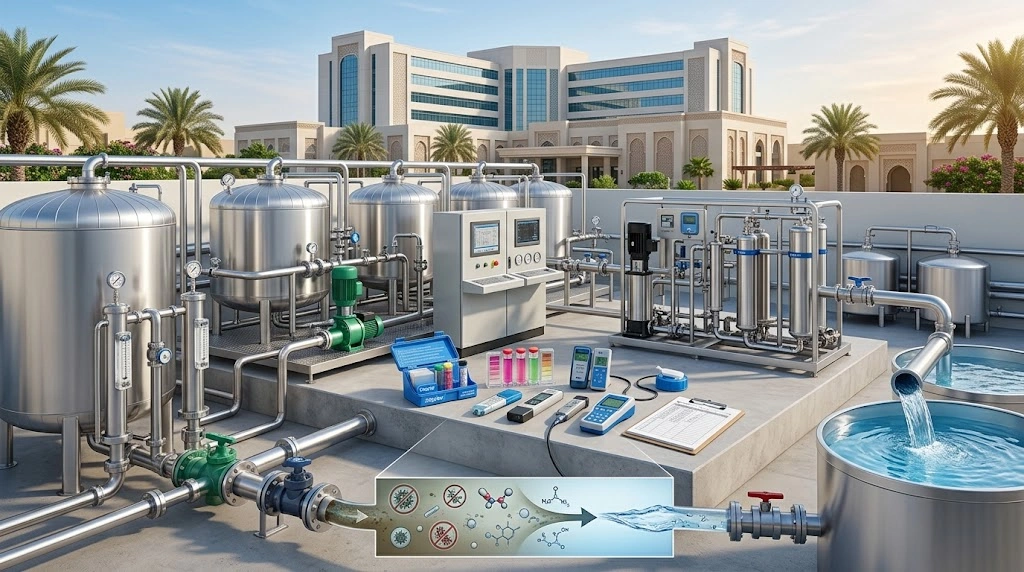
Hospital wastewater treatment in Pakistan addresses a type of effluent that ordinary municipal sewage systems are generally not designed to manage. Hospital wastewater can contain pathogens, antibiotic residues, pharmaceutical compounds, and various chemicals from healthcare operations. Unlike wastewater from a typical building, hospital drains may carry discharge from infectious disease wards, medication residues excreted by patients, and cleaning and disinfection chemicals used in laboratories and operating theatres. For hospitals and clinics in Lahore, Karachi, and other parts of Pakistan, understanding these differences is essential for selecting an effective medical effluent treatment plant and meeting the specific EPA compliance requirements for healthcare facilities.
What Makes Hospital Wastewater Different from Municipal Sewage
Municipal wastewater treatment plants are designed around fairly predictable domestic sewage. Hospital effluent breaks that assumption in several ways: it can carry pathogenic bacteria and viruses at higher concentrations than typical sewage, particularly from infectious disease wards; it contains pharmaceutical compounds and antibiotic residues excreted by patients, which don’t fully break down through standard biological treatment; and it includes disinfectants and cleaning chemicals from labs, operating theatres, and general sanitation that can interfere with biological treatment processes if not managed carefully. Sending this mix into a municipal sewer without any pre-treatment shifts the burden — and the risk — onto a system that isn’t built to handle it.
The Antibiotic Resistance Concern
Beyond the immediate infection risk, there’s a longer-term concern that’s gaining regulatory attention globally: untreated hospital effluent can carry antibiotic-resistant bacteria and genetic material into the environment, contributing to the broader antimicrobial resistance problem. This is a key reason hospital wastewater treatment is increasingly treated as its own category rather than lumped in with general institutional wastewater — the risk isn’t just about BOD and COD numbers on a compliance report, it’s about what specifically survives standard treatment.
Core Components of a Hospital Wastewater Treatment System
Treatment Stage | Purpose | Why It Matters for Hospitals |
Screening & Primary Treatment | Removes solids and large debris | Protects downstream equipment from clogging |
Disinfection (Chlorination/UV/Ozone) | Inactivates pathogens before or after biological treatment | Directly addresses infectious waste risk, not just organic load |
Biological Treatment (MBBR/MBR) | Reduces BOD/COD from organic waste | Handles general organic load from kitchens, laundry, and sanitation |
Advanced Oxidation / Membrane Polishing | Breaks down or filters out persistent pharmaceutical residues | Targets antibiotics and drug residues that biological treatment alone often misses |
Sludge Handling | Manages biosolids generated during treatment | Hospital sludge may carry pathogens and needs handling as potentially hazardous waste |
Disinfection deserves particular emphasis here: unlike a typical industrial effluent stream, hospital wastewater needs pathogen inactivation as a core treatment goal, not an afterthought. Many hospitals in Pakistan rely on chlorination as a practical, cost-effective disinfection step, sometimes supplemented with UV for wards handling higher infection risk.
NEQS and Regulatory Expectations for Healthcare Facilities
Hospitals discharging wastewater in Pakistan fall under the same National Environmental Quality Standards framework that governs industrial effluent, with limits on BOD, COD, TSS, and other parameters for whatever the receiving body is — municipal sewer, inland water, or otherwise. Punjab EPA and Sindh EPA both include healthcare facilities in their inspection scope, and larger hospitals are increasingly expected to demonstrate a documented wastewater management plan rather than simply discharging into the municipal system. Beyond NEQS, healthcare facilities also need to align their liquid waste handling with Pakistan’s broader biomedical/hospital waste management rules, which govern how infectious waste is segregated and handled before it ever reaches the wastewater stream.
Sizing a Medical Effluent Treatment Plant
- Bed count and department mix: a facility with ICU, dialysis, or infectious disease wards generates a different effluent risk profile than a general outpatient clinic.
- Segregation practices: hospitals that separate high-risk streams (e.g., lab or isolation ward discharge) from general sanitation wastewater can often use a more targeted, cost-effective treatment approach than treating everything as one uniform stream.
- Flow variability: hospital wastewater flow often peaks during specific hours (morning ward rounds, meal times, cleaning shifts) rather than staying constant, which affects equalization tank sizing.
- Space constraints: many hospitals, especially in dense urban areas, need compact or modular treatment systems rather than large footprint plants.
What to Check When Choosing a Hospital Wastewater Treatment Vendor
- Does the vendor understand infectious waste risk specifically, not just general BOD/COD treatment?
- Is disinfection built in as a dedicated stage, not an assumed side-effect of biological treatment?
- Can the system handle flow variability tied to hospital operating patterns rather than a flat average?
- Is sludge handling addressed as a potentially hazardous byproduct, with a clear disposal plan?
- Do they have documented experience with healthcare facilities, since this is a genuinely different effluent profile than industrial or commercial wastewater?
Conclusion
Hospital wastewater treatment succeeds when it’s designed around the specific risks healthcare facilities generate — infectious pathogens and pharmaceutical residues — rather than treated as a scaled-down version of standard industrial or municipal effluent treatment. Facilities that build in dedicated disinfection, appropriate biological treatment, and safe sludge handling protect both regulatory compliance and public health downstream. WCSP has designed wastewater treatment systems for institutional and industrial clients across Pakistan and can help hospitals and clinics assess the right treatment configuration for their specific department mix and effluent risk profile.
Frequently Asked Questions
In most cases, no — hospitals are expected to pre-treat wastewater before discharge, particularly to address pathogen load and, increasingly, pharmaceutical residues. Discharging untreated hospital effluent risks both regulatory penalties and public health consequences downstream.
Chlorination addresses pathogen inactivation effectively, but it doesn’t fully break down pharmaceutical residues or antibiotic compounds. A complete system typically combines disinfection with biological treatment and, where budgets allow, an additional step targeting persistent pharmaceutical contaminants.
The core risk factors — pathogens and pharmaceutical residues — are present regardless of facility size, though a small clinic’s effluent volume and complexity are much lower. A right-sized, compact treatment setup is usually more appropriate than either skipping treatment or over-building for a large hospital’s needs.
Hospital treatment sludge should be handled as potentially hazardous rather than ordinary biosolids, given the pathogen and pharmaceutical residue risk. Proper dewatering and disposal in line with hazardous waste handling requirements is essential rather than treating it like standard municipal sludge.