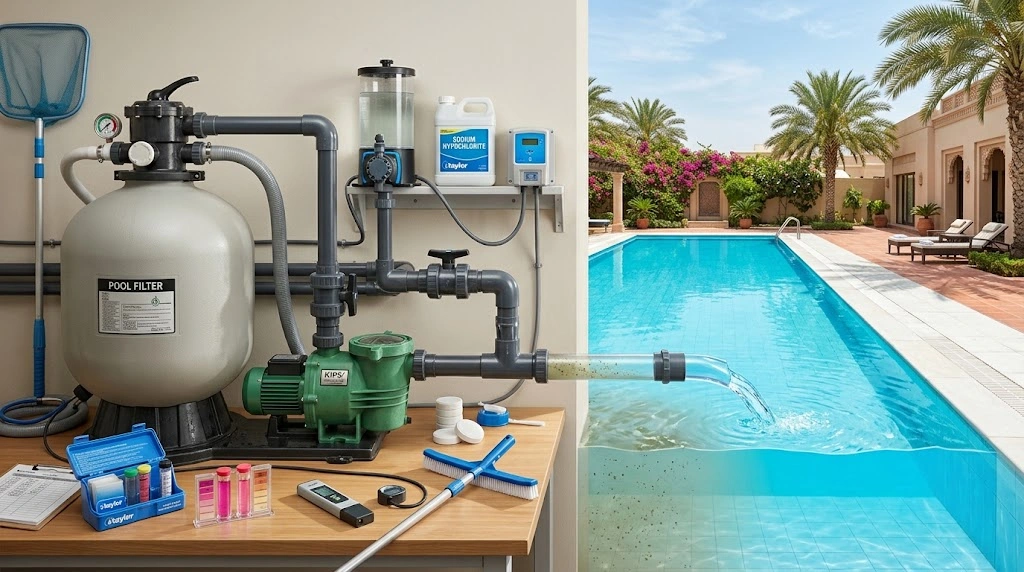
Green, cloudy, or irritating pool water is rarely difficult to diagnose — it usually indicates that swimming pool water treatment is not being maintained properly, often due to Pakistan’s hot climate, high bather loads, or inconsistent chlorine dosing. Whether you manage a hotel pool in Lahore, a community pool in a housing society, or a private residential pool, maintaining clear and safe water requires more than simply adding chlorine when the water appears dirty. This guide explains how chlorination works, why proper filtration is equally important, provides a practical maintenance schedule, and highlights common mistakes that can cause cloudy water, algae growth, or complaints from swimmers — helping you maintain a consistently clean pool instead of reacting to problems after they occur.
Why Pakistani Pools Are Harder to Maintain Than You’d Expect
Heat accelerates almost every problem in pool water chemistry. Higher water temperatures speed up chlorine consumption, encourage faster algae growth, and increase evaporation, which concentrates minerals and can throw off your water balance faster than in cooler climates. Add heavy bather load during summer months, dust and airborne debris in urban areas like Karachi and Lahore, and inconsistent source water quality, and it’s clear why a pool that looked fine on Monday can turn cloudy or green by Thursday without a consistent treatment routine.
How Chlorination Actually Works
Chlorine doesn’t just make water smell like a pool — it’s the primary disinfectant that kills bacteria, viruses, and algae before they can multiply. When chlorine is added to water, it forms hypochlorous acid, the active compound that actually does the disinfecting work. The amount of hypochlorous acid available depends on your pool’s pH: at a well-balanced pH, chlorine is far more effective than at a high pH, where much less of it converts into the active disinfecting form. This is why pH balance and chlorination have to be managed together — dosing more chlorine into a pool with unbalanced pH is often a wasted effort.
Chlorination Methods Compared
Method | How It Works | Best Fit |
Liquid Chlorine / Sodium Hypochlorite | Added directly via dosing pump for continuous disinfection | Larger commercial pools needing consistent, adjustable dosing |
Chlorine Tablets (Trichlor/Dichlor) | Slow-dissolving tablets release chlorine gradually via a feeder or floater | Smaller residential and community pools needing low-maintenance dosing |
Salt Water Chlorination | A salt cell generates chlorine on-site through electrolysis of dissolved salt | Pools wanting steadier chlorine levels with less manual handling of chemicals |
UV or Ozone (secondary disinfection) | Destroys pathogens and byproducts using UV light or ozone, used alongside a lower chlorine residual | Pools looking to cut chlorine odor and disinfection byproducts while maintaining safety |
Most pools in Pakistan rely on chlorine tablets or liquid chlorine as the core pool water chlorination method, since they’re cost-effective and widely available. UV or ozone systems are increasingly used as a secondary step in higher-end commercial or hotel pools to reduce the strong chlorine odor and irritation associated with chloramines, without eliminating chlorine’s baseline protection.
Filtration: The Other Half of Clean Pool Water
Chlorination handles biological contamination, but filtration is what physically removes dirt, dust, body oils, and fine debris that chlorine alone won’t clear. Sand filters are the most common choice for pools in Pakistan due to their low cost and simple maintenance, while cartridge filters offer finer filtration with less water waste during cleaning, and diatomaceous earth (DE) filters provide the highest filtration quality for pools where water clarity is a top priority, such as hotel or resort pools. Whichever filter type you use, running it long enough each day to turn over the pool’s full water volume at least once is essential — a common mistake is running filtration for too few hours, which lets contaminants build up faster than the filter can remove them.
A Practical Maintenance Schedule
- Daily: Check and adjust free chlorine and pH levels, especially during high bather load periods.
- Weekly: Test total alkalinity and calcium hardness, brush pool walls and floor, and check filter pressure.
- Monthly: Backwash or clean filters thoroughly, inspect pump and dosing equipment for wear.
- Seasonally: Shock-dose the pool to break down chloramine buildup, especially after periods of heavy use or a visible cloudiness.
- As needed: Superchlorinate (shock treatment) after heavy rain, a large event, or any sign of algae growth.
Common Problems and What They Actually Mean
Cloudy Water
Usually a filtration or chlorine-balance issue rather than a single cause — check filter run time, chlorine residual, and pH together rather than assuming it’s just one factor.
Green or Algae-Tinted Water
A clear sign that chlorine residual has dropped too low for too long, allowing algae to take hold. This typically needs a shock treatment followed by consistent daily dosing to prevent recurrence.
Strong Chlorine Smell with Eye/Skin Irritation
Counter-intuitively, this usually means chlorine is too low, not too high — the smell comes from chloramines (used-up chlorine that hasn’t been broken down), which build up when fresh chlorine isn’t dosed consistently enough.
What to Check When Choosing a Pool Water Treatment Provider
- Do they offer a proper dosing system (automated or semi-automated), rather than manual dosing alone for a commercial-scale pool?
- Can they design filtration sized correctly to your pool’s volume and expected bather load, not a generic package?
- Do they provide ongoing water testing support, not just one-time installation?
- Do they have experience with the specific pool type — residential, hotel, or community — since dosing and filtration needs differ by scale?
Conclusion
Consistent swimming pool water treatment comes down to managing chlorination and filtration together, not treating them as separate problems — a well-balanced pH keeps your chlorine effective, and properly sized filtration keeps debris from overwhelming your disinfection. Pools that follow a regular testing and maintenance schedule generally avoid the cloudy water and algae problems that show up when treatment becomes reactive instead of routine. WCSP has designed water disinfection and filtration systems for residential, commercial, and industrial clients across Pakistan and can help assess the right chlorination and filtration setup for your specific pool size and usage pattern.
Frequently Asked Questions
Daily testing for chlorine and pH is recommended, especially in summer, since heat accelerates chlorine consumption and encourages algae growth. Weekly testing for alkalinity and hardness helps catch slower-developing imbalances before they cause visible problems.
No — salt water systems still produce and use chlorine, just generated on-site from dissolved salt rather than added as a pre-made chemical. The end disinfection process is the same; the difference is in how the chlorine is delivered.
Regular dosing maintains a baseline chlorine level, but shock treatment periodically raises chlorine to a much higher level to break down chloramines and organic buildup that regular dosing doesn’t fully clear, especially after heavy bather use.
No. Filtration removes physical debris but doesn’t reliably kill bacteria, viruses, or algae on its own. A safe pool needs both disinfection (chlorine or an alternative like UV/ozone) and filtration working together.