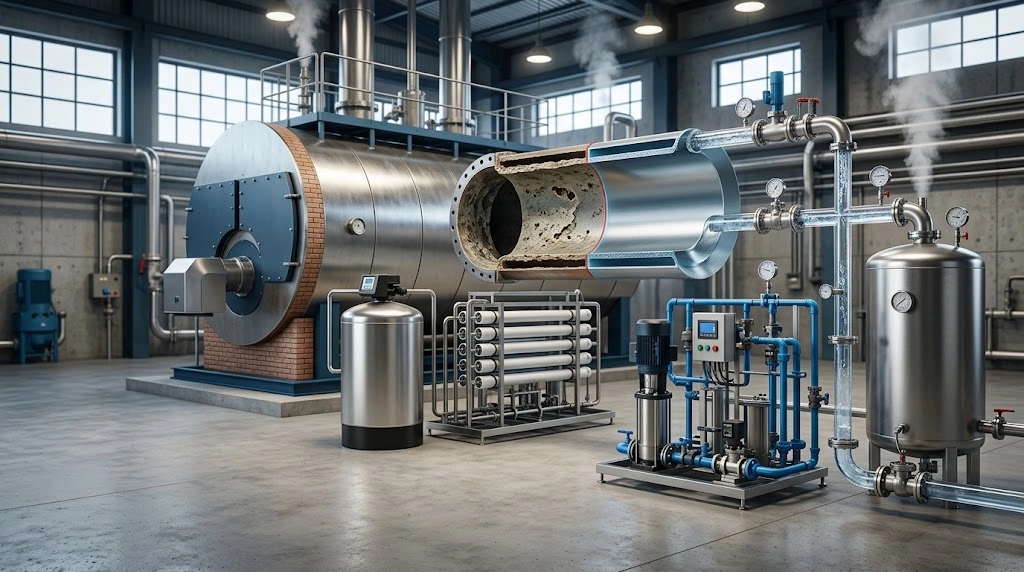
A boiler rarely fails suddenly because of untreated water; instead, damage develops gradually, with scale deposits and corrosion pits building up until a routine inspection reveals the need for an expensive shutdown. Boiler feed water treatment in Pakistan is essential because raw water from borewells, canals, or municipal supplies contains dissolved minerals and gases that may be harmless for drinking but can cause serious damage inside high-pressure, high-temperature boiler systems. This guide explains what happens when boiler feed water is left untreated, which treatment steps are important for preventing boiler scaling, and how the cost of treatment compares with the potential expense of unplanned downtime or premature boiler replacement.
What’s Actually in Your Feed Water — and Why It Matters
Raw water contains dissolved hardness minerals (calcium and magnesium), dissolved oxygen and carbon dioxide, silica, and suspended solids. None of these cause visible problems at room temperature, but inside a boiler operating under heat and pressure, they behave very differently:
- Calcium and magnesium precipitate out as hard scale on heat transfer surfaces as water is heated and concentrated through repeated boiling and blowdown cycles.
- Dissolved oxygen and carbon dioxide become corrosive once heated, attacking boiler tubes, condensate lines, and feed water piping from the inside.
- Silica can form hard, glass-like deposits that are especially difficult to remove once formed, particularly in higher-pressure systems.
- Suspended solids and organic matter contribute to fouling and can interfere with proper steam-water separation.
How Untreated Water Destroys a Boiler Over Time
Scale is the most visible consequence, but it’s also the most costly: even a thin layer of mineral scale acts as an insulator on the heat transfer surface, forcing the boiler to burn more fuel to produce the same amount of steam. Left untreated, scale buildup thickens, heat transfer efficiency keeps dropping, and tube metal temperatures rise beyond safe limits — a leading cause of tube failure in industrial boilers. Corrosion works differently but is just as damaging: dissolved oxygen creates pitting that thins tube walls from the inside, often invisibly, until a leak or rupture forces an unplanned shutdown. Together, scaling and corrosion are the two most common reasons boilers need premature tube replacement or full retubing well before their expected service life.
Core Boiler Feed Water Treatment Steps
Treatment Step | What It Removes/Controls | Why It’s Needed |
Softening (Ion Exchange) | Calcium and magnesium hardness | Primary defense for boiler scaling prevention |
Deaeration | Dissolved oxygen and carbon dioxide | Reduces internal corrosion of tubes and piping |
Reverse Osmosis / Demineralization | Dissolved solids, silica, most ionic impurities | Needed for higher-pressure boilers requiring very low mineral content |
Chemical Dosing (oxygen scavengers, pH adjusters, scale inhibitors) | Residual oxygen, pH imbalance, minor hardness slip-through | Fine-tunes water chemistry within the boiler itself |
Blowdown Control | Concentrated dissolved solids in boiler water | Prevents mineral concentration from exceeding safe limits over time |
Most industrial boilers in Pakistan rely on a combination of softening plus deaeration as a baseline, with reverse osmosis or demineralization added for higher-pressure systems where even trace hardness or silica becomes a scaling risk. Chemical dosing and blowdown control then manage what the upstream treatment doesn’t fully remove.
Boiler Feed Water Quality: What to Monitor
- Total hardness — should be reduced to near-zero for most industrial boiler applications.
- Dissolved oxygen — controlled through mechanical deaeration and chemical oxygen scavengers together, not one alone.
- pH — maintained within the range recommended by the boiler manufacturer to minimize both corrosion and scale-forming tendency.
- Total Dissolved Solids (TDS) inboiler water — tracked through regular blowdown to prevent concentration buildup.
- Silica — particularly important for higher-pressure boilers, since it can carry over into steam and deposit on turbine blades in power generation applications.
Cost of Treatment vs. Cost of Not Treating
Boiler feed water treatment is often viewed as a pure cost center, but the comparison that matters is against the alternative: reduced fuel efficiency from scale buildup, unplanned downtime from tube failures, and early boiler or tube replacement. A boiler operating with even a thin scale layer requires meaningfully more fuel to produce the same steam output, and that inefficiency compounds daily for as long as the scale remains. Investing in consistent water treatment is generally far cheaper over the life of a boiler than absorbing the fuel penalty and eventual repair or replacement cost of an untreated system.
What to Check When Choosing a Boiler Water Treatment Provider
- Do they design treatment around your specific boiler type and operating pressure, or offer a generic one-size-fits-all package?
- Is regular water quality testing (hardness, pH, dissolved oxygen, TDS) included, or only the initial treatment plant installation?
- Can they support both mechanical treatment (softening, RO, deaeration) and ongoing chemical dosing programs, or only one side of the equation?
- Do they have documented experience with industrial boilers in your sector — textile, food & beverage, pharmaceutical, or power generation — since feed water demands vary by application?
Conclusion
Boiler feed water treatment isn’t an optional add-on — it’s the difference between a boiler that runs efficiently for its full expected service life and one that needs early tube replacement because of preventable scaling and corrosion. Getting the basics right (softening, deaeration, and appropriate chemical dosing) protects both your fuel efficiency and your capital investment. WCSP has designed boiler and cooling water treatment programs for industrial clients across Pakistan and can help assess the right combination of mechanical and chemical treatment for your specific boiler system
Frequently Asked Question's
A water softener addresses hardness, which is the main scaling risk, but it doesn’t remove dissolved oxygen or dissolved solids. For most industrial boilers, softening needs to be paired with deaeration and, for higher-pressure systems, reverse osmosis or demineralization for complete protection.
It depends on your raw water hardness and how hard the boiler runs, but scale accumulation is continuous from day one without treatment. Even water that looks and tastes fine can carry enough hardness to cause a measurable efficiency loss within months of continuous operation.
No — corrosion pitting permanently thins tube walls. Treatment can stop further corrosion from occurring, but it can’t repair metal that’s already been lost, which is why prevention (proper deaeration and oxygen scavenging) matters more than trying to catch the problem after damage has started.
Yes, in principle — scale and corrosion mechanisms don’t care about boiler size. Smaller boilers can use a proportionally smaller, more compact softening and dosing setup, but skipping treatment entirely on a small unit still leads to the same scaling and corrosion problems over time.