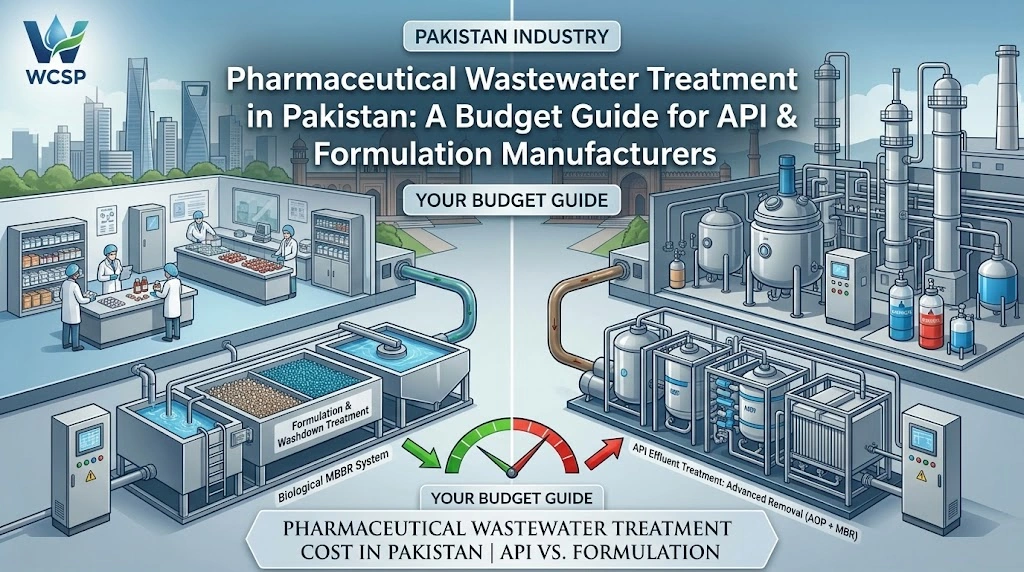
Budgeting for pharmaceutical wastewater treatment cost in Pakistan is harder than budgeting for most other industrial effluent because the cost isn’t driven by volume alone — it’s driven by what’s dissolved in that volume. A formulation unit filling tablets and syrups produces a very different effluent, and a very different price tag, than an API (active pharmaceutical ingredient) manufacturing plant running chemical synthesis. This guide breaks down what actually shapes pharmaceutical wastewater treatment cost in Pakistan, how an API effluent treatment plant differs in price from a standard formulation-unit setup, and what questions to ask before you sign a vendor contract, so you can budget realistically instead of comparing quotes that aren’t actually for the same scope of work.
Why Pharma Wastewater Costs More to Treat Than Most Industrial Effluent
Two pharmaceutical plants with identical flow rates can need very different treatment budgets. What matters most is the source: formulation and packaging operations mainly generate cleaning water, washdown, and low-strength organic waste, while API manufacturing generates process effluent containing residual active compounds, solvents, and sometimes antibiotic residues that don’t break down easily through standard biological treatment. Conventional treatment processes are often only partially effective against these compounds, which is why pharma effluent frequently needs an additional, more advanced treatment stage — and that stage is usually where the budget difference shows up.
Cost Drivers Specific to Pharmaceutical Effluent
- Type of operation: formulation/packaging effluent is generally cheaper to treat than active ingredient (API) synthesis effluent.
- Presence of APIs and antibiotic residues: these often require an oxidation step (such as Advanced Oxidation Process) in addition to biological treatment, adding to both capex and opex.
- Solvent content: some API processes use organic solvents that must be separated or pre-treated before biological treatment can proceed safely.
- Flow variability: batch-based pharma manufacturing often produces effluent in surges rather than a steady stream, which affects equalization tank sizing.
- Discharge target: treating to NEQS discharge-only standards costs less than treating for water reuse within a GMP-regulated facility.
Technology Options and Their Relative Cost
An API effluent treatment plant typically layers multiple treatment stages rather than relying on one. Here’s how the common options compare on cost and capability:
Technology | Relative Cost | What It Handles Well | Limitation |
Biological Treatment (MBBR/ASP) | Lower | General organic load (BOD/COD) from cleaning and formulation waste | Limited effectiveness against APIs and antibiotic residues alone |
Bioremediation (enzyme/microbial) | Moderate | Complex organics with lower chemical addition than conventional treatment | Best suited to biodegradable pharma waste, not all solvent-heavy streams |
Advanced Oxidation Process (AOP) | Higher | Breaking down persistent APIs and antibiotic residues | Higher energy and reagent cost than biological treatment alone |
Membrane Bioreactor (MBR) | Higher | High-quality effluent suitable for reuse, good API removal in combination with AOP | Higher capex and membrane maintenance cost |
Most cost-effective pharma effluent treatment plants combine a biological or bioremediation stage for the general organic load with a smaller, targeted AOP or membrane stage specifically for API and antibiotic residues — treating the whole stream with AOP alone would be far more expensive than necessary.
NEQS and EPA Compliance Costs to Budget For
Beyond BOD, COD, and TSS limits that apply broadly under Pakistan’s NEQS, pharmaceutical plants face closer scrutiny because of the environmental and antibiotic-resistance concerns tied to untreated API discharge. Punjab EPA and Sindh EPA inspections on pharma facilities often include effluent sampling specifically for these markers, and non-compliance carries the same risk of fines or closure notices as any other regulated industry — with reputational risk being especially high for manufacturers supplying export markets or multinational partners with their own environmental audits.
Typical Cost Ranges by Facility Type
Facility Type | Effluent Profile | Typical Technology Mix | Cost Positioning |
Formulation/packaging unit | Low-strength cleaning & washdown water | Biological treatment, minimal or no AOP | Lower end of the range |
Mixed formulation + small API line | Moderate organic load with some residual actives | Biological + bioremediation, targeted AOP | Mid-range |
Full API/synthesis plant | High-strength, solvent and API-containing effluent | Multi-stage: biological/bioremediation + AOP or MBR | Higher end, scales with production complexity |
Questions to Ask Before Signing a Pharma ETP Contract
- Does the quote include a dedicated stage for API/antibiotic residue removal, or only general BOD/COD treatment?
- Is the system designed for batch-flow variability, not just average daily volume?
- What ongoing testing or monitoring is included to confirm API removal, not just BOD/COD compliance?
- How is chemical or solvent-laden sludge disposed of, and is that cost included or billed separately?
- Does the vendor have documented experience with pharmaceutical clients specifically, not just general industrial effluent?
Conclusion
Pharmaceutical wastewater treatment cost in Pakistan comes down to one core question: are you treating general cleaning effluent, or effluent that contains active pharmaceutical ingredients? Getting a vendor to quote against your actual effluent profile — not a generic industrial average — is the single biggest factor in getting an accurate, realistic budget. WCSP has treated pharmaceutical effluent for a Lahore-based manufacturing client using its BioCleaner technology, achieving strong BOD/COD reduction, and can help assess whether your facility’s effluent needs biological treatment alone or a combined approach for API removal.
Frequently Asked Questions
Often yes, per unit of flow, because pharma effluent — particularly from API manufacturing — usually needs an additional treatment stage (like AOP) to break down active compounds that biological treatment alone can’t fully remove. Formulation-only facilities are closer in cost to standard industrial effluent.
For many formulation and lower-strength pharma effluent streams, yes — bioremediation using enzymes and microbes can achieve strong BOD/COD reduction without heavy chemical use. For effluent containing persistent APIs or antibiotic residues, it usually needs to be paired with an oxidation step for reliable results.
Yes, reuse-grade treatment (often involving membrane filtration) costs more upfront than treating purely to meet NEQS discharge limits, but GMP-regulated facilities increasingly consider it worthwhile given rising water costs and stricter scrutiny of pharmaceutical water use.
The plant may pass a basic NEQS test on BOD/COD while still discharging pharmaceutical compounds that persist in the environment. Regulatory scrutiny on this specific issue is increasing, and treating for API removal now is generally more cost-effective than retrofitting later under pressure.