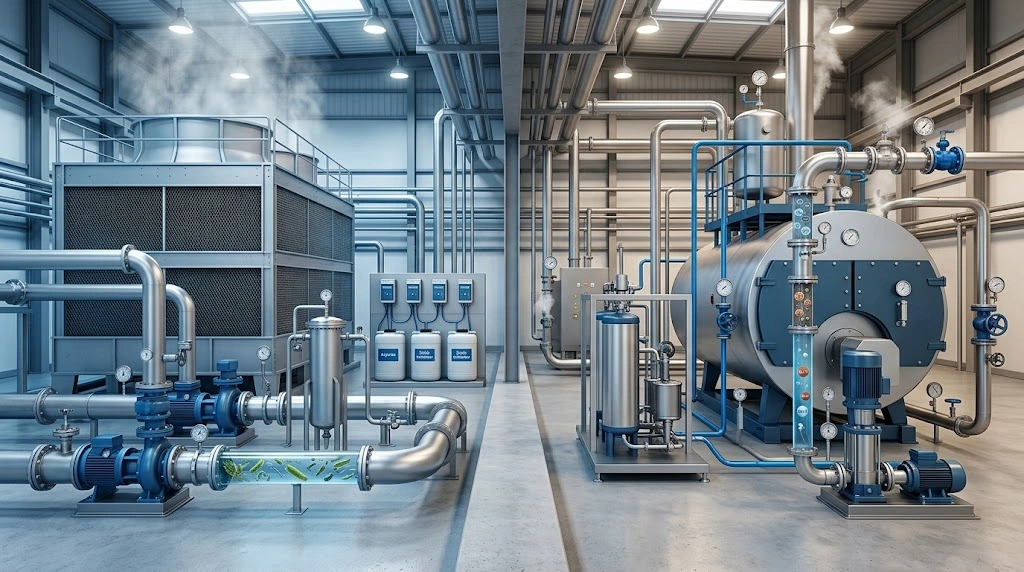
In many Pakistani industrial plants, the same chemical program is used for both the boiler and the cooling tower. It is an easy assumption to make, and a costly one. Cooling tower vs boiler water treatment is not a matter of applying the same principles twice: each system runs under different conditions and fails in different ways. This guide explains how the two differ, why their water chemistry needs are so different, and how to avoid using one program for both.
The Core Difference: Open vs Closed, Evaporative vs Pressurized
A cooling tower is an open, evaporative system operating at or near atmospheric pressure and moderate temperatures, constantly losing water to evaporation and picking up airborne contaminants as it recirculates. A boiler is a closed, pressurized system operating at high temperature, where water is converted to steam and any impurity left behind becomes dramatically more concentrated and more reactive than it would be at atmospheric conditions. This single structural difference is why the two systems demand almost opposite treatment priorities.
Side-by-Side Comparison
Factor | Cooling Tower | Boiler |
System Type | Open, evaporative, atmospheric pressure | Closed, pressurized, high temperature |
Main Water Loss | Evaporation and blowdown | Steam generation (converted, not lost) |
Primary Risk | Scale, corrosion, and biological growth (algae, Legionella) | Scale and corrosion inside high-pressure tubes |
Biological Control | Critical — biocides needed to control Legionella and algae | Minimal — high temperatures largely prevent biological growth |
Mineral Concentration | Managed through blowdown as water evaporates and concentrates | Managed through blowdown and near-total mineral removal via pretreatment |
Typical Pretreatment | Basic filtration, sometimes softening | Softening plus deaeration, often demineralization |
Why Cooling Towers Need Biological Control That Boilers Don’t
Cooling towers operate at warm-but-not-boiling temperatures and are constantly exposed to open air, which makes them an ideal environment for algae and bacteria — including Legionella, a serious health risk if allowed to establish itself in the system. Boilers, by contrast, run hot enough that biological growth generally isn’t a practical concern; the treatment challenge there is almost entirely about mineral scale and metal corrosion, not microbiology. Applying a boiler-style chemical program without biocide dosing to a cooling tower is a common and risky shortcut — it leaves the biological risk completely unmanaged.
Why Boiler Water Needs Far Stricter Mineral Control
Because a boiler concentrates whatever’s dissolved in the feed water through repeated boiling, even trace hardness or silica that a cooling tower could tolerate indefinitely becomes a serious scaling risk inside a boiler over time. This is why boiler feed water typically needs deaeration (removing dissolved oxygen) and much more thorough softening or demineralization than a cooling tower’s makeup water. A cooling tower can often run acceptably on softened water alone; a boiler, especially at higher operating pressures, usually can’t.
Not Sure Your Boiler and Cooling Tower Are Treated Correctly?
Send us your water analysis and we will tell you what each system needs, from softening and demineralization for boiler feed water to biocide control for your cooling tower.
What Happens When the Wrong Chemistry Is Applied
- Boiler-style scale inhibitor dosed into a cooling tower: may not address the biological growth risk at all, leaving Legionella and algae unmanaged.
- Cooling tower-style light softening applied to boiler feed water: often insufficient — residual hardness that a cooling tower can handle will scale a boiler’s high-temperature surfaces much faster.
- Same blowdown strategy applied to both: cooling towers and boilers concentrate minerals at very different rates and need separately calculated blowdown schedules.
- One combined chemical dosing program for a shared water source feeding both systems: usually under-serves one system to avoid over-treating the other.
Building Separate Treatment Programs That Work Together
- Test and treat each system’s makeup water and recirculating water separately, even if they draw from the same source.
- Include biocide dosing and regular Legionella testing specifically for cooling towers, not as an afterthought.
- Prioritize deaeration and thorough softening/demineralization for boiler feed water, sized to the boiler’s actual operating pressure.
- Set blowdown rates independently for each system based on its own mineral concentration factor, not a shared assumption.
- Monitor each system with its own real-time monitoring — cooling towers for biological indicators and cycles of concentration, boilers for hardness, pH, and dissolved oxygen.
Conclusion
Treating cooling towers and boilers with the same chemistry misses what makes each system risky in the first place — biological growth in one case, mineral concentration in the other. Facilities that design separate, appropriately matched treatment programs for each system avoid both the compliance risk of unmanaged Legionella and the operational risk of premature boiler scaling. WCSP has designed cooling tower and boiler water treatment programs for industrial clients across Pakistan and can help assess the right chemistry for each system rather than a one-size-fits-all approach.
Frequently Asked Questions
Q1. Can one water treatment company handle both cooling tower and boiler systems?
Yes, and it’s common for one provider to manage both — but the key is confirming they’re running separate, appropriately designed programs for each, not a single generic chemical package applied to both systems.
Q2. Does a cooling tower need softened water like a boiler does?
Not always to the same degree. Cooling towers can often tolerate more hardness than boilers because they don’t concentrate minerals through boiling, though softening still helps reduce scaling risk, especially in areas with very hard source water.
Q3. Why doesn't Legionella grow in boilers the way it does in cooling towers?
Boiler water operates at temperatures well above the range where Legionella bacteria can survive and multiply, which is why biological control isn’t a primary boiler treatment concern the way it is for the cooler, open-air environment of a cooling tower.
Q4. Is it more expensive to treat cooling towers or boilers?
It varies by system size and water quality, but boiler treatment often carries higher pretreatment cost (softening, deaeration, sometimes RO) due to stricter mineral limits, while cooling towers carry ongoing biocide and monitoring costs tied to biological control.