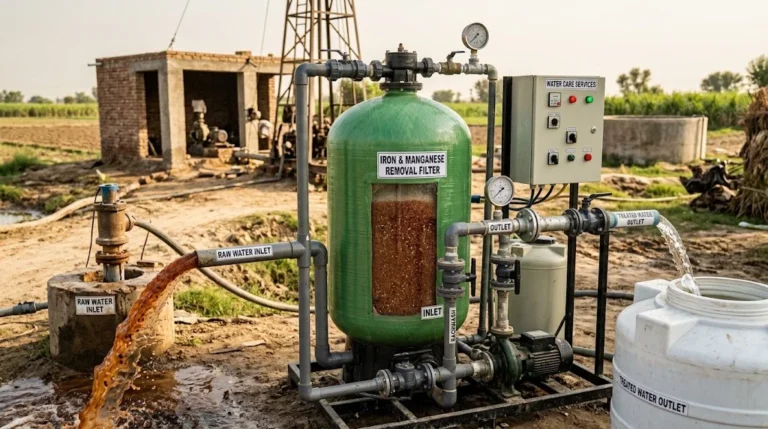
Why Borewell Water Carries Iron and Manganese
Iron and manganese are naturally occurring elements in soil and rock formations, and groundwater dissolves small amounts of both as it passes through underground layers before reaching a borewell. This is a geological issue, not usually a contamination or pollution problem — it’s simply a function of what minerals exist in the aquifer a particular borewell draws from. Some regions and depths in Pakistan produce noticeably higher iron and manganese levels than others, which is why two borewells in the same general area can show very different staining problems depending on the specific soil layers each one taps into.Iron vs Manganese: Telling the Stains Apart
| Sign | Likely Iron | Likely Manganese |
| Stain color | Reddish-orange or rust-colored | Brownish-black or dark gray |
| Where it appears | Sinks, tubs, toilets, laundry (especially white fabric) | Similar fixtures, but often more pronounced in pipes and water heater tanks |
| Water appearance fresh from tap | May look clear at first, then turns orange/rusty after exposure to air | May look clear initially, then develops dark discoloration |
| Taste/odor | Metallic taste often noticeable | Less distinct taste, sometimes described as slightly bitter |
Orange or Black Stains From Your Borewell Water?
Send us your water test result and we will confirm whether it is iron, manganese or both, then recommend an oxidation and filtration system sized for your flow. Start with our water testing kits or explore our water filtration plants.
Why Iron Removal Isn’t Always Simple
The treatment approach depends heavily on what chemical form the iron is in. Dissolved (ferrous) iron is invisible in the water until it’s exposed to air and oxidizes into the visible reddish (ferric) form — this is why water can look clear straight from the tap but turn orange in a bucket or sink after sitting for a while. Treating dissolved iron effectively usually requires oxidizing it first (converting it to the filterable solid form) before it can be physically removed, which is why a simple sediment filter alone often fails to solve an iron problem — it can only catch iron that’s already oxidized, not the dissolved form causing ongoing staining.Treatment Methods Compared
| Method | How It Works | Best Fit |
| Aeration + Filtration | Exposes water to air to oxidize dissolved iron/manganese, then filters out the resulting solids | Moderate iron/manganese levels, lower ongoing chemical cost |
| Chemical Oxidation (Chlorine or Potassium Permanganate) + Filtration | Chemically oxidizes iron and manganese faster and more completely than aeration alone, then filters the result | Higher iron/manganese concentrations, or where iron bacteria are also present |
| Manganese Greensand Filtration | A specialized filter media that oxidizes and filters iron/manganese in a single step | Combined iron and manganese removal with more consistent output |
| Water Softener (ion exchange) | Can remove low levels of dissolved iron alongside hardness, but isn’t a dedicated iron solution | Only for low iron levels alongside a hardness problem, not as a standalone fix |
Signs You Need Professional Testing, Not Just a Filter
- Stains persist or worsen despite installing a basic sediment or carbon filter — a sign the iron is still in dissolved form and needs oxidation, not just filtration.
- Reddish-brown slime in toilet tanks or on fixtures — this can indicate iron bacteria, which needs a different treatment approach (typically shock chlorination plus ongoing oxidation) than mineral iron alone.
- Inconsistent staining severity — suggests fluctuating iron/manganese levels that need a system sized for peak concentration, not average.
- Metallic taste alongside staining — worth testing total iron concentration specifically, since taste thresholds and staining thresholds don’t always align.
What to Check When Choosing an Iron Removal System
- Has your specific borewell water been tested for iron and manganese concentration, not just assumed from stain appearance?
- Does the proposed system include an oxidation step, or only filtration — a filtration-only system won’t reliably remove dissolved iron?
- Is the system sized for your actual flow rate and household or facility usage, not a generic residential average?
- Does the vendor test for iron bacteria specifically if you’re seeing slime or biofilm, since this needs different treatment than mineral iron alone?
Conclusion
Orange or dark staining from borewell water is almost always solvable, but the fix depends on correctly identifying whether you’re dealing with iron, manganese, or both, and in what chemical form. A filter alone often disappoints because it can’t address dissolved iron without an oxidation step first — testing your specific water before choosing a system saves both money and frustration. WCSP has supported groundwater treatment for residential and commercial clients across Pakistan and can help test and size the right iron removal water filter for your borewell’s specific water chemistry.Frequently Asked Questions
Q1. Is iron in borewell water dangerous to drink?
At typical levels found in most borewell water, iron is primarily an aesthetic and taste problem rather than a direct health hazard — it’s classified as a secondary rather than health-based contaminant in most drinking water frameworks. That said, very high concentrations can still affect taste significantly and may indicate other water quality concerns worth testing for.
Q2. Why does my water look clear but still stains my sink orange?
This is a classic sign of dissolved (ferrous) iron, which is invisible in water until it’s exposed to air and oxidizes into the visible reddish form. A simple filter often can’t catch it because it’s not yet in a filterable solid state when it first comes out of the tap.
Q3. Can a water softener fix an iron staining problem?
A water softener can remove low levels of dissolved iron as a side effect of the ion exchange process, but it isn’t designed as a dedicated iron removal solution and can struggle or need frequent regeneration if iron levels are more than minimal.
Q4. How do I know if I have manganese removal borewell water needs specifically, versus just iron?
Dark, blackish staining rather than orange-red is the first clue, but the only reliable way to confirm is a water test measuring both iron and manganese concentrations separately, since treatment systems need to be sized for whichever element (or combination) is actually present.