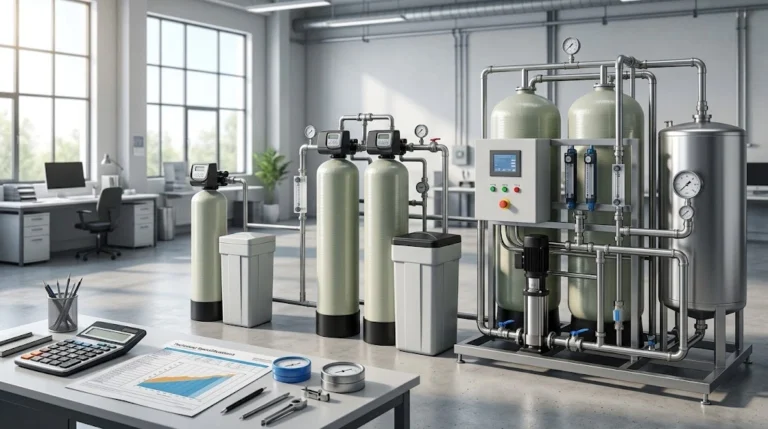
What Determines Water Softener Price
- Flow capacity: measured in gallons or liters per hour, this is the single biggest driver — a whole-house unit costs far less than a commercial system serving a hotel or factory.
- Source water hardness: harder water requires more frequent regeneration cycles, which affects resin volume and salt consumption, and can push you toward a larger unit than flow rate alone would suggest.
- Regeneration type: manual regeneration units cost less upfront but need more hands-on operation; automatic (metered or timer-based) units cost more but run with far less supervision.
- Resin quality and tank material: higher-grade resin and corrosion-resistant tanks (fiberglass vs standard steel) add to upfront cost but generally last longer.
Softener Technology Options and Relative Cost
| Technology | Relative Upfront Cost | Relative Ongoing Cost | Best Fit |
| Manual Ion Exchange Softener | Lower | Requires salt purchase and manual regeneration labor | Small households, budget-conscious buyers |
| Automatic (Metered) Ion Exchange | Moderate | Salt cost, but less labor since regeneration is automatic | Homes and small businesses wanting convenience |
| Salt-Free Conditioner (template-assisted crystallization) | Moderate to Higher | No salt purchase, minimal maintenance | Households wanting to avoid sodium in water and reduce salt handling |
| Industrial/Commercial Softener Skid | Higher | Scales with water volume and hardness | Factories, hotels, and large commercial facilities |
Want a Softener Quote Based on Your Actual Water?
Send us your water hardness result and daily water use, and our engineers will size the right capacity and technology for your home, business or factory. Explore our water softening plants or test your hardness first with our water testing kits.
Typical Cost Positioning by Application
| Application | Typical Capacity Range | Cost Positioning |
| Single household | Low flow, whole-house unit | Lowest end of the range |
| Small guesthouse or commercial building | Moderate flow, higher regeneration frequency | Mid-range |
| Factory or hotel (boiler/process feed) | High flow, continuous operation | Higher end, scales with capacity and automation |
Ongoing Costs Beyond the Initial Price
- Salt: ion exchange softeners need a regular salt supply for regeneration, and cost scales with hardness level and water usage.
- Water usage during regeneration: automatic softeners use water during the regeneration cycle itself, which is worth factoring into your water budget.
- Resin replacement: softener resin degrades over years of use and eventually needs replacement, particularly if the source water has high iron content alongside hardness.
- Maintenance visits: commercial and industrial units typically benefit from periodic professional servicing to check resin condition and valve function.
What to Check Before Buying
- Has your actual source water hardness been tested, or is the vendor sizing based on a generic estimate?
- Does the quote include installation and initial salt/resin charge, or are these billed separately?
- For commercial/industrial buyers: is the unit sized for peak demand, not just average daily flow?
- Is there a service plan or warranty covering the resin and control valve, not just the tank itself?
Conclusion
Water softener plant price in Pakistan varies enormously because capacity, hardness level, and technology choice all move the number in different directions — which is exactly why a generic quote without a water test behind it is hard to trust. Buyers who get their source water tested and compare quotes against actual flow and hardness data end up with a system sized correctly the first time, rather than paying for capacity they don’t need or replacing an undersized unit within a year. Water softening plant supply and service has supplied and serviced water softening systems for residential, commercial, and industrial clients across Pakistan and can help size the right capacity for your specific water chemistry.Frequently Asked Questions
Q1. Is a salt-free water conditioner cheaper to run than a salt-based softener?
Generally yes for ongoing costs, since there’s no recurring salt purchase, though the upfront unit cost is often similar or slightly higher. The trade-off is that salt-free systems reduce scale-forming tendency rather than fully removing hardness minerals from the water.
Q2. How is a commercial softener priced differently from a residential one?
Commercial and industrial softeners are priced primarily on flow capacity and regeneration frequency needed for continuous or high-volume use, which pushes cost well above residential units designed for a single household’s intermittent demand.
Q3. Does harder source water always mean a bigger, more expensive softener?
Not necessarily bigger, but it does mean more frequent regeneration cycles and higher salt consumption, which affects ongoing running cost even if the unit size itself doesn’t change dramatically.
Q4. Can I use the same softener for both home use and a small home-based business?
It depends on the added flow demand. A residential unit sized only for household use may regenerate too frequently or underperform if a business adds significant additional water use — it’s worth recalculating capacity based on combined demand rather than assuming the original sizing still fits.