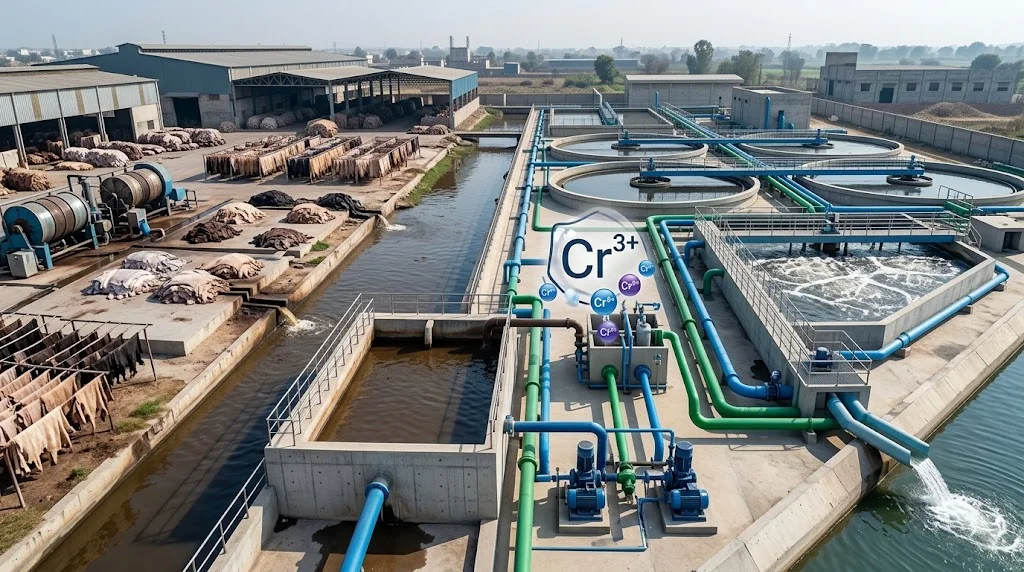
If you run or manage a tannery in Sialkot, Kasur, or Karachi’s Korangi belt, you already know chromium is both your most useful tanning agent and your biggest compliance headache. Leather tannery wastewater treatment exists precisely because raw tannery effluent carries chromium levels far above what’s safe to discharge — sometimes tens or hundreds of times higher than NEQS limits allow. This guide walks through where the chromium in your effluent comes from, which treatment technologies actually remove it reliably, what Punjab EPA and Sindh EPA expect from your discharge, and how tanneries in Sialkot and Kasur are approaching compliance today. The goal is a clear, practical picture — not a chemistry lecture — so you can make an informed decision about your treatment setup.
Why Tannery Wastewater Is So Difficult to Treat
Tanning converts raw hide into stable leather using chromium salts, primarily trivalent chromium (Cr³⁺), along with lime, sulfides, salts, and dyes. A meaningful share of the chromium applied during tanning — often a large fraction of what’s used — doesn’t stay fixed in the leather and ends up in the wastewater stream instead. On top of the chromium load, tannery effluent typically carries high BOD and COD from organic hide material, high salinity from curing salts, sulfides from the dehairing process, and strong odor.This combination means a tannery effluent treatment plant can’t rely on a single treatment step; it needs a sequence of processes, each targeting a different pollutant group.
Where the Chromium Actually Comes From
- Tanning drum discharge (spent tanning liquor) — the single largest source of dissolved chromium.
- Wash water after tanning, which carries residual chromium rinsed off the hides.
- Shaving and splitting operations, where chromium-laden leather shavings and dust enter the general waste stream if not segregated.
Segregating the concentrated chrome tanning liquor from your general wastewater stream — rather than mixing everything together — is one of the simplest ways to cut treatment cost, because it lets you recover and reuse chromium instead of diluting it into a much larger volume that then needs full-scale treatment.
Chromium Removal Technologies Compared
Several proven methods exist for chromium removal wastewater treatment in tanneries, each with different cost and recovery trade-offs:
Method | How It Works | Chromium Recovery? | Best Fit |
Chemical Precipitation | Raises pH (typically with lime or caustic soda) to precipitate chromium hydroxide, then settles/filters it out | Possible, with extra recovery step | Most common baseline method for small-medium tanneries |
Chrome Recovery & Reuse | Precipitates chromium from spent tanning liquor specifically, redissolves it in acid, and reuses it in the next tanning batch | Yes — chromium is reused, not just removed | Tanneries wanting to cut chromium purchase cost and effluent load together |
Membrane Filtration (UF/NF) | Concentrates chromium ions using pressure-driven membranes for recovery or safe disposal | Yes, high recovery rates | Larger operations investing in water reuse |
Uses an electric current to destabilize and coagulate metal ions, including chromium, for removal | Removal, not reuse | Tanneries also dealing with color and organic load together |
Chrome recovery and reuse deserves special attention because it solves two problems at once: it lowers the chromium concentration your ETP has to treat, and it reduces how much fresh chromium tanning agent you need to buy. Many tanneries treat it as a cost-saving measure first and a compliance measure second.
NEQS and EPA Compliance Requirements
Pakistan’s National Environmental Quality Standards (NEQS) set discharge limits for a wide range of parameters — including chromium, BOD, COD, TSS, and sulfide — for effluent released into inland waters, sewers, or the sea. Hexavalent chromium in particular is held to a tight limit for inland water discharge, reflecting its higher toxicity compared to trivalent chromium, and raw tannery effluent commonly arrives far above that limit before treatment. Punjab EPA and Sindh EPA enforce these standards through periodic effluent testing and can issue closure notices to units that discharge non-compliant effluent, which is why many tanneries in Kasur and Sialkot have moved toward common or dedicated effluent treatment plants over the past two decades, including collective efforts like the Kasur Tanneries Waste Management Authority and the Sialkot Tannery Zone initiative.
What a Practical Tannery ETP Setup Looks Like
- Segregation: keep chrome tanning liquor separate from general (non-chrome) wastewater streams.
- Chromium precipitation/recovery: treat the segregated chrome stream first, ideally with recovery for reuse.
- Screening and equalization: remove solids and balance flow/load from the general wastewater stream.
- Biological treatment: reduce BOD/COD from organic hide material using an activated sludge or MBBR-type process.
- Sludge management: dewater and dispose of chrome-bearing sludge in line with hazardous waste handling requirements, since it cannot be treated as ordinary solid waste.
Cost Factors Specific to Tannery Effluent
Tannery ETP costs are shaped by a few factors beyond simple flow rate: whether you’re investing in chrome recovery (higher upfront cost, but ongoing chemical savings), how much sulfide and salinity your process generates (both add treatment complexity), and whether you’re treating individually or as part of a shared common effluent treatment plant (CETP) serving multiple tanneries in a cluster, which spreads capital cost across several units — an approach that’s worked well in tannery zones with high unit density like Kasur and Sialkot.
Frequently Asked Question's
Trivalent chromium (Cr³⁺) is the form used in tanning and is less toxic, though still regulated. Hexavalent chromium (Cr⁶⁺) can form under certain oxidizing conditions and is significantly more toxic and carcinogenic, which is why it carries a much stricter discharge limit under NEQS.
Yes. Chrome recovery systems precipitate chromium from spent tanning liquor, redissolve it in acid, and feed it back into the tanning process. Many tanneries find this pays for itself over time through reduced chemical purchase, on top of the compliance benefit.
Both models exist in Pakistan. Individual ETPs work for larger units with steady effluent volume, while common effluent treatment plants (CETPs) serving a cluster of smaller tanneries — as seen in parts of Kasur and Sialkot — reduce the capital burden per unit while still achieving NEQS compliance.
At minimum, in line with your provincial EPA’s reporting schedule, but tanneries with variable production volumes often test more frequently to catch spikes in chromium concentration before they show up in a regulatory inspection.
Conclusion
Chromium is what makes leather tanning work, but it’s also the single hardest pollutant to manage safely in tannery wastewater. The tanneries that handle it well tend to do three things consistently: segregate the chrome tanning liquor early, recover and reuse chromium where possible instead of just removing it, and treat sludge as hazardous waste rather than an afterthought. WCSP has designed effluent treatment systems for industrial clients across Punjab and Sindh and can help tannery operators assess whether an individual ETP or a shared CETP approach makes more sense for their specific effluent volume and budget.