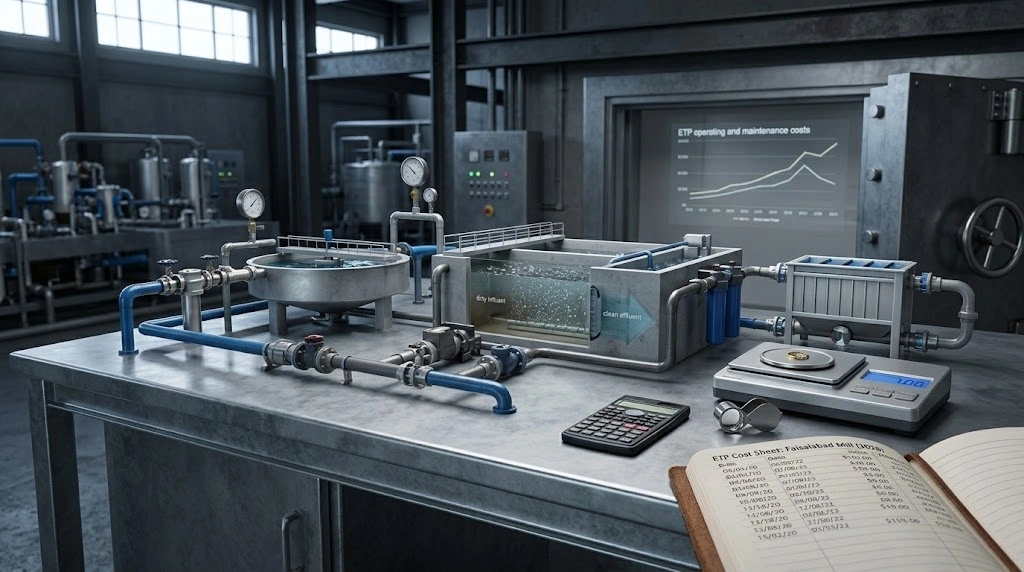
If you have requested quotes from two or three vendors for a textile effluent treatment plant cost in Pakistan and received very different prices, there is usually a clear reason behind the variation. A basic biological treatment system for a small dyeing unit can cost very differently from a complete MBBR-plus-RO setup designed for a large composite textile mill. This guide explains the main factors that influence textile ETP pricing, including treatment capacity, effluent characteristics, technology selection, and site conditions. It also looks at operating costs and hidden expenses that mill owners in Faisalabad, Karachi, and Lahore may encounter after installation, helping you compare quotations based on the complete project cost rather than simply choosing the lowest initial price.
What Determines Textile ETP Cost in Pakistan
No two textile mills produce identical wastewater, so no two ETP quotes should look the same either. Before comparing prices, it helps to understand the variables that actually move the number:
- Effluent flow rate (cubic meters per day) — the single biggest cost driver, since tank sizes, pump capacity, and membrane area all scale with volume.
- Effluent characteristics — dyeing and finishing units generate high-COD, high-color effluent that needs more treatment stages than a simple washing unit.
- Discharge requirement — treating water to meet NEQS limits for canal discharge costs less than treating it to a standard suitable for reuse in production.
- Land and civil works — tank construction, piping, and electrical work often account for 30–40 percent of total project cost, and vary by site condition.
- Automation level — manual dosing and monitoring systems cost less upfront but require more labor; PLC-based automation costs more initially but reduces long-term operating risk.
Capital Cost Breakdown: What You’re Actually Paying For
A textile ETP quote typically bundles several cost categories together. Understanding each one helps you spot where a vendor may be cutting corners — or padding the price.
- Equipment: pumps, blowers, aerators, clarifiers, filter press or centrifuge for sludge dewatering, and membrane modules if UF/RO is included.
- Civil works: equalization tank, aeration tank, clarifier, sludge drying beds, and associated foundations and piping.
- Electrical and instrumentation: control panels, level sensors, flow meters, and (if included) online COD/BOD monitoring for EPA reporting
As a rough, indicative order of magnitude, a conventional biological ETP for a small-to-mid-size dyeing unit in Pakistan can range from a few million to several tens of millions of PKR depending on capacity and technology, with larger composite mills requiring proportionally more. Treat any figure quoted without a corresponding flow rate and effluent characteristics report with caution — it isn’t a real estimate.
Technology Choice and Its Impact on Cost
The treatment technology you choose affects both capital cost and ongoing operating cost, and the cheapest option upfront isn’t always the cheapest option over five years.
Technology | Relative Capex | Relative Opex | Best Fit |
Chemical Coagulation (Alum/PAC) | Lower | Higher (chemical + sludge disposal cost) | Smaller units, tight upfront budget |
Moderate | Moderate (electrode + power cost) | Units struggling with color/heavy metal removal | |
MBBR (Moving Bed Biofilm Reactor) | Moderate to Higher | Lower (less chemical dependency) | Medium-large mills with space constraints |
MBBR + UF/RO for reuse | Highest | Lowest per unit of water reused | Mills targeting water recycling / export compliance |
If your effluent has strong reactive-dye color, note that alum-based coagulation typically removes 60–75 percent of color, which often isn’t enough to pass a visual EPA inspection even when BOD/COD readings are within limits. Electrocoagulation or an AOP step usually closes that gap, at a moderate cost premium.
Operating Costs Mill Owners Often Underestimate
The installation invoice is only the beginning. Monthly operating costs are what determine whether an ETP is sustainable for your business long-term.
- Chemicals: coagulants, pH adjusters, and disinfectants — a recurring cost that scales with flow and effluent strength.
- Energy: aeration blowers and pumps run continuously; for biological systems, energy is frequently the single largest recurring operating cost.
- Sludge disposal: every treatment process generates sludge that must be dewatered, transported, and disposed of in line with Pakistan’s Hazardous Substances Rules.
- Manpower: even a semi-automated plant needs a trained operator on-site or on call, plus periodic lab testing to verify discharge quality.
- Membrane replacement: if your system includes UF or RO for water reuse, membrane fouling and periodic replacement is a cost that’s easy to leave out of a capex-only comparison.
Typical Cost Ranges by Mill Size
Because every site is different, treat the ranges below as a starting point for budgeting conversations, not a firm quote.
Mill Size | Approx. Flow Rate | Typical Technology | Cost Positioning |
Small dyeing/finishing unit | Under 200 m3/day | Chemical coagulation + basic biological | Lower end of the range |
Medium composite mill | 200-1,000 m3/day | MBBR or activated sludge + coagulation | Mid-range, scales with automation level |
Large export-oriented mill | 1,000+ m3/day | MBBR/MBR + UF/RO for reuse | Higher end, offset over time by water reuse savings |
Hidden Costs That Catch Mill Owners Off Guard
- EPA non-compliance penalties if the system is undersized for future production growth.
- Retrofit costs when a vendor quotes a system that meets today’s NEQS limits but can’t be upgraded for stricter reuse or export-buyer requirements later.
- Sludge transport and disposal fees that aren’t included in the original quote but appear as a recurring line item.
- Downtime cost during commissioning or breakdowns, especially if the vendor doesn’t offer a service level agreement (SLA) or fast response time.
How to Get an Accurate Textile ETP Cost Quote
A reliable quote should be based on an actual effluent characteristics report, not a generic per-liter rate. Before requesting quotes, gather:
- Average and peak daily flow rate.
- A recent lab report showing COD, BOD, TSS, and color for your effluent stream.
- Your discharge point — municipal sewer, canal, or reuse in-process — since each has a different treatment target.
- Available land area and whether the plant needs to be compact or containerized.
Vendors who ask for this information before quoting are generally more trustworthy than those who provide a number over the phone. It’s also worth asking whether the quote includes civil works, commissioning, and a maintenance contract, since these are commonly excluded and added later.
Frequently Asked Questions
It depends heavily on flow rate, effluent strength, and technology. A small unit with basic biological treatment costs far less than a large composite mill installing MBBR with UF/RO for water reuse. Get a quote based on your actual effluent report rather than a rule-of-thumb figure.
Electrocoagulation usually has a moderate capital cost premium over chemical coagulation, but it often reduces chemical purchase and sludge disposal costs over time, and performs significantly better on color and heavy metal removal — both common compliance failure points for textile mills.
For most biological systems, energy consumption from aeration blowers and pumps is the largest ongoing cost, followed by chemical dosing and sludge disposal. An energy audit can often identify meaningful savings on an existing plant.
Yes, treating to discharge-only standards is cheaper upfront than treating for in-process reuse. However, mills exporting to brands with sustainability requirements, or facing rising water costs, often find that the extra investment in UF/RO for reuse pays back through reduced freshwater purchase over a few years.
Yes — NEQS compliance applies regardless of unit size, and Punjab EPA and Sindh EPA inspections don’t exempt smaller mills. A right-sized, appropriately scaled system is usually more cost-effective than either under-treating and risking penalties, or over-building capacity you don’t need yet.
Conclusion
Textile ETP cost in Pakistan isn’t a single number — it’s a combination of flow rate, effluent strength, technology choice, and how much of the operating cost you’re willing to carry monthly versus invest upfront. Mill owners who request quotes based on an actual effluent analysis, and who compare capex against realistic operating costs, generally end up with systems that are both compliant and financially sustainable. WCSP has worked with textile mills across Faisalabad, Lahore, and Gujranwala to design ETP systems sized to actual effluent data rather than generic estimates, and can help you get a clear, itemized cost picture before you commit.