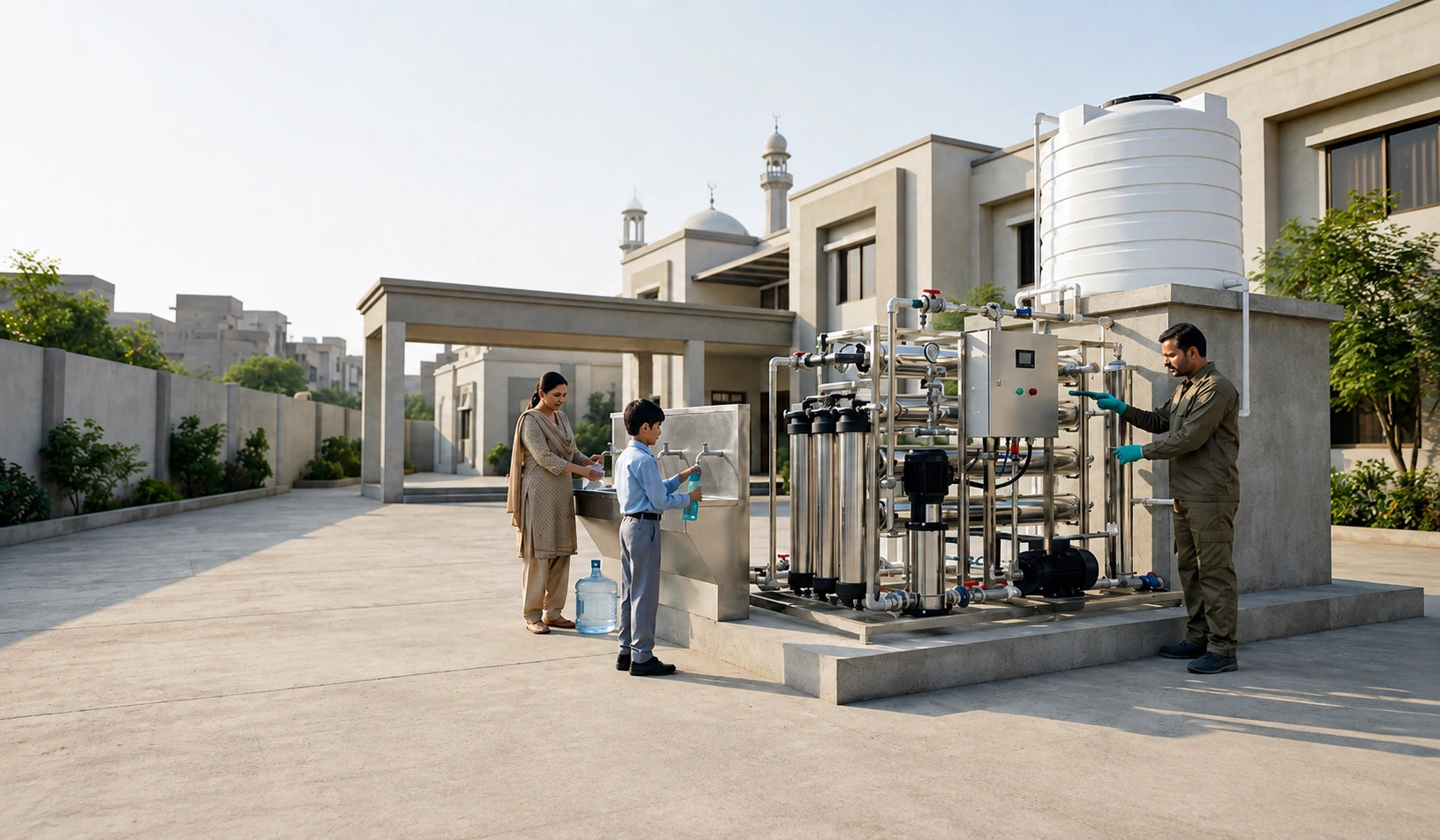
Across Pakistan, schools and masjids are increasingly serving as shared sources of clean water for entire neighborhoods—not only providing water to students and worshippers but also functioning as reliable community water points. A properly planned Community RO Plant installed at one of these locations can provide clean water to hundreds of people every day. However, securing funding, arranging the installation, and ensuring proper ongoing maintenance requires a different planning approach compared with a typical residential or commercial installation.
This guide covers how community RO projects for schools and masjids are typically funded, what the setup process actually involves, and — critically — how to plan for maintenance so the system keeps serving the community for years rather than falling into disrepair after the first year.
Why Schools and Masjids Make Sense as Community Water Points
Schools and masjids share a few practical advantages that make them natural sites for community RO installations:
- Existing infrastructure — most schools and masjids already have some level of electrical connection, physical space, and basic plumbing, reducing setup complexity compared to a standalone community facility.
- Consistent foot traffic and trust — both are trusted, regularly visited community institutions, meaning a water point located there naturally reaches a broad cross-section of the surrounding population.
- Built-in stewardship — school administration or masjid committees can take on an ongoing oversight role, providing a natural point of accountability for system upkeep that a purely public installation might lack.
- Dual benefit — a masjid RO plant serves the institution’s own daily water needs (wudu, drinking water for worshippers) while also serving the broader community; the same applies to schools providing safe drinking water for students while extending access to nearby residents.
Typical Funding Sources for Community RO Projects
Unlike a commercial or residential RO plant, community installations are rarely funded by a single paying customer. Common funding approaches include:
- Community fundraising (chanda/donation drives) — a well-established model in Pakistan, particularly for masjid-based projects, where local community members contribute directly toward the plant’s cost.
- Philanthropic and CSR contributions — businesses and individual donors, sometimes specifically targeting water access as a charitable cause, may fund part or all of a community installation, particularly through Corporate Social Responsibility programs.
- NGO and development organization partnerships — various organizations working on water access and public health in Pakistan support community water infrastructure projects, sometimes providing full funding or partial subsidy alongside technical support.
- School or masjid institutional budget — where the installing institution has its own funds allocated for facility improvements, sometimes combined with community contributions to cover the full project cost.
- Hybrid funding models — many successful projects combine several of these sources rather than relying on a single funding stream, which also spreads project risk if one funding source falls through.
Whichever funding path is used, having a clear, itemized cost estimate before fundraising begins — covering equipment, installation, and at least the first year of maintenance — helps avoid underfunded projects that can’t sustain themselves once installed.
What the Setup Process Actually Involves
Setting up a community RO plant at a school or masjid generally follows these stages:
- Water source and quality assessment — testing the specific site’s water source (municipal connection, borewell, or other) to determine the treatment configuration actually needed, rather than assuming a generic system will work.
- Capacity planning based on expected daily users — a system serving a small neighborhood masjid has very different capacity needs than one serving a large school or a masjid in a densely populated area.
- Site preparation — confirming adequate space, electrical capacity, and plumbing access, and addressing any gaps before equipment installation.
- Installation and commissioning — professional installation, system testing, and initial calibration before the plant is opened for community use.
- Community communication — informing the surrounding community about access hours, any usage guidelines, and how to report issues, so the facility is used appropriately and problems get reported quickly.
For guidance on evaluating equipment suppliers for a project like this, our guide on trusted domestic RO plant companies in Pakistan covers what to look for, much of which applies equally to institutional and community-scale procurement.
Maintenance: The Part Most Community Projects Underestimate
This is where many community RO projects genuinely struggle after the initial installation excitement fades. A system that isn’t properly maintained doesn’t just underperform — it can fail outright, sometimes within the first year, leaving the community without the access the project was meant to provide.
Key maintenance planning considerations:
- A designated maintenance budget, not just an installation budget — funding the initial equipment without planning for filter replacement, membrane maintenance, and periodic servicing sets the project up for early failure.
- A clearly assigned responsible party — whether that’s school facilities staff, a masjid committee member, or a paid local technician, someone needs clear ownership of routine checks and issue reporting, rather than assuming “someone” will notice if something goes wrong.
- A service agreement with the equipment supplier, where feasible — many suppliers offer maintenance contracts that provide scheduled servicing and faster response to breakdowns, which is particularly valuable for community installations without in-house technical staff.
- Community-level accountability — some successful projects establish a small, transparent system where the community itself contributes modestly toward ongoing maintenance costs, creating shared investment in the system’s upkeep rather than treating it as a one-time gift with no ongoing responsibility.
Water Quality Considerations Specific to Shared Community Use
Community-scale installations serving many daily users have some specific considerations beyond a typical single-household system:
- Higher daily throughput means more frequent filter and membrane monitoring compared to a residential system serving one household.
- Source water testing matters even more given the number of people relying on the same system daily — our guide on arsenic and lead in Pakistani groundwater and how commercial RO systems address it is directly relevant for community installations drawing on groundwater sources in regions with known contamination concerns.
- Regular water quality verification, not just equipment maintenance, ensures the treated water continues meeting safe drinking standards over time, rather than assuming initial commissioning results remain valid indefinitely.
Conclusion
A community RO plant at a school or masjid in Pakistan can extend clean water access well beyond the institution itself, serving entire neighborhoods where reliable, safe drinking water might otherwise be scarce. The projects that succeed long-term are the ones that plan for maintenance and ongoing accountability from the very beginning, not just the initial installation and funding drive. Water Care Services Pakistan (WCSP) has supported water treatment system design across Pakistan since 2007, including community and institutional-scale projects, and can help schools, masjid committees, and community organizers plan a system sized and maintained correctly for long-term reliability.
Frequently Asked Questions
Costs vary significantly based on capacity needed (expected daily users), local water quality, and site conditions, generally scaling similarly to a mid-size commercial installation rather than a small residential system. Getting a proper site assessment and quote based on expected usage gives a far more accurate figure than a generic estimate.
This should be clearly assigned before installation, typically to school facilities staff, a masjid committee member, or a contracted local technician, rather than left informally undefined. Projects that skip this step are significantly more likely to experience system failure within the first year due to neglected maintenance.
Yes, many NGOs and development organizations support water access projects in Pakistan, sometimes providing full or partial funding alongside technical guidance. Reaching out to organizations with an established focus on water access or public health in your specific region is a reasonable starting point for exploring this funding path.
Community systems generally require more frequent monitoring and filter/membrane servicing than a residential system, since daily usage volume is significantly higher with many users drawing from the same plant. A proper maintenance schedule based on actual usage volume, not just a generic residential timeline, should be established from the outset.
This is exactly why a dedicated maintenance budget — separate from the initial installation funding — matters so much during project planning. Some communities address this through ongoing small contributions from users, a service agreement with the equipment supplier, or a standing arrangement with the funding NGO or institution for continued support beyond initial installation.