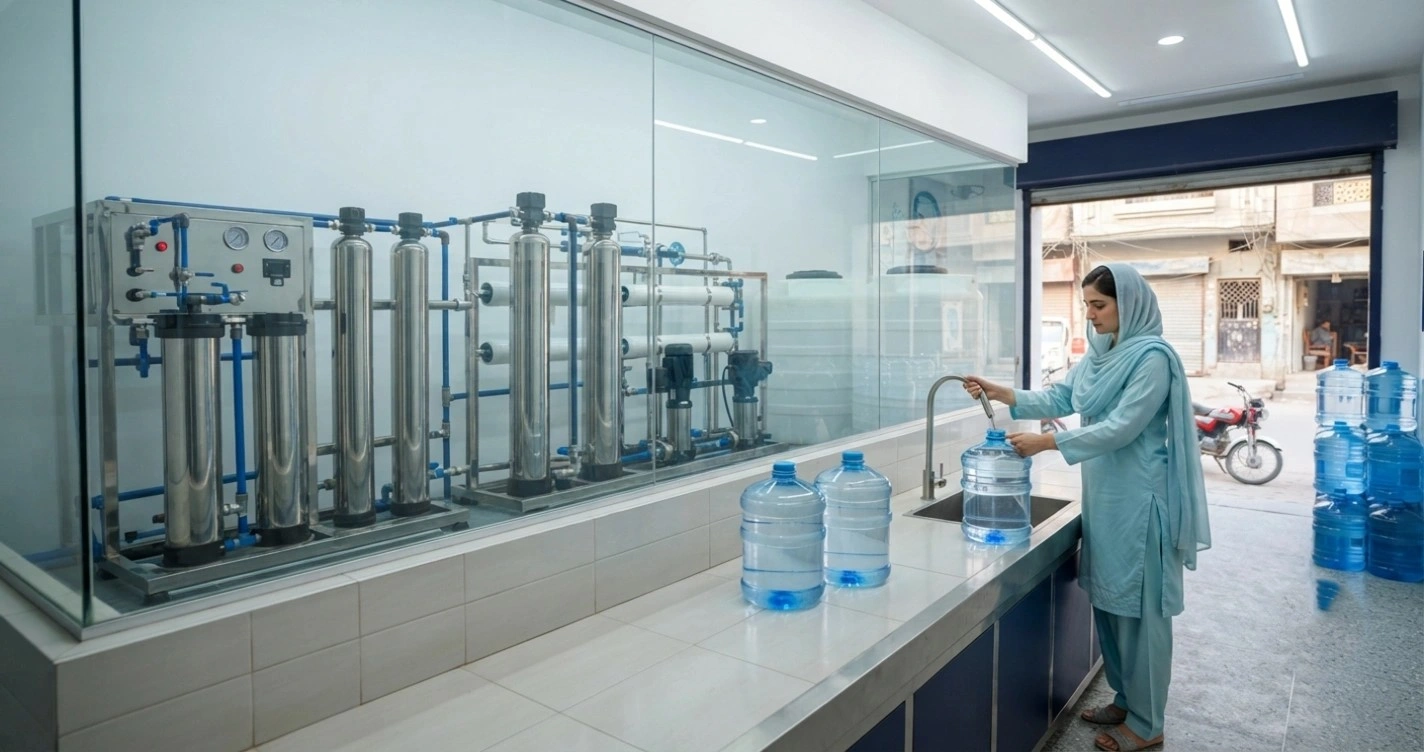
Walk through almost any residential or commercial area in Lahore, Karachi, or Faisalabad, and you’re likely to find at least one water shop selling purified drinking water by the gallon. It is one of the most common small-business ideas people consider when exploring a Water Shop Business in Pakistan—and for good reason. The demand for clean drinking water continues to grow, while the initial investment is relatively lower than that of most other manufacturing-based businesses.
But “low cost” doesn’t mean you can skip proper planning. Before investing in equipment, this guide explains the actual cost of setting up a water shop, the licenses you may need, how RO water shop investment cost varies by business scale, and what realistic profit margins you can expect—helping you determine whether this business suits your budget and local market.
What Is a Water Shop Business, Exactly?
A water shop is a small commercial setup that purifies raw water — usually through Reverse Osmosis (RO) — and sells it directly to walk-in customers, either in bottles, cans, or refillable containers. It’s different from a full bottled water manufacturing plant in scale: a water shop typically serves a local neighborhood or a handful of nearby streets, rather than distributing packaged water across a city or province.
Most water shops in Pakistan operate on one of two models:
- Retail counter model — customers walk in with their own containers and pay per gallon or per liter, refilled on the spot.
- Delivery model — the shop fills bottles or cans in advance and delivers them to homes, offices, or shops within a set radius.
Many successful setups run both models together, using the retail counter to cover daily operating costs and delivery subscriptions to build predictable recurring revenue.
RO Water Shop Investment Cost: What You’re Actually Paying For
The core investment in a water shop breaks down into four categories. Actual figures vary by city, plot size, and the capacity you choose, but understanding what each category covers helps you compare quotes from different suppliers on equal footing.
| Cost Category | What It Covers |
|---|---|
| RO plant equipment | Pre-filtration, RO membranes, pump, storage tank, dispensing unit |
| Shop setup | Rented or owned space, counter, signage, basic fittings |
| Utility connections | Electricity load upgrade, water source (municipal line or borewell), plumbing |
| Working capital | Bottles/cans, initial inventory, staff wages for the first few months |
Of these, the RO plant equipment itself is usually the single largest line item, and it scales with the daily output capacity you choose — a shop serving 200 households a day needs a larger system than one serving 30. Working with a trusted domestic RO plant company at this stage helps you size the system correctly instead of guessing.
Small vs Mid-Size Water Shop Setup
| Factor | Small Setup | Mid-Size Setup |
|---|---|---|
| Typical capacity | 500–1,000 GPD | 2,000–5,000 GPD |
| Best suited for | A single street or small residential block | A larger neighborhood or mixed residential-commercial area |
| Relative investment | Lower — a few lakh rupees | Moderate to higher — mid to upper lakh range |
| Staffing needs | Often owner-operated or one helper | Typically needs 2-3 staff for counter and delivery |
A shop owner in a mid-sized city like Faisalabad, for example, serving a residential block of around 300 households, would generally look at a mid-size setup rather than the smallest capacity option — undersizing the plant early on is one of the most common mistakes new water shop owners make, since it forces an early and costly upgrade once demand outpaces supply.
Licensing and Regulatory Requirements
Before opening, a few regulatory steps are worth budgeting time and money for:
- Business registration — registering as a sole proprietorship or partnership with the relevant local authority.
- Water quality testing and certification — your source water and finished product should be tested by an accredited lab, and in many cities a health or municipal certificate is expected before you can legally sell drinking water.
- Local trade license — issued by your city’s municipal corporation or cantonment board, depending on where the shop is located.
- Environmental compliance — while a small retail water shop isn’t typically subject to the same discharge regulations as an industrial effluent treatment plant, proper disposal of reject water (the concentrated waste stream from RO filtration) should still be planned responsibly rather than dumped untreated into drains or open ground.
Skipping the water testing and certification step is one of the fastest ways to lose customer trust — and in some cities, to face closure — so treat it as a first step, not a formality to handle later.
Profit Expectations: What’s Realistic?
Profitability in a water shop business depends heavily on volume, pricing, and how well you control operating costs — especially electricity and membrane replacement, which are the two biggest recurring expenses.
Rough profit drivers to model before you commit:
- Price per gallon/liter in your local market (this varies significantly between cities and even neighborhoods)
- Daily volume sold, which ramps up gradually as the shop builds a customer base — few shops hit full capacity in month one
- Electricity cost, since RO pumps run for extended hours daily
- Membrane and filter replacement, a recurring cost every several months depending on raw water quality and usage
- Bottle/can costs if you’re selling packaged rather than refill-only
A shop that reaches steady, consistent daily volume within its first six to twelve months is generally considered a healthy trajectory. Shops that rely purely on foot traffic without building any delivery subscriptions tend to see more volatile, seasonal demand — which makes cash flow harder to predict.
Choosing the Right Equipment Supplier
Since RO water shop investment cost is front-loaded, choosing the right equipment partner matters more than chasing the lowest quote. A few things worth checking before you commit:
- Does the supplier provide a water test-based system design, or a one-size-fits-all package regardless of your local water quality?
- What does the warranty actually cover — membranes, pumps, or just the tank and housing?
- Is after-sales maintenance support available locally, or will you be waiting days for a technician if something breaks down?
- Can they provide references from other water shop owners currently running similar-capacity systems?
A supplier that under-quotes on equipment but leaves you without local service support often costs more in downtime and lost sales than a slightly higher initial investment with a proper maintenance plan attached. If you’re also considering a self-service format, automatic water ATM dispensers are worth evaluating as an alternative or add-on business model.
Common Mistakes First-Time Water Shop Owners Make
- Undersizing the plant to save on upfront cost, then hitting capacity limits within the first year of growth.
- Skipping proper water testing before choosing a treatment configuration, leading to inconsistent output quality.
- Underestimating electricity costs, especially in areas with inconsistent power supply requiring backup generators.
- No maintenance plan, resulting in unplanned downtime that damages customer trust in a business built entirely on reliability. Reviewing predictive maintenance strategies for RO plants before you open can help you avoid the most common and costly breakdowns.
Conclusion
A water shop business in Pakistan can be a genuinely viable investment, but the RO water shop investment cost only makes sense when it’s matched to realistic local demand, proper licensing, and a maintenance plan from day one — not just the lowest equipment quote you can find. Getting the capacity, water testing, and supplier support right at the start avoids the costly mid-year upgrades that catch many first-time owners off guard. Water Care Services Pakistan (WCSP) has been designing water treatment systems for commercial and industrial clients across Pakistan since 2007, and can help new water shop owners size a system correctly from the outset.