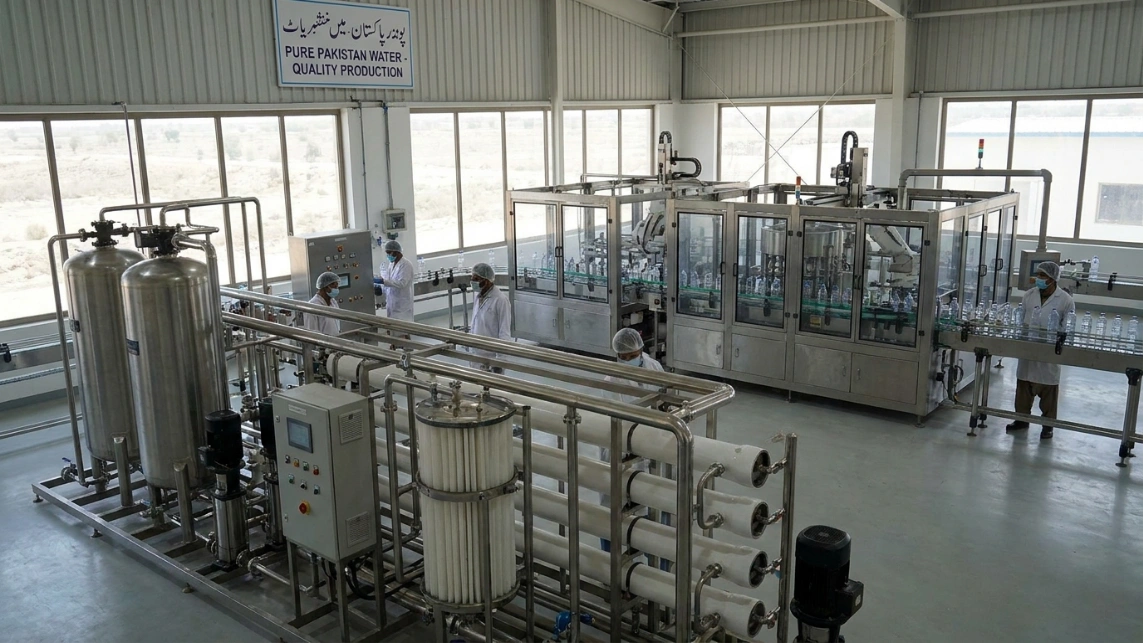
Setting up a bottled water plant in Pakistan requires a PSQCA license, compliance with PS 4047-1 quality standards, and a multi-stage water treatment system including reverse osmosis, UV disinfection, and ozone. Capital investment starts from PKR 8–12 million for a small plant. With Pakistan’s bottled water market growing at over 12% annually, well-positioned operations typically recover investment within 2–4 years.
Pakistan’s bottled water market is one of the fastest-growing consumer sectors in the country — and most of the demand is still unmet.
According to the Pakistan Council of Research in Water Resources, over 80% of Pakistan’s drinking water supply does not meet WHO standards for human consumption. That gap between safe water supply and population demand is not a crisis statement — it is a market opportunity. Pakistan’s bottled water industry was valued at approximately USD 800 million in 2023, according to Euromonitor International, and is forecast to grow at a compound annual rate exceeding 12% through 2028.
Entrepreneurs, existing beverage operators, and industrial groups are entering this space — but most stumble on the same two obstacles: not knowing the regulatory requirements before they invest, and miscalculating the true cost of treatment equipment required to meet PSQCA standards.
This guide covers bottled water plant setup Pakistan entrepreneurs and investors actually need: the licensing pathway, the correct treatment technology stack, realistic capital costs, operating economics, and what separates profitable operations from those that stall at the compliance stage.
What Licenses Do You Need to Start a Bottled Water Plant in Pakistan?
The licensing process for a bottled water plant in Pakistan involves multiple regulatory bodies, and you need to understand the sequencing — applying to the wrong body first wastes months.
The primary regulatory framework is Pakistan Standard PS 4047-1: Packaged Drinking Water, enforced by the Pakistan Standards and Quality Control Authority. A PSQCA bottled water license is the central legal requirement without which you cannot label, sell, or distribute packaged water commercially. PSQCA evaluates your production facility, water source, treatment process, and laboratory testing capability before issuing a license.
The second regulatory layer is your provincial Environmental Protection Agency. Under Pakistan’s Environmental Protection Act 1997 and NEQS, any water processing facility above a threshold scale requires a No Objection Certificate confirming your operation’s environmental impact is within permissible limits.
The PSQCA Licensing Sequence
Step one is registering your business and securing a water source — either a bore well, municipal supply connection, or a recognized natural source. Your source water must be tested by an accredited laboratory against PS 4047-1 parameters before PSQCA will consider your application.
Step two is designing and constructing your treatment plant to meet the standard. PSQCA inspectors visit your facility to verify that your treatment train — source water intake, sediment filtration, activated carbon filtration, reverse osmosis, remineralization if applicable, UV disinfection, ozone treatment, and filling — matches the approved design.
Step three is product testing. Samples from your production line go to PSQCA’s laboratory for microbiological, physical, and chemical analysis. Passing this test triggers license issuance.
The full process takes 3–6 months from formal application submission to license receipt, assuming your facility passes first inspection. WCSP’s bottled water plant design and commissioning service includes full documentation support for PSQCA applications — a service that consistently shortens the compliance timeline for clients in Lahore, Karachi, and Faisalabad.
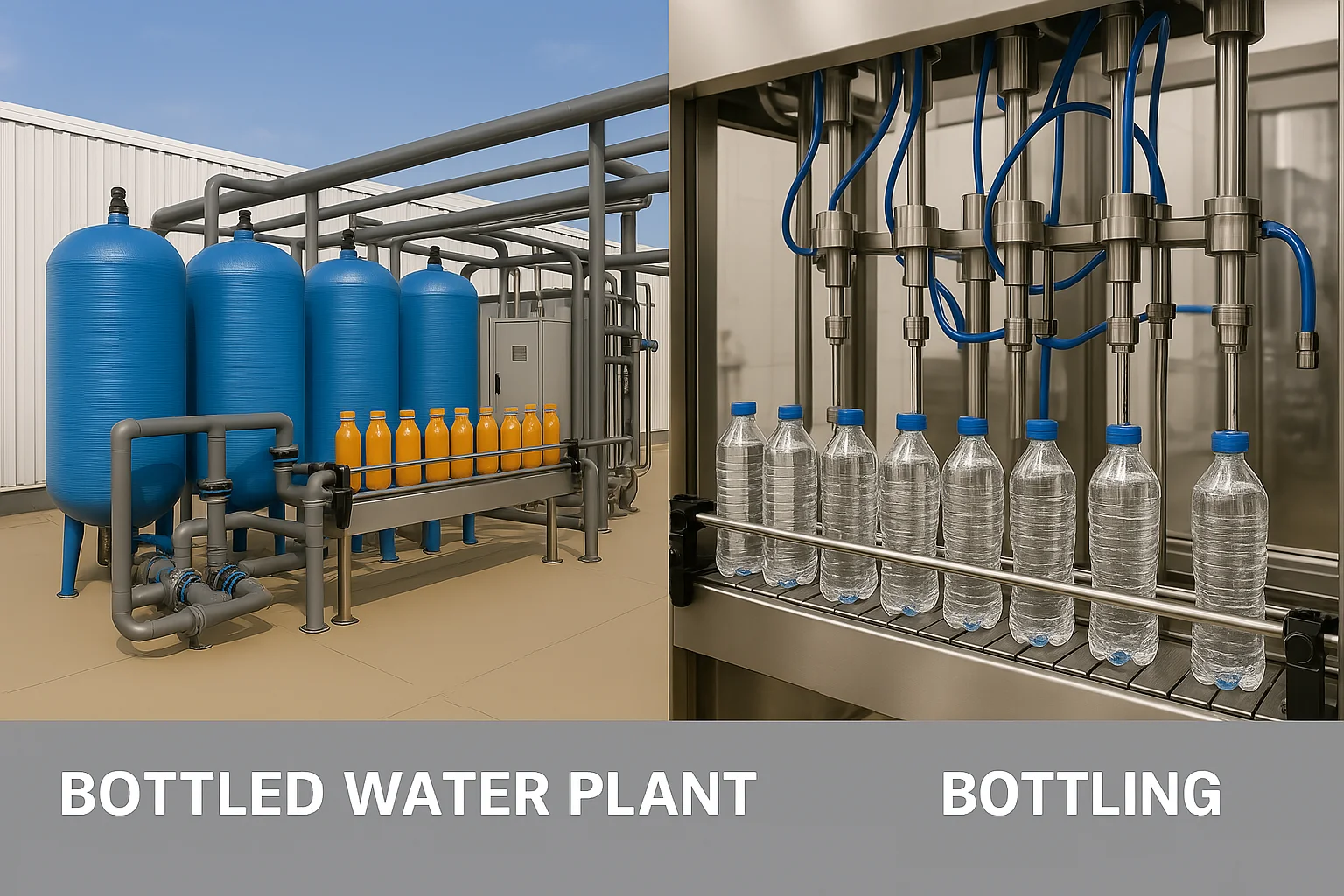
Bottled Water Plant
What Treatment Technology Does a PSQCA-Compliant Bottled Water Plant Require?
PS 4047-1 does not mandate specific equipment — it mandates output quality. But in practice, only one treatment technology stack reliably achieves compliant product water from the range of source water conditions found across Pakistan.
The standard treatment train for a PSQCA-compliant bottled water plant in Pakistan runs in this sequence:
Raw water storage — Sediment pre-filtration (multi-media or sand filtration) — Activated carbon filtration for chlorine, taste, and odor removal — Antiscalant dosing — High-pressure pump — Reverse osmosis membranes — Post-RO remineralization (if producing mineral water) — UV disinfection at 254nm wavelength, minimum 40 mJ/cm2 dose — Ozone contact tank for residual disinfection — Storage in food-grade tanks — Automated filling, capping, and labeling line.
Why Reverse Osmosis Is the Non-Negotiable Core
RO removes dissolved solids, heavy metals, nitrates, fluoride, and microbiological contaminants to levels reliably below PS 4047-1 limits regardless of source water quality. Pakistan’s groundwater in industrial cities — Lahore, Gujranwala, Faisalabad, and Sialkot — frequently contains elevated TDS, iron, manganese, and coliform bacteria from agricultural runoff and industrial contamination. Without RO, achieving consistent product quality from these sources is not reliably possible.
WCSP’s RO systems for bottled water applications are engineered with recovery rates of 65–75%, automatic membrane cleaning (CIP) cycles, and real-time TDS monitoring at the permeate outlet. This is not a specification to compromise on. The cost difference between an under-specified RO unit and a correctly engineered system is modest at capital stage — the consequences of membrane underperformance at full production are not.
The Role of Ozone in Finished Water Quality
Ozone is the industry standard final treatment step for bottled water for one reason: it provides residual disinfection during filling without leaving chemical taste. At 0.1–0.4 mg/L dissolved ozone in the finished water, pathogenic microorganisms cannot survive long enough to create a product quality failure even if filling-line contamination occurs. WCSP’s ozone generators are sized specifically for bottled water applications — integrated with the storage tank before the filling line, with automatic dosing control and residual monitoring.
How Much Does a Bottled Water Plant Setup in Pakistan Cost?
The capital cost of a bottled water plant setup in Pakistan varies significantly by production capacity, level of automation, and whether you are producing still water, sparkling water, or labeled mineral water requiring remineralization. The figures below reflect WCSP’s current project costs in the Pakistan market as of 2026.
| Plant Scale | Capacity (litres/day) | Treatment Equipment | Filling Line | Total Capital Estimate |
|---|---|---|---|---|
| Micro-scale | 5,000 – 10,000 | PKR 2.5 – 4M | PKR 1.5 – 2.5M | PKR 4 – 6.5M |
| Small-scale | 10,000 – 30,000 | PKR 4 – 7M | PKR 3 – 5M | PKR 7 – 12M |
| Medium-scale | 30,000 – 80,000 | PKR 8 – 14M | PKR 6 – 10M | PKR 14 – 24M |
| Large-scale | 80,000 – 200,000+ | PKR 16 – 30M | PKR 12 – 20M | PKR 28 – 50M+ |
Note: Costs exclude civil works, utilities connection, land, and PSQCA licensing fees. Treatment equipment costs include RO system, pre-filtration, UV, ozone, and storage. Filling line costs include semi or fully-automatic bottle washing, filling, capping, and labeling.
The most common budgeting error WCSP encounters with first-time bottled water investors is planning civil works and filling lines first, then discovering the treatment equipment budget is insufficient for the required production volume. Treatment is the core of your product quality and your license — it should be the first budget line, not the last.
Pro Tip: The Water Source Decision That Determines Your Entire Business Model
In 17 years of designing bottled water plants across Pakistan, WCSP has seen one decision cause more investor regret than any other: choosing a water source based on availability rather than chemistry. A bore well in Lahore’s industrial periphery may be cheap to access but carries iron, manganese, and agricultural nitrate loads that require significantly more pre-treatment than groundwater from a cleaner aquifer in Murree or Abbottabad. The difference in treatment cost between a low-TDS source water at 300 mg/L and a high-TDS source at 1,200 mg/L can be PKR 2–4 million in additional capital and 15–25% higher operating cost over the plant’s life. Commission a full source water analysis before you sign a lease on a production facility. This single step costs PKR 30,000–60,000 and can save you millions.
What Is the ROI on a Water Bottling Business in Pakistan?
Pakistan’s mineral water plant Pakistan investors are drawn to for one fundamental reason: the margin structure is strong and the market is demonstrably underserved.
The retail selling price of 1.5-litre PET-bottled water from an established brand ranges from PKR 60–120 in urban Pakistan. FMCG distribution margins typically take 20–30% of shelf price, leaving PKR 42–96 per 1.5-litre bottle at the factory gate. Production cost for treated, bottled, and labeled water at a medium-scale plant — including energy, consumables, packaging, labor, and amortized capital — runs approximately PKR 18–28 per 1.5-litre unit at efficient operations.
Revenue and Payback Period Projections
A medium-scale plant producing 50,000 litres per day, running 25 days per month, generates 1.25 million litres monthly. Converting that to 1.5-litre bottles: approximately 833,000 units. At a conservative factory gate price of PKR 45 per unit and production cost of PKR 25 per unit, gross margin per month is approximately PKR 16.6 million. Against a total capital investment of PKR 18–24 million for equipment, the payback period falls within 14–18 months at this scale.
Smaller operations serving local commercial customers — hotels, offices, restaurants in Lahore or Karachi — without entering formal FMCG distribution can operate profitably at 10,000–15,000 litres per day with payback periods of 24–36 months.
According to the All Pakistan Bottled Water Manufacturers Association, the formal bottled water sector in Pakistan grew by approximately 14.5% in volume terms in 2023. Entry-level and mid-tier brands are capturing the majority of this growth, not the established names — which signals that new market entrants with quality product and consistent supply can compete effectively.
What Are the Ongoing Operating Costs for a Bottled Water Plant in Pakistan?
Capital cost is a one-time conversation. Operating cost is the number that determines whether your water bottling business Pakistan generates profit or erodes it month by month.
The primary ongoing cost categories for a bottled water plant are:
Energy — RO systems are the largest energy consumer, typically drawing 0.4–0.7 kWh per cubic metre of permeate produced. For a 50,000 litre/day plant, monthly electricity cost at current industrial tariffs runs PKR 150,000–250,000. Energy management optimization — variable frequency drives on high-pressure pumps, automated production scheduling to off-peak hours — can cut this by 15–25%.
Consumables — RO membranes require replacement every 3–5 years at PKR 15,000–25,000 per membrane element depending on specification. Activated carbon media requires annual replacement. Antiscalant chemical dosing runs approximately PKR 0.5–1.0 per cubic metre of RO feed water. UV lamp replacement is required annually.
Packaging — PET bottle cost ranges from PKR 8–14 per 1.5-litre unit at current market prices in Pakistan depending on order volume. Caps at PKR 0.8–1.5 each. Labels at PKR 0.5–1.5 each. Carton packaging at PKR 3–6 per carton of 12 units.
Quality Control and Compliance — Monthly product testing at an accredited laboratory is mandatory for PSQCA license maintenance. Budget PKR 25,000–50,000 per month for testing, documentation, and compliance management at a small to medium-scale operation.
WCSP’s real-time monitoring and automation systems allow bottled water plant operators to track energy consumption, RO recovery rates, and water quality parameters from a central dashboard — reducing both operating cost and the labor burden of manual quality checks.
How Do You Scale a Bottled Water Business Beyond a Single Plant?
The water bottling business Pakistan operators who achieve significant scale typically do so through one of three models: regional multi-plant deployment, vertical integration into Water ATM dispensers and Water Shops, or private-label supply to FMCG distributors under established brand licensing arrangements.
Water ATM dispensers — standalone purified water vending units deployed in urban residential areas, petrol stations, and commercial hubs — represent the fastest-growing distribution channel for treated water in Pakistan. According to the International Finance Corporation’s Pakistan Water Sector report, the Water ATM model captures significantly higher margins per litre than conventional bottled water by eliminating packaging cost entirely. WCSP designs and deploys Water ATM systems and Water Shop operations as standalone businesses or as extensions of existing bottled water plant operations.
For operators who want to avoid the capital-intensive FMCG distribution route — sales teams, cold-chain logistics, retailer credit terms — the Water ATM model offers a compelling alternative. A cluster of 20–30 Water ATM units deployed across a single city neighborhood, operated by a single plant, can generate consistent monthly revenue at operating margins exceeding 45%.
The franchise model is also emerging in Pakistan. Several mid-tier bottled water brands are now offering franchise arrangements — supply the treated water, use the brand license, benefit from marketing support. This model lowers the barrier to entry for entrepreneurs who want market presence without building brand recognition from scratch.
CONCLUSION
Pakistan’s bottled water sector is not a saturated market chasing marginal growth — it is a fundamentally under-supplied sector with 220 million consumers, the majority of whom currently have no reliable access to safe packaged drinking water at affordable prices.
Four things every bottled water plant setup Pakistan investor should carry forward from this guide. First, the PSQCA bottled water license is the non-negotiable starting point — design your plant to pass inspection on the first visit by engaging experienced plant designers, not equipment vendors. Second, treatment technology selection must be led by source water chemistry — commission a full analysis before committing to equipment. Third, the ROI case is strong at every scale from micro to large, but only when treatment equipment is correctly specified and operating costs are modeled accurately. Fourth, the Water ATM and Water Shop model offers a high-margin path to scale that complements or partially replaces conventional bottled water distribution.
WCSP has designed, built, and commissioned bottled water plants, Water ATM systems, and Water Shop operations across Pakistan since 2007 — from micro-scale 5,000 litre/day facilities to large automated production lines.
FAQ SECTION
1: How much does a bottled water plant setup in Pakistan cost in 2026?
Bottled water plant setup Pakistan costs range from PKR 4–6.5 million for a micro-scale plant producing 5,000–10,000 litres per day, up to PKR 28–50 million for a large-scale automated operation producing 80,000–200,000 litres per day. These figures cover treatment equipment and filling lines. Civil works, land, utilities, and licensing fees are additional costs that vary significantly by location.
2. What is the PSQCA license requirement for a bottled water plant in Pakistan?
A PSQCA bottled water license is required for any commercial packaged drinking water operation in Pakistan. The licensing process involves facility inspection, product testing against Pakistan Standard PS 4047-1, and verification of your treatment system design. The process takes 3–6 months from formal application to license issuance, assuming your facility passes the first inspection. Annual renewal is required with ongoing product testing.
3. What treatment equipment does a bottled water plant in Pakistan need?
A PSQCA-compliant bottled water plant requires multi-stage treatment: sediment pre-filtration, activated carbon filtration, reverse osmosis membranes, UV disinfection at minimum 40 mJ/cm2 dose, and ozone contact treatment for residual disinfection. This sequence reliably achieves PS 4047-1 quality parameters from the full range of source water conditions — groundwater, municipal supply, or borehole — found across Pakistan.
4. What is the ROI on a mineral water plant in Pakistan?
A medium-scale mineral water plant Pakistan operation producing 50,000 litres per day can generate gross margins of PKR 14–18 million per month at conservative factory gate pricing, against a total equipment investment of PKR 18–24 million. This implies a payback period of 14–18 months. Smaller operations serving local commercial customers typically achieve payback within 24–36 months depending on distribution channel and pricing strategy.
5. How long does it take to set up and commission a bottled water plant in Pakistan?
Total timeline from project inception to commercial production is typically 6–10 months. This covers source water testing (1 month), PSQCA application preparation (1–2 months), plant construction and equipment installation (2–4 months), PSQCA facility inspection and product testing (1–2 months), and final license issuance. Engaging an experienced plant designer who understands PSQCA documentation requirements significantly reduces the risk of delays from failed inspections.
6. Can a bottled water plant in Pakistan also supply Water ATM dispensers?
Yes, and many operators do exactly this. A single RO-based treatment plant can supply both bottled water production and a network of Water ATM dispensers, using the same treated water output for both distribution channels. Water ATMs eliminate packaging cost entirely and deliver significantly higher margins per litre than bottled water. WCSP designs integrated systems that supply both channels from a single water treatment infrastructure, maximizing return on the core plant investment.