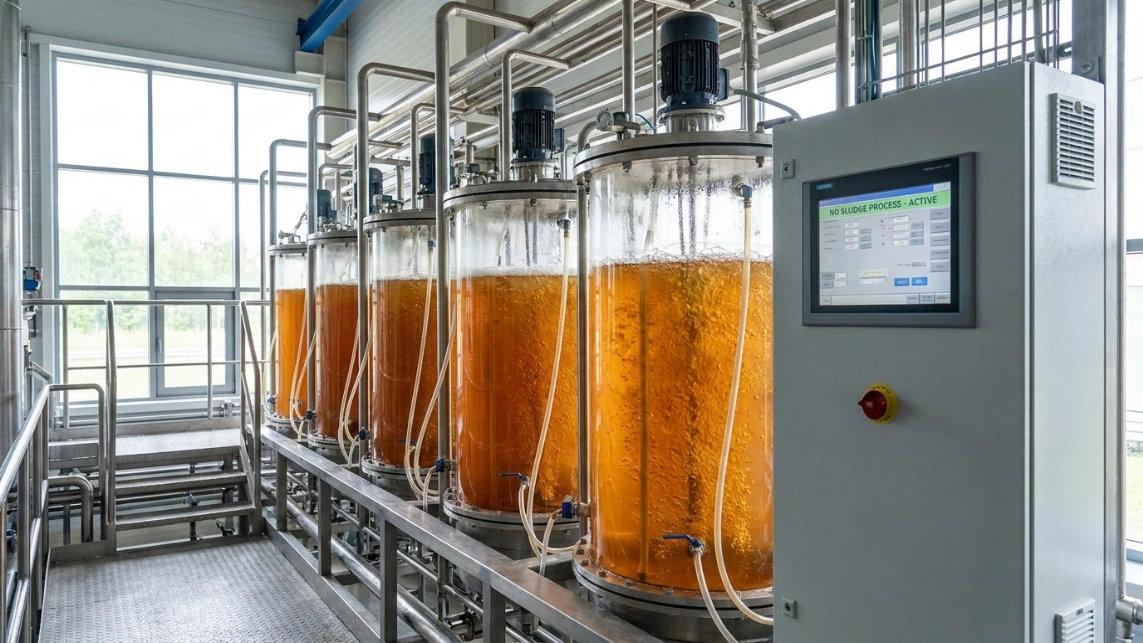
Sludge free bioremediation is a biological wastewater treatment approach that uses specially engineered microbial cultures to fully mineralize organic pollutants into carbon dioxide, water, and inert gases — eliminating the sludge byproduct entirely. No dewatering. No disposal. No landfill cost. It is already operating in industrial facilities across Pakistan and delivering measurable cost savings.
Every conventional wastewater treatment plant produces sludge. And sludge costs money — every single day.
Dewatering equipment. Filter press maintenance. Transportation. Landfill tipping fees. Hazardous waste disposal for industrial sludge with heavy metal content. According to the Water Environment Federation, sludge management accounts for 50–60% of the total operating cost of a conventional biological treatment plant. For a mid-scale textile processing facility in Faisalabad running a 500 m³/day activated sludge system, that translates to PKR 3–6 million per year spent purely on getting rid of the byproduct of your treatment process.
There is a better option. Sludge free bioremediation uses advanced microbial culture wastewater systems to break down organic matter completely — leaving no settleable solids, no filter cake, no disposal burden. This article explains exactly how the process works, which industries it suits best, how it compares to conventional biological treatment, and what you need to know before adopting it for your facility.
Why Conventional Biological Treatment Creates a Sludge Problem You Cannot Ignore
Conventional activated sludge and MBBR systems are effective at reducing BOD and COD to NEQS-compliant levels. But they work by growing large populations of heterotrophic bacteria that consume organic matter — and then those bacteria, along with the organic solids they partially digest, settle out as sludge. The treatment works. The byproduct is the problem.
Industrial sludge in Pakistan is categorized under the Hazardous Substances Rules 2003 when it contains heavy metals, toxic organics, or pathogenic loading above threshold levels. Textile dyeing sludge, pharmaceutical sludge, and tannery sludge all typically meet hazardous classification criteria. That classification triggers specific disposal obligations — transport manifests, licensed disposal facilities, chain-of-custody documentation — all of which add cost and compliance risk simultaneously.
The Hidden Cost Calculation Most Plant Managers Miss
Most procurement decisions evaluate treatment technology on capital cost and energy consumption. What rarely appears in the spreadsheet is the total cost of sludge over a 10-year plant operating life. Consider: a 500 m³/day activated sludge plant in Gujranwala’s industrial zone generating 800–1,200 kg of dry sludge per day at PKR 15–25 per kg disposal cost runs a sludge bill of PKR 4.4–10.9 million annually. Over 10 years, that is PKR 44–109 million spent on sludge disposal alone — before factoring in filter press maintenance, polymer costs, and labor.
This is the financial context that makes no sludge wastewater treatment not just an environmental preference but a compelling operational economics argument.
What Is Sludge Free Bioremediation and How Does It Actually Work?
Sludge free bioremediation achieves complete organic mineralization by deploying highly specialized, multi-strain microbial consortia that metabolize organic compounds through pathways that produce only gaseous end-products — primarily CO2 and water vapor — rather than cellular biomass. The result is biological treatment without sludge accumulation.
Conventional heterotrophic bacteria convert roughly 50% of consumed organic carbon into new cellular mass — which becomes sludge. The microbial strains used in sludge-free systems are selected and conditioned to operate at very low yield coefficients, meaning the ratio of new cell mass produced per unit of organic matter consumed is near zero. Combined with endogenous respiration enhancement — where bacteria consume their own cellular material during low-substrate periods — net sludge production approaches zero over a complete operating cycle.
The Role of Microbial Culture Selection in No-Sludge Performance
The microbial culture wastewater consortium is the core intellectual property of any sludge-free bioremediation system. Effective consortia typically include aerobic heterotrophs, facultative anaerobes, and specialized degraders targeting recalcitrant compounds specific to the wastewater profile — reactive dye molecules in textile effluent, pharmaceutical intermediates in pharma wastewater, fat, oil, and grease fractions in food and beverage discharge.
These cultures are not generic inoculants. Effective sludge-free systems require culture adaptation to the specific wastewater chemistry of each facility — a process that takes 4–8 weeks of acclimation under controlled conditions before the system achieves stable performance. WCSP’s biological treatment without sludge deployments begin with detailed wastewater characterization followed by culture selection and conditioning specific to the client’s discharge profile. This is why off-the-shelf biological products marketed as sludge-free solutions frequently underperform — the microbiology must match the chemistry.
How Does No-Sludge Bioremediation Compare to Conventional Treatment?
| Comparison Factor | Conventional Activated Sludge | MBBR | No-Sludge Bioremediation |
|---|---|---|---|
| Sludge Production | High (0.3–0.5 kg DS/kg BOD removed) | Moderate (0.1–0.2 kg DS/kg BOD) | Near zero |
| Sludge Disposal Cost | High — PKR 4–10M/year for mid-scale plant | Moderate | Eliminated |
| BOD Removal | 85–95% | 85–95% | 85–95% |
| COD Removal | 70–90% | 70–90% | 70–90% |
| NEQS Compliance | Achievable with correct design | Achievable | Achievable |
| Footprint | Large (requires sludge handling area) | Medium | Small (no sludge handling) |
| Capital Cost | Medium | Medium | Medium-High |
| Operating Cost (10-year) | High (sludge disposal dominates) | Medium | Low (no sludge costs) |
| Commissioning Time | 4–8 weeks | 4–6 weeks | 6–10 weeks (culture acclimation) |
| Best-Fit Industry | General industrial | Variable flow industrial | High-organic, continuous-operation |
Source: Water Environment Federation Technical Practice series; WCSP operational data from Pakistan deployments
This comparison makes the economics clear. No-sludge bioremediation carries a marginally higher capital cost and longer commissioning timeline. Over a 5–10 year operating horizon, total cost of ownership is lower for most high-organic-load industrial applications — particularly where sludge has hazardous classification.
Wastewater Treatment System
Expert Insight: Why Most No-Sludge Trials Fail — and How to Avoid It
In 17 years of biological treatment work across Pakistan, WCSP has encountered numerous facilities that trialled no-sludge microbial products and declared them ineffective. In almost every case, the failure was not the biology — it was the process conditions. No-sludge bioremediation requires stable dissolved oxygen levels between 2–4 mg/L, consistent hydraulic retention time, and controlled organic loading rates. Shocking the system with peak loads, running it at dissolved oxygen below 1 mg/L, or dosing industrial cleaning chemicals into the inlet will crash any microbial community — conventional or sludge-free. Invest in basic process automation and real-time monitoring before switching to a no-sludge system, and your results will be dramatically better.
Which Industries in Pakistan Benefit Most from Biological Treatment Without Sludge?
Not every industry is an ideal candidate for sludge free bioremediation. The process is most effective where wastewater contains high concentrations of biodegradable organic compounds, where sludge disposal cost or hazard classification creates significant operational burden, and where continuous or near-continuous operation allows microbial cultures to maintain stable populations.
Textile Industry — Lahore, Faisalabad, and Gujranwala
Pakistan’s textile sector generates approximately 450 billion litres of wastewater annually, according to the Pakistan Textile Council. Textile dyeing effluent contains high COD loads from sizing agents, dyeing auxiliaries, and finishing chemicals — most of which are biodegradable with the right microbial consortium. The sludge from conventional textile ETP systems carries residual dye, heavy metals from fixatives, and chemical oxygen demand — qualifying it as hazardous waste under Pakistan’s Hazardous Substances Rules. Eliminating sludge production removes the disposal burden entirely while maintaining NEQS-compliant discharge.
Food and Beverage Processing — Karachi and Lahore
Food processing wastewater — dairy effluent, beverage factory discharge, slaughterhouse wastewater — is among the most amenable to sludge-free biological treatment. Organic loading is high but readily biodegradable. Fat, oil, and grease fractions respond well to lipase-producing microbial strains included in advanced consortia. WCSP’s no-sludge systems for food and beverage clients in Karachi’s industrial zones have consistently achieved BOD below 40 mg/L — well within NEQS limits — with zero sludge production verified over operational periods exceeding 18 months.
Pharmaceutical Manufacturing — Karachi and Lahore Industrial Estates
Pharmaceutical wastewater contains complex organic molecules — solvents, API intermediates, fermentation residues — that require specialized degrading cultures for effective mineralization. Pharma sludge is almost universally classified as hazardous waste, making disposal not just expensive but heavily regulated. The combination of high disposal cost and regulatory liability makes sludge-free bioremediation a compelling solution for pharma sector clients seeking to reduce both operational expenditure and compliance exposure.
How Do You Implement a No-Sludge Bioremediation System at Your Facility?
Implementation follows a structured sequence. Rushing any stage — particularly culture acclimation — is the primary cause of underperformance in no-sludge deployments.
Step 1 — Wastewater Characterization and Culture Matching Run a 30-day sampling program covering BOD, COD, TSS, nitrogen, phosphorus, and any industry-specific parameters (dye loading, pharmaceutical intermediates, fat and oil content). This data drives culture selection. A generic microbial inoculant will not perform adequately against a complex wastewater profile.
Step 2 — Reactor Design and Process Conditions No-sludge bioremediation typically operates in a sequencing batch reactor (SBR) or continuous stirred tank reactor (CSTR) configuration with enhanced aeration control. Dissolved oxygen management is critical — the system requires more precise DO control than conventional activated sludge. WCSP integrates real-time DO sensors, automated aeration modulation, and process logic controllers as standard in all no-sludge reactor designs.
Step 3 — Culture Inoculation and Acclimation Introduce the selected microbial consortium at low organic loading — typically 20–30% of design capacity — and incrementally increase over 6–8 weeks. Monitor volatile suspended solids weekly. A functioning sludge-free system shows stable or declining VSS despite organic loading increase — confirming near-zero net sludge yield.
Step 4 — Performance Validation and NEQS Documentation Run effluent sampling at design load for a minimum of 30 days. Document results against NEQS Schedule I limits. Confirm sludge production data. This record forms the basis for EPA reporting and internal compliance documentation.
Step 5 — Long-Term Culture Maintenance No-sludge microbial cultures require periodic supplementation — approximately every 6–12 months depending on wastewater variability — to maintain consortium diversity and performance. WCSP provides culture maintenance and performance monitoring as part of ongoing service agreements for all biological treatment without sludge installations.
What Are the Regulatory Implications of No-Sludge Treatment Under NEQS?
From a NEQS compliance standpoint, no-sludge bioremediation is evaluated identically to any other biological treatment technology — on the quality of final discharge, not on the absence of sludge. If your treated effluent meets NEQS Schedule I limits for BOD, COD, TSS, and relevant parameters, you are compliant. The absence of sludge is an operational benefit, not a regulatory exemption.
That said, eliminating sludge production does resolve several secondary compliance obligations that conventional plants carry. Under Pakistan’s Hazardous Substances Rules 2003, facilities generating hazardous sludge must maintain transport manifests, use licensed disposal contractors, and retain disposal records for a minimum of five years. Every one of those obligations disappears when you eliminate sludge production entirely.
Pakistan’s provincial EPAs are increasingly scrutinizing sludge disposal practices independently of effluent quality. WCSP’s environmental monitoring services have documented cases in Punjab where facilities with NEQS-compliant discharge still received EPA notices for improper sludge disposal documentation. No-sludge systems remove this liability category entirely — a point worth factoring into your compliance risk assessment alongside the direct cost savings.
For export-oriented manufacturers in Sialkot’s surgical instruments sector, Lahore’s pharmaceutical cluster, or Karachi’s food processing zone, eliminating sludge also streamlines the environmental documentation required by international buyers conducting supply chain sustainability audits.
Is Sludge Free Bioremediation Cost-Effective for Small and Medium Factories?
For smaller industrial operations — those generating 50–200 m³/day of process wastewater — sludge free bioremediation often delivers the strongest financial case. Why? Because the capital cost differential between no-sludge and conventional systems is smallest at low flow rates, while the operational cost advantage of eliminating sludge disposal is proportionally just as significant.
A conventional 100 m³/day activated sludge system serving a food processing unit in Lahore might generate 150–250 kg of wet sludge daily. At licensed disposal costs of PKR 20–30 per kg, that runs PKR 1–2.7 million annually in disposal alone. A no-sludge system at the same scale eliminates that cost entirely, typically recovering the capital cost premium within 18–30 months.
According to a 2021 analysis by the Asian Development Bank on SME environmental compliance costs in South Asia, sludge management represents the single largest variable operating cost for small and medium industrial wastewater operations — accounting for 35–55% of annual treatment expenditure. That proportion is roughly consistent with what WCSP observes in the Pakistani SME industrial sector. For operations where sludge disposal is both costly and logistically difficult — as it is for factories in Sialkot’s industrial estates and Gujranwala’s manufacturing clusters — no-sludge bioremediation converts a recurring cost burden into a one-time capital investment.
CONCLUSION
The wastewater treatment industry has spent decades optimizing how to manage sludge more efficiently. No-sludge bioremediation asks a more productive question: what if you simply did not produce it?
Here are four things to take away from this guide. First, sludge free bioremediation uses engineered microbial culture wastewater systems to fully mineralize organic pollutants — producing no settleable biomass and eliminating sludge disposal costs entirely. Second, the financial case is strongest over a 5–10 year horizon — capital cost premiums are recovered quickly when sludge disposal costs and hazardous waste compliance obligations are eliminated. Third, implementation requires proper wastewater characterization and culture-specific acclimation — off-the-shelf microbial products without process support almost always underperform. Fourth, the technology is NEQS-compliant and already proven across textile, food and beverage, and pharmaceutical operations in Pakistan.
If your current treatment plant is producing sludge that costs more to dispose of than your energy bill, it is time to have a different conversation.
FAQ SECTION
1. What is sludge free bioremediation and how does it work?
Sludge free bioremediation is a biological wastewater treatment process that uses specially engineered microbial consortia operating at near-zero cell yield. Instead of accumulating as biomass, the organic matter they consume is fully mineralized into carbon dioxide and water. The result is effective BOD and COD reduction without production of settleable sludge, eliminating dewatering, transport, and disposal entirely.
2. How much money can a factory save by switching to no sludge wastewater treatment?
Savings depend on wastewater volume and current sludge disposal costs. For a mid-scale industrial plant in Pakistan generating 500 m³/day of wastewater, sludge disposal typically costs PKR 4–10 million annually. No-sludge bioremediation eliminates that recurring cost. Most operations recover the capital cost premium over conventional systems within 18–36 months, with compounding savings every year thereafter.
3. Does sludge free bioremediation meet NEQS effluent discharge standards in Pakistan?
Yes. NEQS compliance is determined by the quality of final effluent discharge — BOD, COD, TSS, and other parameters — not by the treatment technology used. No-sludge bioremediation systems designed and commissioned correctly consistently achieve discharge within NEQS Schedule I limits. The absence of sludge provides additional compliance benefit by eliminating obligations under Pakistan’s Hazardous Substances Rules 2003.
4. How long does it take to commission a no-sludge bioremediation system?
Allow 6–10 weeks from system startup to stable operation. The commissioning period is longer than conventional activated sludge because the microbial consortium requires controlled acclimation to site-specific wastewater chemistry. Starting at 20–30% design load and incrementally increasing over 6–8 weeks allows the culture to stabilize before operating at full capacity.
5. Which industries are best suited for biological treatment without sludge in Pakistan?
Industries generating high-organic, continuous-flow wastewater benefit most from biological treatment without sludge. This includes textile dyeing operations in Faisalabad and Gujranwala, food and beverage processors in Karachi and Lahore, pharmaceutical manufacturers producing fermentation or solvent-based wastewater, and tanneries where hazardous sludge disposal costs are exceptionally high. Lower-flow and highly variable operations may suit different configurations.
6. What maintenance does a no-sludge microbial culture wastewater system require?
Microbial culture wastewater systems require monthly performance monitoring through effluent quality testing, regular dissolved oxygen and pH control checks, and periodic culture supplementation — typically every 6–12 months — to maintain consortium diversity as wastewater chemistry shifts. Process automation and real-time DO control significantly reduce daily operator intervention requirements compared to conventional biological systems.