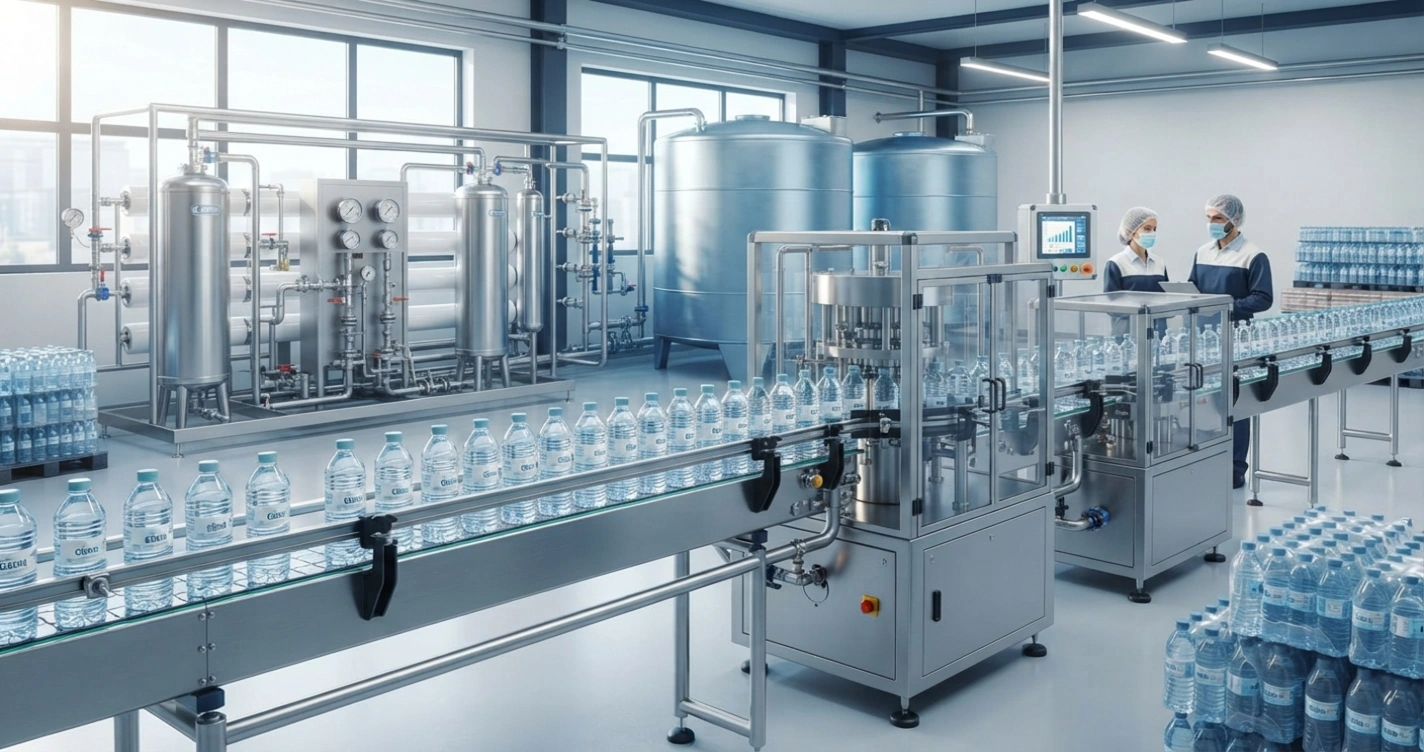
Bottled water has become one of Pakistan’s fastest-growing consumer categories, which explains why many investors are considering the mineral water plant business in Pakistan as a serious investment opportunity. Demand remains consistent, profit margins can be attractive at scale, and the entry barrier is lower than in many other manufacturing industries. However, this business is also more regulated and requires greater capital than a typical neighborhood water shop, and many first-time investors underestimate this difference.
This guide explains how the business operates, what factors influence mineral water bottling plant cost at different scales, the licenses required before legally selling even a single bottle, and the operational factors that determine whether a plant becomes profitable or struggles to break even.
Mineral Water Business vs a Local Water Shop: Know the Difference
Before going further, it’s worth being clear about what you’re actually building, because “mineral water business” and “water shop” get used interchangeably in casual conversation but are very different investments.
A local water shop typically purifies water on-site and sells it to a small geographic area — refills, cans, or small-scale delivery. A mineral water bottling plant, on the other hand, is a manufacturing operation: it purifies, bottles, labels, and packages water at volume, intended for wider retail distribution — shops, supermarkets, wholesalers, or your own branded product line.
That distinction matters because it changes everything downstream: equipment needs, licensing complexity, packaging costs, and the capital required to get started. For a deeper look specifically at licenses, equipment, and ROI, see our companion guide on setting up a bottled water plant in Pakistan.
What Determines Mineral Water Bottling Plant Cost
Four factors drive most of the variation in mineral water bottling plant cost between different setups:
- Production capacity — measured in bottles or liters per hour. A plant designed for a few thousand bottles a day is a very different investment from one designed for tens of thousands.
- Treatment process complexity — beyond basic filtration, most branded mineral water requires multi-stage purification (sediment filtration, activated carbon, RO, UV or ozone disinfection) to meet consistent quality standards batch after batch.
- Bottling and packaging line — automatic filling, capping, and labeling machinery costs significantly more than semi-automatic or manual setups, but delivers far higher throughput and lower per-bottle labor cost.
- Branding and distribution setup — if you’re launching your own labeled product rather than supplying unbranded/private-label water, add design, packaging materials, and distribution logistics to your budget.
Rough Cost Tiers by Scale
| Scale | Typical Output | What’s Included | Relative Investment |
|---|---|---|---|
| Small/entry-level | A few thousand bottles/day | Basic RO treatment, semi-automatic filling | Lower — suited to testing local demand |
| Mid-scale | Tens of thousands of bottles/day | Multi-stage treatment, automatic filling & capping line | Moderate to high |
| Large-scale/branded | High-volume, retail distribution | Full automation, ozone disinfection, branded packaging, cold storage/logistics | Highest |
Most first-time entrants start at the small or mid-scale tier to validate demand and refine operations before committing to full automation — scaling up an already-proven process is a lower-risk path than starting at maximum capacity from day one. If you want to model expected payback period at your chosen scale, our water treatment plant ROI calculator guide walks through that process.
Licensing and Regulatory Requirements
Selling packaged drinking water in Pakistan involves more regulatory steps than running a simple water shop, since you’re producing a packaged consumer product for retail sale. Key requirements typically include:
- Business and manufacturing registration with the relevant provincial or federal authority.
- Pakistan Standards and Quality Control Authority (PSQCA) certification — mineral and bottled water sold commercially generally needs to meet PSQCA’s quality standards before it can carry that certification mark.
- Water source testing and ongoing quality monitoring — both the raw source and the finished bottled product need regular lab testing, not just a one-time certificate at launch.
- Local health and municipal approvals, which vary by city and are typically required before commercial production begins.
- Environmental compliance for reject water disposal — RO-based treatment produces a concentrated reject stream, and responsible disposal (rather than untreated discharge) matters even at commercial bottling scale, not just for large industrial effluent producers.
Because PSQCA certification and ongoing quality testing are non-negotiable for legal retail sale, budgeting time and cost for this early — rather than treating it as a final step before launch — avoids production delays once your bottling line is already running.
Operational Costs That Affect Long-Term Profitability
Beyond the initial mineral water bottling plant cost, several recurring expenses shape whether the business stays profitable:
- Electricity — treatment and bottling lines run for extended hours, and this is typically the largest recurring operating cost after raw materials.
- Packaging materials — bottles, caps, labels, and shrink wrap are ongoing per-unit costs that scale directly with production volume.
- Membrane and filter replacement — a recurring maintenance cost tied to both usage volume and raw water quality.
- Distribution and logistics — getting product from the plant to retail shelves, especially if you’re targeting multiple cities rather than a single local market.
- Quality testing — ongoing lab testing isn’t a one-time cost; regulatory compliance requires it on a continuing basis.
A mid-scale plant supplying local retailers in a city like Faisalabad, for example, would typically see packaging and electricity as its two largest recurring line items — both of which scale with volume, meaning profitability generally improves as production efficiency increases, not just as sales grow.
Choosing the Right Treatment Technology
Not every mineral water business needs the same treatment configuration. The right setup depends on your raw water source:
- Municipal or relatively clean groundwater may need a simpler multi-stage filtration and RO setup.
- Higher-TDS or borewell water typically requires more robust pre-treatment (softening, sediment removal) before RO to protect membrane life and maintain consistent output quality.
- Sourcing from areas with documented groundwater contamination — arsenic in groundwater has been reported in parts of Pakistan — makes proper source testing before plant design essential, not optional.
Skipping a proper water test before finalizing your treatment design is one of the most common — and most expensive — mistakes in this business, since it often means retrofitting equipment after the plant is already operational. Our guide on understanding the science behind water testing kits explains what to look for in a proper source water test.
Conclusion
The mineral water plant business in Pakistan can be a strong opportunity, but mineral water bottling plant cost only tells part of the story — licensing, ongoing quality testing, packaging economics, and treatment technology matched to your actual raw water source all determine whether the business is profitable long-term. Starting at a scale you can validate and grow from, rather than over-investing in automation before demand is proven, is generally the safer path for first-time entrants. Water Care Services Pakistan (WCSP) has designed water treatment systems for commercial and industrial clients across Pakistan since 2007, and can help new entrants choose the right treatment configuration based on their actual source water quality.