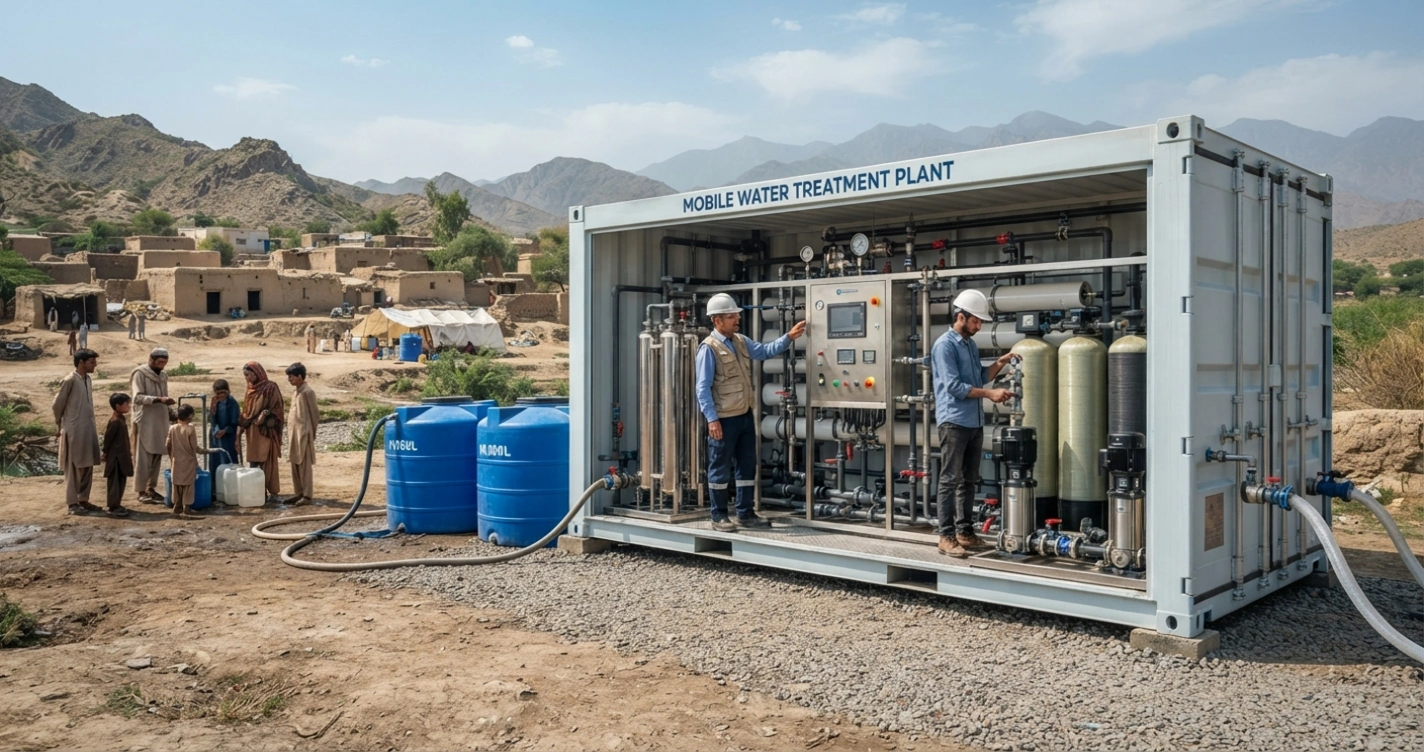
When a flood disrupts a town’s water supply, or a construction project requires clean water at a location without existing infrastructure, waiting months for a permanent treatment facility is simply not practical. This is where a Mobile RO Plant in Pakistan provides the ideal solution — a fully operational water treatment system installed on a container or skid, designed to be transported, set up, and put into operation within days instead of months.
This guide explains how containerized water treatment systems actually work, where they make sense compared to a permanent installation, what affects their cost, and what to check before choosing a supplier — whether you’re planning for disaster response, a remote worksite, or a temporary but urgent water need.
What Is a Mobile or Container RO Plant?
A mobile RO plant is a Reverse Osmosis treatment system pre-installed inside a standard shipping container or mounted on a compact skid frame, rather than built on-site from individual components. Everything — pre-filtration, RO membranes, pumps, control panel, and often a small storage tank — is assembled, tested, and calibrated at the factory before it ever reaches its destination.
This matters because the main bottleneck with a conventional water treatment plant is often not the equipment itself, but the civil work, site preparation, and commissioning time required. A containerized water treatment system eliminates much of this delay by arriving as a nearly complete unit that requires minimal assembly on-site.
Where Mobile RO Plants Are Actually Used
Container and mobile RO systems solve a specific kind of problem: urgent or temporary water need, in a location where building a permanent plant isn’t practical or fast enough. Common scenarios in Pakistan include:
- Disaster response — after flooding events, particularly in areas of Sindh and southern Punjab that have experienced significant flood-related water contamination in recent years, restoring safe drinking water during flooding quickly is a public health priority, not a convenience.
- Remote construction and infrastructure sites — projects in areas without reliable municipal water access, where a permanent plant isn’t justified for a temporary project timeline.
- Military and relief operations — situations requiring rapid, self-contained water treatment that can be relocated as operations move.
- Temporary industrial capacity — a factory undergoing expansion or plant relocation that needs interim treatment capacity while a permanent system is being installed.
- Rural and off-grid communities — villages or settlements where extending municipal infrastructure isn’t economically feasible, but reliable clean water for remote areas is still needed.
How Container RO Plants Differ From Permanent Installations
Factor | Mobile/Container RO Plant | Permanent Fixed Installation
|
|---|---|---|
Deployment time | Days to a couple of weeks | Several weeks to months |
Civil work required | Minimal — mainly a level pad and utility hookup | Significant — foundation, plant room, plumbing |
Mobility | Can be relocated to a new site | Fixed once installed |
Typical use case | Temporary, urgent, or remote needs | Long-term, fixed-location operations |
Capacity flexibility | Fixed to container size, though units can be linked | Can be designed and scaled precisely to site needs |
Cost per unit of capacity | Generally higher per GPD due to factory pre-fabrication | Generally lower per GPD at larger, custom-built scale |
The trade-off is straightforward: you’re paying a premium for speed and mobility. For a genuinely temporary or urgent need, that premium is usually worth it. For a facility that knows it needs treatment capacity for the next decade, a custom-built permanent plant is typically the more cost-effective long-term choice.
What Affects Containerized Water Treatment System Cost
Several factors shape the price of a mobile RO unit beyond raw capacity:
- Container size and capacity — standard 20-foot or 40-foot container configurations handle different flow rate ranges, and larger capacity naturally costs more.
- Pre-treatment complexity — if the source water (river, flood water, or contaminated groundwater) needs heavier pre-treatment before RO, the unit needs additional filtration stages built in.
- Power source — grid-connected units cost less than those requiring a built-in generator or solar power system for fully off-grid operation.
- Automation level — remote monitoring and automated control panels add cost but reduce the need for a trained operator to be present at all times, which matters for remote or disaster-response deployments.
- Transportation and site setup — delivery distance and site accessibility (particularly relevant for flood-affected or genuinely remote areas) can add meaningfully to total deployment cost.
Choosing Between Rental and Purchase
For genuinely temporary needs — disaster response, short-term construction projects, or feasibility testing at a new site — renting is often more practical, especially as part of a broader emergency planning and redundancy strategy for industrial water supply.
- Disaster response, where the deployment period is inherently uncertain
- Short-term construction projects with a defined end date
- Testing water treatment feasibility at a new site before committing to a permanent installation
Purchasing makes more sense when the mobile format is chosen specifically for the mobility itself — for example, an organization that regularly relocates operations to different remote sites and needs the same unit to move with them repeatedly, rather than a one-time deployment.
What to Check Before Choosing a Supplier
Not all mobile RO units are built to the same standard. Before committing, it’s worth confirming:
- Pre-treatment adequacy for your actual source water — a unit designed for relatively clean groundwater won’t necessarily handle turbid flood water or high-organic-load surface water without modification.
- Power requirements match your site — confirm whether the unit needs stable grid power, or genuinely functions on generator or solar power if that’s your deployment reality.
- Output water quality guarantees, especially for disaster response scenarios where the treated water may be used directly for drinking without additional downstream treatment.
- Support and spare parts availability if the unit is deployed somewhere with limited access — a breakdown in a remote area with no nearby technician defeats the purpose of rapid deployment.
Conclusion
A mobile RO plant in Pakistan solves a problem that permanent installations simply can’t — getting clean water flowing within days at a site with no existing infrastructure, whether that’s a flood-affected community, a remote construction project, or a temporary operational need. Containerized water treatment systems trade some long-term cost efficiency for speed and mobility, which is exactly the right trade-off when time matters more than optimizing for the lowest per-gallon cost. Water Care Services Pakistan (WCSP) has supported industrial, municipal, and emergency water treatment needs across Pakistan since 2007, including rapid-deployment packaged RO systems for sites that can’t wait for a conventional build.