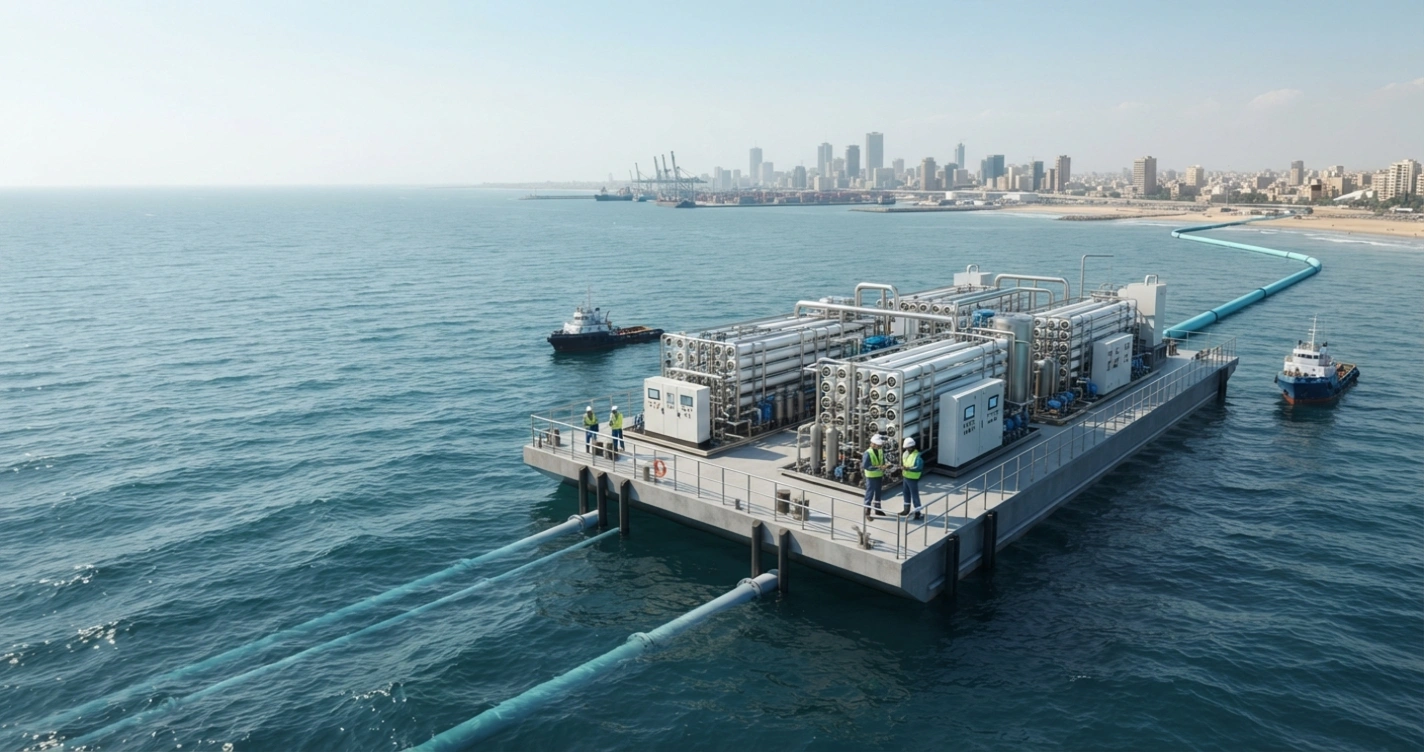
Karachi and other coastal areas of Sindh and Balochistan are located beside one of the largest bodies of water on Earth, yet some parts of these cities continue to experience chronic water shortages. This contrast is a key reason why seawater desalination Pakistan is increasingly discussed as a long-term solution for water security. It is also why floating and coastal desalination plants are gaining serious attention as faster and more flexible alternatives to traditional land-based facilities.
This article looks at how floating desalination technology works, where it genuinely makes sense for Pakistan’s coastal water challenges, what limits its usefulness, and what factors would determine whether a project like this is viable for a specific site or municipality.
Why Pakistan’s Water Crisis Keeps Pointing Toward the Coast
Pakistan’s water stress isn’t just about total supply — it’s increasingly about distribution and reliability. Groundwater in many areas is over-extracted or affected by rising salinity, and dependence on the Indus River system for both agricultural and municipal use leaves little buffer during dry periods. Coastal cities like Karachi have the added disadvantage of seawater intrusion into groundwater aquifers, which can make some traditional groundwater sources progressively less usable over time.
Desalination — turning seawater into fresh water — is one of the only water sources that doesn’t compete with existing freshwater systems at all. That’s a meaningful advantage in a country where nearly every other water source is already under some form of strain.
What Makes a Desalination Plant “Floating”
A floating desalination plant is exactly what its name suggests: the RO treatment system is installed on a barge or vessel positioned offshore or near the coastline instead of being constructed on land. Seawater is taken directly from the ocean, processed using the same core Reverse Osmosis technology as land-based plants, and the resulting fresh water is then transported to shore through pipelines.
The core desalination technology itself isn’t fundamentally different from a land-based RO desalination facility — for a full breakdown of how RO-based desalination works at the membrane level, our earlier guide on desalination through Reverse Osmosis covers that process in detail. What changes with a floating plant is the deployment model, not the underlying treatment chemistry.
Floating RO Plant vs Land-Based Desalination Facility
Factor | Floating RO Plant | Land-Based Facility
|
|---|---|---|
Deployment speed | Faster — no major land acquisition or construction | Slower — requires site development, permitting, construction |
Land requirement | Minimal onshore footprint (piping and pumping station) | Significant coastal land needed |
Relocation flexibility | Can potentially be moved or repositioned | Fixed once built |
Brine discharge management | Diluted more readily into open water, though still requires proper management | Requires dedicated outfall infrastructure |
Long-term cost per unit of capacity | Generally higher for large-scale, permanent supply | Generally lower once fully built and amortized |
Best suited for | Urgent capacity gaps, disaster response, smaller municipalities | Large-scale, long-term municipal or industrial supply |
The pattern here is consistent with mobile and containerized water treatment more broadly: floating plants trade some long-term cost efficiency for speed and flexibility. That trade-off makes the most sense when a coastal community needs additional capacity faster than a conventional facility could be built and approved.
Where Floating Desalination Genuinely Fits in Pakistan
Floating desalination isn’t a universal fix for the country’s water crisis — it’s a targeted tool for specific situations:
- Coastal towns with limited groundwater options and no practical access to river-based supply, where a small-to-mid-scale floating unit could provide meaningful supplementary capacity faster than building permanent infrastructure.
- Emergency or drought-response capacity for coastal areas facing an acute, temporary shortage rather than requiring the full permanence of a land-based plant.
- Industrial facilities located directly on the coast, particularly in sectors like textile or food processing, that need a dedicated water source independent of municipal supply constraints.
- Bridging capacity while a larger, permanent desalination facility is being planned, permitted, and constructed — using a floating unit to cover the gap rather than leaving a community without supply during that lead time.
What it isn’t well-suited for is replacing large-scale municipal water supply for a major city outright — at that scale, the economics generally favor land-based facilities designed and built for long-term, high-volume operation.
Environmental and Regulatory Considerations
Desalination — floating or land-based — isn’t without environmental trade-offs that need proper management:
- Brine discharge — the concentrated saltwater byproduct needs to be discharged responsibly, since improperly managed brine can affect local marine ecosystems near the discharge point.
- Energy consumption — RO desalination is more energy-intensive than treating fresh water sources, since seawater has significantly higher salt content requiring higher pressure to filter.
- Marine intake design — drawing seawater without harming marine life at the intake point requires proper screening and intake engineering.
- Regulatory approval — any desalination project, floating or fixed, involving coastal waters would typically require environmental clearance from the relevant provincial environmental protection agency before deployment.
These aren’t reasons to avoid the technology — they’re standard engineering and regulatory considerations that any credible desalination project, floating or otherwise, needs to plan for from the outset rather than address after the fact.
Is Seawater Desalination the Answer to Pakistan’s Water Crisis?
The honest answer is: it’s part of the answer, not the whole answer. Seawater desalination in Pakistan — floating or land-based — makes the most sense as one component of a broader water security strategy that also includes better groundwater management, wastewater treatment and reuse, and reduced agricultural water losses. For a broader look at how Pakistan’s water challenges are being addressed across sectors, our article on Pakistan’s water crisis and industrial treatment responsibility covers the wider picture beyond desalination alone.
Conclusion
Floating and coastal desalination plants offer a genuinely useful tool for Pakistan’s coastal water challenges — faster to deploy than land-based facilities, with real potential for emergency response, bridging capacity, and smaller coastal communities that can’t wait years for conventional infrastructure. They’re not a wholesale substitute for large-scale municipal desalination or the broader water management reforms Pakistan’s water scarcity challenge demands across sectors, but as a targeted, flexible option, seawater desalination in Pakistan deserves serious consideration where the coastline meets acute water shortage. Water Care Services Pakistan (WCSP) has worked on Reverse Osmosis-based water treatment solutions across Pakistan since 2007 and can help assess whether a desalination-based approach fits a specific coastal site’s needs.