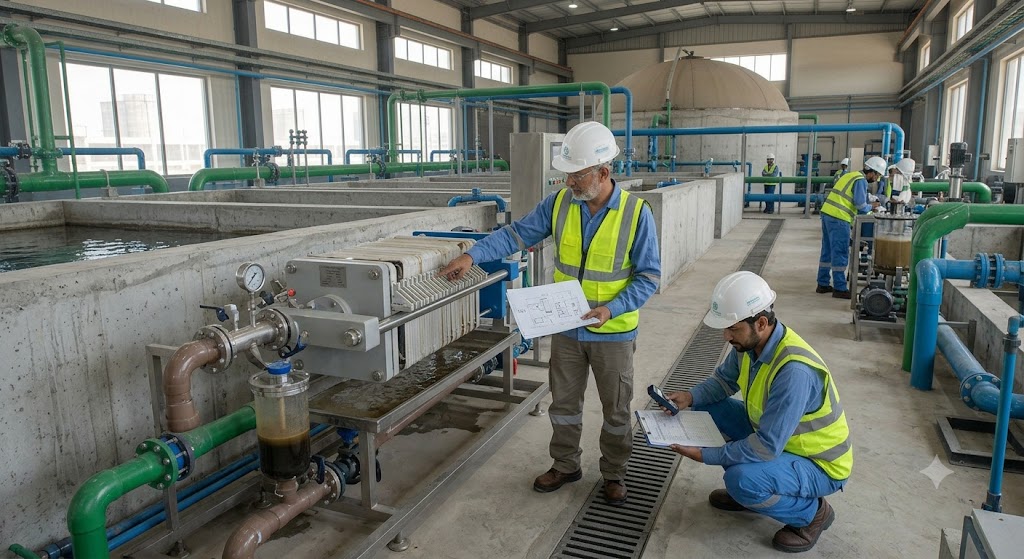
Every wastewater treatment system generates sludge — it is unavoidable. However, the amount of sludge produced, how it must be managed, and the cost of disposal can vary significantly depending on the treatment technology you select. Plant managers often concentrate heavily on the water treatment process and overlook sludge management, only to realize later that disposal expenses and handling requirements are reducing the savings the treatment system was expected to provide.
This article compares the major sludge management approaches available to Pakistani industrial facilities, what drives cost and footprint for each, and the disposal rules that shape your options. If you’re evaluating a new treatment system or trying to reduce sludge-related costs on an existing one, this should give you a practical basis for comparison.
Why Sludge Management Deserves Its Own Evaluation
Sludge isn’t just a byproduct — for many facilities, it’s a significant and growing operating cost. Sludge volume, moisture content, and composition directly determine handling equipment needs, transport costs, and disposal fees. A treatment system that looks efficient on paper based purely on water quality output can still be expensive to run overall if it generates large volumes of wet, hard-to-handle sludge.
Composition also matters for regulatory reasons: sludge from a biological wastewater process is generally treated differently than sludge containing chemical coagulants or precipitated metals, which is why sludge disposal Pakistan requirements can vary meaningfully depending on your treatment technology and industry sector.
How Different Treatment Technologies Affect Sludge Output
Sludge volume and characteristics vary significantly by treatment technology, which is exactly why sludge management should be part of the technology selection decision, not an afterthought once a system is already chosen:
Treatment Technology | Relative Sludge Volume | Sludge Characteristics |
Conventional activated sludge | Moderate to high | Biological sludge, generally easier to dewater with standard equipment |
Moving Bed Biofilm Reactor (MBBR) | Lower than conventional activated sludge | Biological sludge, benefits from biofilm’s higher biomass retention |
Chemical coagulation | Moderate to high | Chemical-heavy sludge, often bulkier and harder to dewater |
Electrocoagulation | Generally lower, denser sludge | Metal hydroxide sludge, typically settles and dewaters more readily |
Fenton process/advanced oxidation | Moderate | Iron-based chemical sludge requiring specific handling |
No sludge/bioremediation approaches | Minimal to none | Relies on biological digestion that significantly reduces solid byproduct |
Technologies that generate less sludge per unit of pollutant removed aren’t automatically “better” across the board — they often trade off against capital cost or specific effectiveness for certain pollutant types — but sludge volume should be weighed alongside treatment performance when comparing options.
Sludge Dewatering: The Step That Determines Handling Cost
Raw sludge is mostly water, and dewatering — reducing that water content before disposal — is what determines transport volume, handling equipment needs, and ultimately disposal cost. Common dewatering approaches include:
- Gravity thickening, a low-cost first step that concentrates sludge before further dewatering, though limited in how much moisture it can remove alone
- Filter presses, which mechanically squeeze sludge to a drier cake, offering good dewatering performance for many industrial sludge types
- Centrifuges, effective for higher-throughput operations, though with higher capital and energy cost than filter presses
- Drying beds, a lower-cost, lower-energy option where space and climate conditions allow, though slower and more space-intensive
The right dewatering method depends heavily on sludge volume, available space, and how much you’re willing to invest upfront to reduce ongoing transport and disposal costs. A facility generating large sludge volumes generally sees faster payback on mechanical dewatering equipment than a smaller facility, where the capital cost may not be justified by the volume being handled.
Sludge-Free and Low-Sludge Treatment Approaches
For facilities looking to minimize sludge management burden from the outset, certain treatment approaches are specifically designed to reduce solid byproduct generation. No Sludge Treatment These approaches, typically based on advanced bioremediation, use specialized microbial consortia to break down organic pollutants more thoroughly, significantly reducing the amount of residual solids compared with conventional biological treatment. This can be especially beneficial for facilities with limited space for sludge-handling infrastructure or for those in areas where sludge disposal Pakistan logistics are particularly costly or difficult to manage.
.
Sludge Disposal Rules and Considerations in Pakistan
Sludge disposal in Pakistan is governed by provincial EPA regulations, and the appropriate disposal route depends significantly on sludge composition and classification:
- Biological (non-hazardous) sludge from conventional wastewater treatment can generally follow standard solid waste disposal routes, though this still requires proper documentation and, in many cases, EPA notification depending on volume and facility category.
- Chemical sludge containing heavy metals or hazardous constituents typically requires more stringent handling, documentation, and disposal through approved hazardous waste channels — treating this sludge as standard waste is a compliance risk many facilities underestimate.
- Sludge testing before disposal is increasingly expected to confirm classification, since assuming a sludge type without testing can lead to improper disposal and associated liability.
- Record-keeping for sludge disposal, including volumes, disposal method, and dates, supports compliance documentation similarly to how discharge monitoring records are maintained.
Facilities using treatment technologies that produce chemical or metal-containing sludge — such as certain electrocoagulation or Fenton process systems — should build proper hazardous sludge handling into their operating budget and procedures from the start, rather than treating it as a standard waste stream.
Cost Comparison: Sludge Management Across Approaches
Factor | High-Sludge Technologies (e.g. conventional activated sludge, chemical coagulation) | Low-Sludge Technologies (e.g. MBBR, electrocoagulation, bioremediation) |
Dewatering equipment cost | Often higher, due to larger volumes | Generally lower |
Transport and disposal cost | Higher, driven by volume | Lower, due to reduced volume |
Handling labor and logistics | More intensive | Less intensive |
Capital cost of core treatment system | Often lower | Can be higher, depending on technology |
Best suited for | Facilities with space and existing dewatering infrastructure | Space-constrained facilities, or those prioritizing lower ongoing disposal cost |
The right choice often comes down to whether you’d rather absorb a higher capital cost upfront for a lower-sludge technology, or accept higher recurring disposal costs with a lower initial investment — a decision that should be modeled over the system’s operating life, not just at installation.
Practical Steps for Managing Sludge Costs
- Factor sludge volume and characteristics into technology selection, not just water treatment performance, when evaluating a new system.
- Test sludge composition regularly, especially for facilities using chemical or metal-based treatment processes, to confirm correct disposal classification.
- Evaluate dewatering equipment based on your actual sludge volume, since over-investing in capacity you don’t need wastes capital, while under-investing increases ongoing transport costs.
- Maintain clear disposal documentation, treating sludge records with the same rigor as discharge monitoring data.
- Consider low-sludge or bioremediation-based technologies if space constraints or high disposal costs are a significant operational burden.
FAQ
Q1. What sludge management option produces the least sludge for industrial wastewater treatment?
Bioremediation-based approaches, sometimes marketed as “no sludge” treatment, and technologies like MBBR and electrocoagulation generally produce significantly less sludge than conventional activated sludge or standard chemical coagulation, due to more efficient biomass retention or denser, more settleable byproducts.
Q2. How is sludge disposal Pakistan regulated for industrial facilities?
Disposal is governed by provincial EPA regulations, with requirements varying based on whether sludge is classified as biological (non-hazardous) or chemical/hazardous. Facilities should test sludge composition to confirm classification rather than assuming a disposal route, since incorrect classification carries compliance risk.
Q3. Is it worth investing in mechanical dewatering equipment for a smaller facility?
It depends on sludge volume — facilities generating substantial sludge quantities typically see faster payback from mechanical dewatering through reduced transport and disposal costs, while smaller facilities may find simpler methods like gravity thickening or drying beds more cost-effective.
Q4. Does the choice of wastewater treatment technology affect sludge disposal cost significantly?
Yes, considerably. Technologies that generate less sludge per unit of pollutant removed directly reduce transport volume, handling labor, and disposal fees over the system’s operating life, which is why sludge output should factor into technology selection, not just treatment performance.
Conclusion
Sludge management is rarely the deciding factor when a facility first selects a wastewater treatment technology, but it often becomes one of the largest ongoing costs once the system is operating. Comparing technologies on sludge volume, dewatering needs, and disposal classification — alongside treatment performance — leads to a far more accurate total cost picture than evaluating water treatment alone. WCSP has helped Pakistani industrial clients since 2007 select and implement wastewater treatment technologies that account for sludge handling and disposal from the outset, not as an afterthought.
.