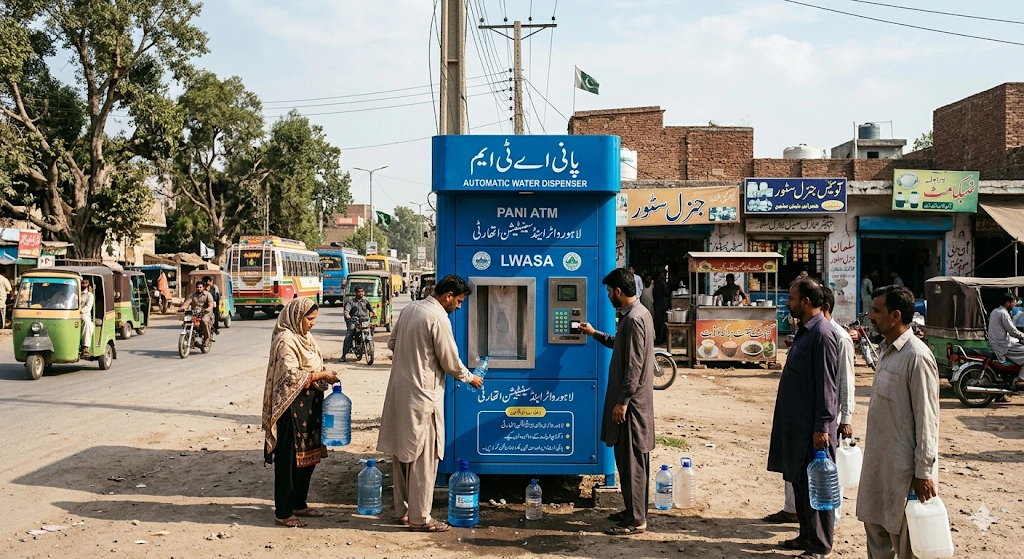
Over 30 million Pakistanis lack access to safely managed drinking water — and the business gap that creates is one of the most undercapitalized opportunities in the country’s growing clean-water sector. If you have considered investing in a water ATM dispenser Pakistan entrepreneurs are increasingly turning to, this article gives you the numbers, the technology breakdown, and the operational model you need to make an informed decision.
The concept is simple but the execution matters: automated, purified water dispensing kiosks that accept coins, tokens, or digital payments. Customers pay per litre. You earn passively. But getting the filtration stack, location, maintenance model, and pricing right is where most first-time operators stumble.
This guide covers setup costs, technology options, site selection, profitability benchmarks, and the regulatory landscape — so you can move from idea to operational unit without the guesswork.
Why the Water ATM Dispenser Business Is Growing Fast in Pakistan
Pakistan’s municipal water infrastructure is under severe strain. According to the Pakistan Council of Research in Water Resources (PCRWR), over 70% of groundwater sources tested in major cities fail to meet WHO drinking water standards. In cities like Lahore, Karachi, Faisalabad, and Gujranwala, contamination from industrial discharge, aging distribution pipes, and inadequate treatment has pushed households toward bottled water — an option that costs 10 to 30 times more per litre than a water ATM kiosk.
The automatic water dispenser business fills that gap precisely. It delivers WHO-compliant purified water at Rs. 1 to Rs. 5 per litre, making it affordable for lower- and middle-income communities who currently spend a disproportionate share of household income on packaged water.
From the investor’s perspective, the tailwinds are structural. Urban population density in Pakistan is increasing. Awareness of waterborne disease — cholera, typhoid, hepatitis A — is rising. And provincial EPAs are pushing harder on groundwater quality compliance, which drives institutional demand for decentralized treatment solutions.
WCSP’s water ATM dispenser and water shop installations, active since 2007, have consistently shown that high-footfall locations in peri-urban and low-income neighborhoods return the strongest profitability ratios precisely because alternatives are most expensive or least accessible there.
What Is a Water ATM Dispenser and How Does It Work?
A water ATM dispenser — also called a safe drinking water kiosk or automated water vending machine — is a self-service unit that dispenses treated water in user-controlled quantities. The user inserts a coin, a token, or scans a QR code, selects a volume, and the machine dispenses through a dispensing nozzle into their container.
The treatment train behind the dispenser is what determines water quality. A properly configured unit typically includes:
Multi-stage Sediment Filtration removes particulate matter, silt, and suspended solids down to 5 microns, protecting downstream membranes.
Activated Carbon Filtration strips chlorine, volatile organic compounds, and taste-and-odor compounds that make municipal supply unpalatable.
Reverse Osmosis Membrane is the core purification stage. A standard RO membrane operating at 75 to 300 GPD (gallons per day) removes dissolved solids, heavy metals, fluoride, nitrates, and biological contaminants. TDS output typically falls below 50 ppm from source water that may exceed 500 to 1,200 ppm in Pakistani cities.
UV Disinfection provides a final bacteriological barrier. A UV lamp rated at 254 nm wavelength inactivates bacteria and viruses without chemical residuals — critical for post-RO polishing before dispensing.
Ozone or Silver Ion Preservation is optionally added to storage tanks to prevent biofilm formation between dispensing cycles.
The vending unit itself houses the payment module (coin acceptor, token reader, or NFC/QR reader), a microcontroller managing flow valves, a digital display, and often a GSM or WiFi module for remote monitoring.
WCSP designs and installs complete water ATM dispenser systems — from source water assessment to treatment configuration to payment integration — giving operators a turnkey solution rather than a patchwork of incompatible components.
Water ATM Dispenser Pakistan: Complete Setup Cost Breakdown
Setup cost is the first question every prospective operator asks, and the honest answer is: it depends on capacity, treatment depth, enclosure quality, and payment infrastructure. Here is a realistic cost structure based on WCSP’s project data across Lahore, Karachi, Faisalabad, and Sialkot installations.
| Component | Basic Unit (500 LPD) | Mid-Range Unit (1,000 LPD) | Commercial Unit (2,000+ LPD) |
|---|---|---|---|
| RO System + Pre-filtration | Rs. 80,000 – 1,20,000 | Rs. 1,50,000 – 2,50,000 | Rs. 3,00,000 – 5,00,000 |
| UV Disinfection | Rs. 15,000 – 25,000 | Rs. 25,000 – 40,000 | Rs. 40,000 – 70,000 |
| Storage Tank (food-grade) | Rs. 12,000 – 20,000 | Rs. 20,000 – 35,000 | Rs. 35,000 – 60,000 |
| Vending / ATM Panel | Rs. 40,000 – 80,000 | Rs. 80,000 – 1,50,000 | Rs. 1,50,000 – 2,50,000 |
| Enclosure / Kiosk Structure | Rs. 50,000 – 90,000 | Rs. 90,000 – 1,50,000 | Rs. 1,50,000 – 3,00,000 |
| Electrical & Plumbing | Rs. 20,000 – 35,000 | Rs. 35,000 – 55,000 | Rs. 55,000 – 90,000 |
| Remote Monitoring (optional) | Rs. 15,000 – 30,000 | Rs. 15,000 – 30,000 | Rs. 30,000 – 60,000 |
| Total Estimated Range | Rs. 2,32,000 – 4,00,000 | Rs. 4,15,000 – 7,10,000 | Rs. 7,60,000 – 13,30,000 |
These figures are before site preparation, civil work, or utility connection costs, which vary significantly by location and access. A rooftop or enclosed commercial space requires different structural considerations than a roadside kiosk in a market area.
Operating costs monthly typically run between Rs. 8,000 and Rs. 25,000 depending on unit size, covering electricity, membrane replacement reserves, filter cartridge changes, UV lamp replacement cycles, and basic maintenance.
Pro Tip — From WCSP’s 17+ Years of Field Experience: The single biggest cost error first-time operators make is undersizing the RO membrane relative to peak demand hours. A 500 LPD membrane running 16 hours per day produces roughly 312 litres in actual operational output — far less than the nameplate capacity suggests. Over-specify your membrane by 30 to 40%, and you protect service continuity during peak hours without burning out the pump prematurely. WCSP’s engineering team sizes every system against real demand curves, not theoretical maximums.
How to Choose the Right Location for a Water Shop Setup in Pakistan
Location is the single largest determinant of profitability in the automatic water dispenser business. A technically perfect machine in the wrong spot will fail. A modest unit in a high-demand location will outperform projections consistently.
The variables that matter most:
Population density and income profile. Your ideal customer is someone who cannot afford bottled water regularly but recognizes the risk of drinking untreated tap water. Dense lower-to-middle-income residential areas — think katchi abadis adjacent to formal housing, or peri-urban settlements outside Karachi’s North Karachi or Lahore’s Raiwind belt — deliver the highest daily transaction volumes.
Distance from alternatives. If a samosa shop 50 metres away sells packaged water sachets, your pricing must be sharper and your quality perception higher. Map competing sources within a 500-metre radius before committing to a site.
Water source quality at the site. This is where operator due diligence matters. Have an independent source water analysis run before installation. WCSP offers pre-installation water quality assessments covering TDS, pH, hardness, bacteriological load, heavy metals, and key NEQS parameters. Your treatment configuration depends entirely on this data — do not guess.
Footfall patterns. Morning and evening peaks matter. Sites near schools, mosques, public transit stops, vegetable markets, and community centers consistently outperform isolated residential side streets.
Security and vandalism risk. Coin-operated machines in low-supervision locations attract tampering. Stainless steel enclosures, tamper-evident payment panels, CCTV coverage, and remote monitoring significantly reduce this risk.
In WCSP’s water shop setup cost assessments across Pakistan, the difference between a 14-month payback and a 36-month payback often comes down entirely to site selection — not the equipment specification.
Water ATM Dispenser Business Model: Revenue and Profitability Analysis
Let’s run the numbers honestly so you can decide if this business makes sense for your situation.
Revenue Scenario — Mid-Range Unit (1,000 LPD capacity):
Assume your unit sells 600 litres per day on average (60% utilization, realistic for a good location). At Rs. 3 per litre — a competitive price in most Pakistani cities — daily revenue is Rs. 1,800.
Monthly gross revenue: Rs. 54,000 Monthly operating costs (electricity, consumables, maintenance reserve): Rs. 15,000 to Rs. 20,000 Monthly net operating income: Rs. 34,000 to Rs. 39,000
At a mid-range setup cost of Rs. 6,00,000, your payback period is approximately 15 to 18 months. After that, the unit generates essentially passive income with periodic maintenance.
What improves the model:
Stacking multiple units at different locations is the scaling lever most successful operators use. Two to three units under centralized remote monitoring reduce per-unit management overhead significantly. WCSP’s remote monitoring integration allows operators to track dispensing volumes, payment totals, filter life remaining, and pump status from a smartphone dashboard — eliminating the need for constant physical presence.
Tiered pricing also improves revenue without increasing costs. Charging Rs. 2 per litre for the first 10 litres and Rs. 3 per litre beyond that, for example, encourages bulk fills while keeping the unit accessible to daily small-volume users.
Institutional contracts with schools, mosques, or small factories in your area can add a guaranteed monthly revenue floor independent of walk-in traffic.
Safe Drinking Water Kiosk: Regulatory and Quality Compliance in Pakistan
Operating a water ATM dispenser business in Pakistan is not regulation-free. The Pakistan Standards and Quality Control Authority (PSQCA) has established standards for packaged drinking water under PS 4393:2008. While vended water from kiosks occupies a regulatory grey area in some provinces, Punjab EPA and Sindh EPA are increasingly requiring operators to maintain water quality logs and submit to periodic testing.
The National Environmental Quality Standards (NEQS) set limits for parameters including total coliform, arsenic, nitrate, fluoride, and TDS. Your treatment system must consistently achieve these limits — not just at installation, but across the operating life of the membranes and UV lamps.
Key compliance practices you should build into operations from day one:
Membrane performance monitoring. RO membranes degrade over time. Track TDS rejection rates quarterly. A membrane dropping below 85% rejection efficiency needs replacement regardless of its nominal lifespan.
UV lamp replacement. UV intensity decreases with hours of operation. Replace lamps at manufacturer-specified intervals — typically 9,000 to 12,000 hours — not when the lamp visually fails.
Bacteriological testing. Run coliform and E. coli testing monthly on dispensed water. Keep records. This protects you legally and operationally.
PSQCA/EPA registration. In Punjab, units operating commercially above certain volumes should be registered with the relevant authority. WCSP’s team can guide you through the documentation requirements specific to your city and unit type.
WCSP’s water quality monitoring services include ongoing water testing, compliance reporting, and corrective action support — so your operation stays on the right side of regulatory requirements without requiring you to build that expertise internally.
How WCSP Designs and Installs Water ATM Dispensers Across Pakistan
WCSP has been designing and deploying water treatment systems since 2007. Our water ATM dispenser installations range from single-unit roadside kiosks in Gujranwala to multi-unit networks for municipal water access programs in Karachi’s peri-urban zones.
What distinguishes a WCSP installation from an off-the-shelf machine sourced from a local vendor:
Source-matched treatment design. Every installation begins with source water characterization. Lahore’s groundwater has a different contamination profile from Sialkot’s or Faisalabad’s — the treatment train must be designed for actual source conditions, not a generic specification.
Engineered membrane selection. We specify RO membranes from verified manufacturers with traceable performance data. Feed water chemistry, recovery rate targets, and brine management are all calculated before equipment selection, not after.
Integrated payment and monitoring infrastructure. WCSP’s water ATM systems support coin, token, and digital payment modes. Remote telemetry provides real-time data on dispensing volume, payment receipts, system alarms, and filter status — accessible from any internet-connected device.
After-sales service contracts. Equipment uptime depends on preventive maintenance. WCSP offers structured service agreements covering scheduled filter replacements, membrane inspections, UV lamp changes, and emergency callout support.
Compliance documentation. We provide water quality certificates at installation and support ongoing testing so your operation meets NEQS and EPA requirements from day one.
If you are evaluating a water shop setup cost in Pakistan and want a rigorous comparison of what different configurations deliver in terms of water quality, uptime, and actual ROI — contact WCSP’s project team for a site-specific feasibility assessment.
Common Mistakes That Kill Water ATM Dispenser Profitability
After 17 years of installations across Pakistan’s industrial and commercial water sector, WCSP has seen the same mistakes repeat across operators who under-research the business before entering.
Buying on price, not specification. The market is flooded with imported and locally assembled units at attractively low prices. Many of these use generic RO membranes with poor rejection rates, undersized UV chambers, and payment panels that fail within months. Your filtration system is your product — false economy in the equipment destroys customer trust faster than any competitor.
Ignoring brine disposal. RO systems produce reject water — typically 30 to 50% of feed water volume — that carries concentrated dissolved solids. In densely populated locations, dumping this brine without a plan creates drainage problems, community complaints, and potential regulatory issues. Plan your reject water management before installation.
No remote monitoring. An operator who discovers a pump failure or depleted UV lamp only when a customer complains has already lost revenue and customer trust. Real-time monitoring is not a luxury — it is the management infrastructure for a profitable multi-unit business.
Underpricing to compete. Pricing at Rs. 1 per litre in a market where Rs. 3 per litre is the norm destroys your margin without meaningfully increasing volume. Customers choosing a water ATM over packaged water are already price-motivated — they are not choosing the cheapest kiosk on the street, they are choosing the one they trust. Quality perception commands price, not just low cost.
Skipping the source water test. Operators who install a standard urban RO configuration on groundwater with high arsenic or extreme hardness find themselves with an underperforming system, dissatisfied customers, and a remediation cost that exceeds what the initial test would have cost. WCSP’s pre-installation assessment costs a fraction of the price of retrofitting a mismatched system.
Conclusion
The water ATM dispenser business in Pakistan is not speculative — it is responding to a documented, growing gap between safe water demand and infrastructure supply. The fundamentals are strong: low operating costs, high daily transaction volume in the right locations, passive income potential once operational, and a clear community benefit that builds customer loyalty.
Here are four things to take away from this guide:
First, setup cost scales with capacity and treatment depth — plan for Rs. 3 lakh to Rs. 13 lakh depending on your configuration, and do not let price alone drive equipment selection. Second, location determines profitability more than any other single factor — run a proper site assessment before committing capital. Third, compliance is not optional — build NEQS-aligned water quality monitoring into your operating model from day one. Fourth, a water ATM dispenser Pakistan business scales through multiple units under centralized remote monitoring, not by running one unit manually.
Ready to start a water ATM dispenser business or scale an existing one? Contact WCSP’s expert team today at /contact-us/ for a site-specific feasibility assessment, source water analysis, and a configuration recommendation grounded in 17 years of real-world Pakistan installations.
Related reading you may find useful next: How Reverse Osmosis Plants Work: A Practical Guide for Pakistan Business Owners, and Water Quality Testing in Pakistan: What Parameters Actually Matter and Why.
FAQ SECTION
1. How much does it cost to set up a water ATM dispenser business in Pakistan?
Setting up a water ATM dispenser in Pakistan costs between Rs. 2,32,000 and Rs. 13,30,000 depending on daily production capacity, treatment technology, enclosure type, and payment system. A basic 500-LPD unit starts around Rs. 2.5 lakh, while a commercial 2,000-LPD unit with remote monitoring and digital payments can reach Rs. 13 lakh or more, excluding site preparation and civil work.
2. How profitable is a water ATM dispenser business in Pakistan?
A mid-range water ATM dispenser business in Pakistan generating 600 litres per day at Rs. 3 per litre earns around Rs. 54,000 monthly in gross revenue. After operating costs of Rs. 15,000 to Rs. 20,000, net monthly income is typically Rs. 34,000 to Rs. 39,000. At this rate, a Rs. 6 lakh unit pays back in 15 to 18 months, after which it generates essentially passive income.
3. What water treatment technology is used in a safe drinking water kiosk?
A properly designed safe drinking water kiosk uses multi-stage filtration: sediment pre-filters, activated carbon, a reverse osmosis membrane, and UV disinfection as the final barrier. Some systems also include ozone or silver ion treatment for storage preservation. The exact configuration should be based on source water analysis — Pakistan’s groundwater varies significantly by city and depth.
4. Is a water ATM dispenser business compliant with Pakistan EPA regulations?
Vended water must meet Pakistan’s NEQS drinking water standards, which set limits for total coliform, TDS, arsenic, nitrate, and other parameters. Punjab EPA and Sindh EPA increasingly monitor commercial water vending operations. Operators should maintain monthly bacteriological test records, track membrane performance quarterly, and register with the relevant provincial authority where required.
5. What is the best location for installing an automatic water dispenser in Pakistan?
The best locations for a water ATM dispenser in Pakistan are dense lower-to-middle-income residential areas, markets, transit stops, schools, and mosques where foot traffic is high and packaged water access is limited or expensive. Site selection should also consider source water quality, vandalism risk, electrical supply reliability, and distance from competing water sources within a 500-metre radius.
6. How often does a water ATM dispenser need maintenance?
A water ATM dispenser requires filter cartridge changes every 3 to 6 months, UV lamp replacement every 9,000 to 12,000 operating hours, and RO membrane inspection quarterly with replacement typically every 2 to 3 years depending on feed water quality. Remote monitoring systems allow operators to track filter life and system performance in real time, reducing the risk of unexpected downtime.