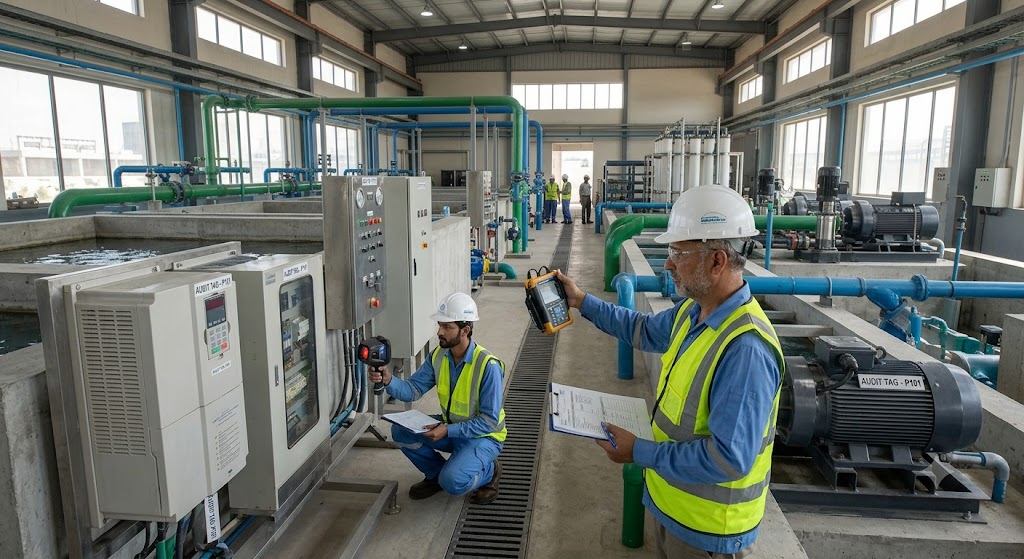
Energy is usually the largest recurring cost in running a water or wastewater treatment plant, yet most facilities have only a rough idea of where that power is actually going. An energy audit for water treatment plants exists precisely to close that gap — it turns a vague sense that “the plant uses a lot of electricity” into specific, actionable numbers showing exactly which equipment, processes, and inefficiencies are driving your bill.
This article explains what an energy audit for a water treatment plant actually involves, where the biggest savings opportunities typically hide, and how to move from audit findings to a genuinely energy efficient water treatment operation. If your power costs have been climbing without a clear explanation, this should give you a practical starting point.
Why Water Treatment Plants Are Energy-Intensive Operations
Water and wastewater treatment involves several continuously running, power-hungry processes: pumping (raw water intake, transfer, and high-pressure feed for membrane systems), aeration for biological treatment, and increasingly, thermal processes for evaporation in systems like Zero Liquid Discharge. Pumping alone often accounts for the single largest share of a treatment plant’s electricity consumption, frequently more than any other individual process. This is exactly why an energy audit almost always starts there.
What an Energy Audit Actually Involves
A proper energy audit for water treatment plants goes well beyond reading the monthly electricity bill. It typically includes:
- Equipment-level power measurement — logging actual energy draw from pumps, blowers, aerators, and dosing systems under real operating conditions, not nameplate ratings alone.
- Load profiling over time — understanding how energy consumption varies across shifts, production cycles, and seasonal changes rather than relying on a single snapshot.
- Efficiency benchmarking — comparing actual equipment performance (e.g., pump efficiency, aeration oxygen transfer efficiency) against design specifications to identify degradation.
- Process-level analysis — evaluating whether treatment stages are running longer, harder, or more frequently than necessary for the actual load being treated.
- Identification of avoidable losses — oversized equipment running at partial load, leaks, poorly calibrated controls, or equipment operating outside its efficient range.
The output isn’t just a report — it should be a prioritized list of specific interventions, each with an estimated energy saving and, ideally, a rough payback period.
Where the Biggest Energy Losses Typically Hide
Based on patterns seen across industrial water treatment operations in Pakistan, a few areas consistently show up as major opportunities:
- Oversized or mismatched pumps running well below their efficient operating range, common when a system was designed for future expansion that hasn’t yet materialized.
- Aeration systems without dissolved oxygen control, running continuously at full output regardless of actual biological load, when demand-based control could cut aeration energy significantly.
- Aging or poorly maintained membranes, which require higher feed pressure — and therefore more pumping energy — to achieve the same output as a properly maintained system, which is why membrane fouling monitoring ties directly into energy efficiency.
- Lack of variable frequency drives (VFDs) on major pumps and blowers, forcing equipment to run at fixed speed even when demand fluctuates throughout the day.
- Inefficient scheduling, where energy-intensive processes run during peak tariff periods instead of being shifted to off-peak hours where tariff structures allow it.
Energy Efficient Water Treatment: Where the Real Savings Come From
Intervention | Typical Impact Area | Relative Payback |
Variable frequency drives on pumps/blowers | Matches energy use to actual demand instead of fixed output | Often fast, especially on oversized systems |
Dissolved oxygen-based aeration control | Reduces continuous full-output aeration | Moderate to fast |
Membrane cleaning and fouling management | Reduces feed pressure needed for target output | Fast, low capital cost |
Pump right-sizing or impeller trimming | Corrects oversized equipment running inefficiently | Moderate |
Off-peak scheduling of flexible processes | Reduces cost exposure to peak tariff rates | Fast, minimal capital cost |
Heat recovery for thermal processes (e.g. evaporators) | Reduces thermal energy input for ZLD/evaporation stages | Longer, but significant at scale |
Building a genuinely energy efficient water treatment operation usually isn’t about a single dramatic upgrade — it’s the combined effect of several of these interventions addressed together, since pumping, aeration, and membrane performance all interact with each other.
A Practical Example: Aeration Energy in Biological Treatment
Aeration is one of the most common places an energy audit uncovers significant waste. Many facilities run blowers at a constant output calibrated for peak load conditions, even though actual biological oxygen demand fluctuates throughout the day based on production schedules and influent characteristics. Installing dissolved oxygen sensors with automated blower control allows the system to match aeration intensity to actual real-time demand instead of a fixed worst-case assumption. In systems using a Moving Bed Biofilm Reactor, this kind of demand-based control is particularly effective, since MBBR systems generally have more stable oxygen demand profiles that respond well to automated control compared to conventional activated sludge processes.
How Real-Time Monitoring Supports Ongoing Energy Efficiency
An energy audit gives you a snapshot, but sustaining energy efficient water treatment requires ongoing visibility, not a one-time assessment. Continuous real-time monitoring of pump pressure, flow rates, and energy consumption allows plant operators to catch efficiency drift — like a slowly fouling membrane or a pump drifting outside its efficient range — long before it shows up as a noticeable spike on the monthly bill. Facilities that pair an initial energy audit with continuous monitoring consistently retain more of their identified savings over time than those that treat the audit as a one-off exercise.
Building the Business Case for Energy Audit Recommendations
Not every finding from an energy audit needs immediate capital investment. A practical approach to prioritization:
- Start with zero-cost and low-cost fixes — adjusting control setpoints, correcting scheduling, fixing leaks, or recalibrating sensors.
- Prioritize interventions with the fastest payback — VFDs on significantly oversized pumps typically fall here.
- Bundle capital-intensive upgrades with planned maintenance or equipment replacement cycles, rather than treating them as standalone projects requiring separate approval.
- Track actual savings post-implementation against audit projections, since real-world results should validate (or refine) the audit’s assumptions for future decisions.
FAQ
Q1. How often should a water treatment plant conduct an energy audit?
Most facilities benefit from a comprehensive audit every 2–3 years, with lighter interim reviews whenever major equipment changes, production volumes shift significantly, or energy costs rise unexpectedly. Continuous monitoring between formal audits helps catch efficiency drift in the meantime.
Q2. What is the single biggest energy cost in a typical water treatment plant?
Pumping is usually the largest single contributor, covering raw water intake, transfer between treatment stages, and high-pressure feed for membrane systems. Aeration in biological treatment is typically the second-largest consumer for plants with a wastewater treatment component.
Q3. Can an energy audit reduce costs without major capital investment?
Yes — many findings involve control adjustments, scheduling changes, and maintenance corrections that require little to no capital, such as fixing leaks, recalibrating dosing, or correcting aeration setpoints. These low-cost fixes are usually recommended as the first phase of any energy efficiency plan.
Q4. How does membrane condition affect energy consumption?
A fouled or aging membrane requires higher feed pressure to maintain the same output, directly increasing pumping energy consumption. Regular membrane maintenance and cleaning is one of the most cost-effective ways to control energy use in RO-based systems.
Conclusion
An energy audit for water treatment plants turns assumptions about power consumption into specific, actionable data — and consistently uncovers savings opportunities that go far beyond simply negotiating a better electricity tariff. Facilities that act on audit findings and pair them with ongoing monitoring build a genuinely energy efficient water treatment operation rather than a one-time cost reduction. WCSP has supported industrial clients across Pakistan with energy management and efficiency improvements for water and wastewater systems since 2007, with practical, site-specific recommendations rather than generic checklists.