Pakistan’s industrial sector generates an estimated 900,000 tonnes of hazardous waste annually — yet fewer than 40% of registered factories maintain functioning environmental monitoring systems, according to the Pakistan Environmental Protection Agency. If your facility runs separate, disconnected compliance checks for air emissions and liquid effluent, you are managing environmental risk the way a pilot manages two engines by checking each gauge on a different flight. The data exists. The connection does not.
Environmental quality monitoring in Pakistan has traditionally been a fragmented exercise: an annual effluent test here, a stack emission survey there, paper reports submitted to satisfy EPA inspectors. That model is collapsing under the weight of tightening NEQS enforcement, investor ESG scrutiny, and a growing body of evidence linking industrial air and water pollution to the same upstream process failures.
This article explains how integrated environmental monitoring works, why it is replacing siloed compliance programs across Pakistan’s industrial belt, what it costs, and how WCSP’s monitoring and treatment capabilities support factories, pharma plants, and municipalities in building systems that work continuously — not just during inspections.
Why Siloed Environmental Monitoring Fails Pakistan’s Industries
Managing air and water compliance separately is not just inefficient — it actively creates blind spots that expose your facility to regulatory and reputational risk.
Consider a textile dyeing unit in Faisalabad. The facility runs quarterly COD and BOD tests on its effluent discharge and submits the results to Punjab EPA. It runs an annual stack emission survey on its boiler. What it does not capture: the correlation between boiler operating load, fuel quality variation, and the colour and pH spikes it pushes into the drain on heavy production days. A high-sulphur coal batch drives up SO2 in the stack while simultaneously acidifying the process water — both violations of NEQS limits — but neither monitoring system sees the relationship.
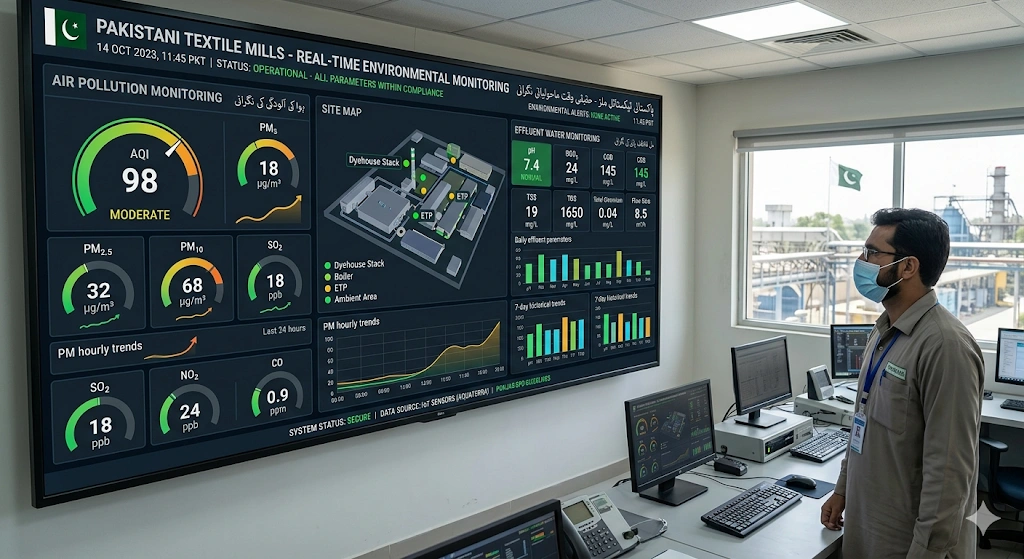
Integrated environmental monitoring closes this gap by treating your facility as a connected system. When your air quality sensors detect a VOC spike, your water monitoring simultaneously checks whether your effluent contains solvent residuals from the same process line. When your effluent pH drops, the integrated system flags the associated boiler or chemical dosing event that caused it.
The practical consequence for compliance officers is dramatic. Instead of reconciling two separate datasets for a single EPA inspection, you pull one report. Instead of discovering a NEQS exceedance after the quarterly lab test returns, you receive a real-time alert when the parameter crosses 80% of its limit — giving you time to correct the process before the violation is recordable.
According to the World Bank, facilities that deploy continuous environmental monitoring reduce regulatory penalty exposure by 40 to 60% compared to batch-testing models. That figure reflects not just detection speed but the credibility that continuous data provides when EPA auditors review your compliance history.
What Integrated Environmental Monitoring Actually Measures
Effective integrated environmental quality monitoring in Pakistan covers three interconnected parameter domains — air, water, and soil — though most industrial implementations begin with air and liquid effluent as the highest-risk and most NEQS-regulated streams.
Air Quality Parameters Relevant to Pakistani Industry
The primary air pollutants covered under NEQS National Environmental Quality Standards include particulate matter at PM2.5 and PM10, sulphur dioxide, nitrogen oxides, carbon monoxide, and total volatile organic compounds. For industrial stacks, opacity and temperature are also monitored as proxy indicators of combustion efficiency and filter condition.
Cement plants in Karachi and coal-fired process units in Sialkot typically lead on PM and SO2 exceedances. Food and beverage processing in Lahore faces higher scrutiny for ammonia and refrigerant VOCs. Pharmaceutical manufacturing in Karachi’s industrial zones must track solvent vapour emissions under stricter thresholds.
Monitoring hardware for air quality includes electrochemical sensors for SO2, NOx, and CO; optical particle counters for PM; photoionization detectors for VOCs; and continuous opacity monitors for stack-specific applications.
Water and Effluent Quality Parameters
NEQS for liquid effluents covers COD, BOD, TSS, pH, oil and grease, heavy metals including chromium, lead, and arsenic, total dissolved solids, and temperature. For textile units, colour is an additional monitored parameter due to azo dye compounds that resist conventional biological treatment.
Online water quality sensors for integrated systems include pH and ORP probes, dissolved oxygen sensors, turbidity meters, conductivity cells, and multi-parameter sondes that can measure 8 to 12 parameters simultaneously from a single submersible probe.
WCSP’s environmental monitoring service covers both air and effluent parameter suites, with sensor selection matched to your specific process profile, discharge characteristics, and applicable NEQS thresholds.

Water Quality Monitoring
The Technology Stack Behind a Real-Time Environmental Monitoring System
Understanding what components make up an integrated monitoring system helps you evaluate vendors, compare proposals, and avoid being sold hardware that does not match your compliance requirements.
Sensor Layer
Field sensors collect raw data continuously. For air: wall-mounted or mast-mounted ambient monitors and inline stack sensors. For water: submersible probes at discharge points, treatment system inlets, and process drain collection sumps. Sensor calibration frequency matters — an uncalibrated pH probe drifts by 0.3 to 0.5 pH units per month in high-conductivity industrial effluents, which can mask genuine compliance exceedances.
Data Acquisition and Transmission
Sensor data is routed through a data logger or PLC to a central acquisition system, typically via 4–20 mA analogue signals, RS-485 Modbus, or increasingly over cellular IoT networks using protocols such as MQTT. For facilities in industrial zones of Lahore or Gujranwala where wired infrastructure is feasible, hardwired SCADA integration provides the lowest-latency data paths. Remote sites use GSM or LoRaWAN transmission to cloud platforms.
SCADA and Dashboard Layer
Your compliance team and plant management see data through a SCADA or environmental management dashboard. Modern platforms display real-time readings, trend graphs, NEQS limit overlays, and automated alert triggers. The best systems also generate EPA-format compliance reports automatically from the stored data record.
Treatment System Integration
This is where WCSP’s approach differs from pure monitoring vendors. Rather than treating monitoring as a separate function, WCSP integrates environmental sensors directly into treatment system control loops. When effluent COD exceeds a threshold, the system can automatically increase aeration in an MBBR bioreactor or trigger additional chemical dosing — correcting the problem rather than simply recording it.
WCSP’s real-time monitoring and automation services build exactly this closed-loop architecture, connecting your environmental compliance data to your treatment system controls.
NEQS Compliance in Pakistan: What the Regulations Actually Require
Pakistan’s NEQS, established under the Pakistan Environmental Protection Act 1997 and periodically revised by the National Environmental Quality Standards notification, sets legally binding limits for both air emissions and liquid effluent discharge across industrial categories.
Key NEQS Effluent Parameters and Limits
| Parameter | NEQS Limit | Common Industrial Exceedance Sources |
|---|---|---|
| COD | 150 mg/L | Textile dyeing, food processing, tanneries |
| BOD | 80 mg/L | Dairy, food/beverage, pulp and paper |
| TSS | 150 mg/L | Textile, cement, construction |
| pH | 6 – 9 | Chemical manufacturing, battery plants |
| Total Chromium | 1 mg/L | Tanneries, electroplating (Sialkot) |
| Oil and Grease | 10 mg/L | Engineering, automotive, food processing |
| Total Dissolved Solids | 3,500 mg/L | Textile wet processing, dye houses |
| Colour | 150 Hazen units | Textile dyeing (Punjab and Sindh clusters) |
Key NEQS Air Emission Standards
For point source stack emissions, NEQS sets limits for SO2 at 400 mg/Nm3, NOx at 400 mg/Nm3, PM at 300 mg/Nm3, and CO at 800 mg/Nm3. Ambient air quality standards are set separately and generally govern community proximity rather than facility boundaries.
Punjab EPA’s enforcement posture has tightened significantly since 2020, with increased use of mobile effluent testing units and unannounced inspections at textile clusters in Faisalabad and Sheikhupura. Sindh EPA similarly increased field enforcement at Karachi’s SITE and Korangi industrial areas.
WCSP’s environmental monitoring service includes a compliance gap assessment against current NEQS standards before system design — so you know exactly which parameters require continuous monitoring and which can be managed through periodic sampling.
Industrial Environmental Compliance: The Cost of Not Monitoring
The compliance cost calculation most plant managers run is: what does monitoring cost? The more useful calculation is: what does not monitoring cost?
The direct costs of non-compliance with environmental regulations in Pakistan include EPA fines, which under the Pakistan Environmental Protection Act can reach Rs. 1,000,000 per violation per day for serious breaches. Facility shutdown orders, which Punjab EPA has issued against dyeing units in Faisalabad and tanneries in Kasur, eliminate production revenue entirely during closure periods. Remediation orders require you to install treatment infrastructure on a court timeline, not your budget cycle.
The indirect costs are larger and less discussed. Export orders from European and North American buyers increasingly require documented environmental compliance as a condition of purchase. Pakistan’s textile sector — which accounts for over 60% of national export earnings according to the State Bank of Pakistan — faces growing buyer pressure on environmental performance. A factory without credible, continuous environmental monitoring data is increasingly a factory that cannot access premium international markets.
Voluntary environmental monitoring before enforcement action also gives you negotiating room. A facility that self-reports a process exceedance with documented corrective action is treated differently by EPA inspectors than one caught during an unannounced inspection with no monitoring data at all.
The cost of a mid-range integrated environmental monitoring system for a medium-sized factory in Pakistan typically runs between Rs. 8 lakh and Rs. 25 lakh depending on parameter scope, sensor count, and data infrastructure. That cost amortizes over the equipment lifetime against fine avoidance, export market access, and operational efficiency gains from process optimization data.
EXPERT INSIGHT — FROM WCSP’S FIELD EXPERIENCE:
The most costly compliance failures WCSP encounters are not from factories that ignored environmental regulations entirely — they are from facilities that monitored intermittently and assumed the data from their last good test remained valid. Effluent quality in a dyeing unit can shift dramatically within a 48-hour period as product lots and dye recipes change. A quarterly lab test gives you a snapshot. Continuous monitoring gives you the actual picture. The gap between those two views is where EPA penalties live.
Integrated Environmental Monitoring for Pakistan’s Key Industrial Sectors
Different industries face different monitoring priorities based on their process chemistry, discharge volumes, and the regulatory attention their sector receives from provincial EPAs.
Textile Industry — Punjab
Pakistan’s textile sector is the single largest contributor to industrial water pollution in Punjab, according to the Pakistan Environmental Protection Agency. Dyeing and finishing units in Faisalabad, Lahore, and Sheikhupura discharge effluents with high COD, colour, sulphide, and heavy metal content. Air emissions from coal-fired boilers and thermal processes add PM and SO2 to the compliance picture.
An integrated monitoring system for a textile unit should cover: effluent pH, COD, colour, sulphide, and TDS on the water side; PM, SO2, and CO on the stack side. Treatment integration with MBR or MBBR bioreactors and ozone colour removal connects monitoring data to active remediation.
Pharmaceutical Industry — Karachi and Lahore
Pharma manufacturing produces effluents with active pharmaceutical ingredients, solvents, and biological material that standard COD/BOD tests do not fully capture. Air emissions from solvent recovery and fermentation processes require VOC monitoring. Regulatory scrutiny from both Pakistan EPA and international quality auditors makes continuous documentation essential.
Food and Beverage — Multiple Cities
Dairy processing in Sahiwal and Lahore, beverage manufacturing in Karachi, and food processing in Gujranwala generate high-BOD effluents from wash water and process drains. Ammonia from cold storage systems adds an air quality monitoring requirement. Continuous BOD monitoring using UV-visible spectroscopy surrogates allows real-time load management that periodic sampling cannot support.
WCSP’s environmental monitoring capabilities span all three sectors, with sector-specific sensor selection and NEQS parameter mapping built into the system design process.
How to Design and Implement an Integrated Environmental Monitoring System
Building an integrated monitoring system from a blank site plan follows a structured sequence. Skipping steps — particularly the baseline characterization and parameter selection phases — leads to monitoring infrastructure that measures the wrong things or generates data too noisy to act on.
Step 1: Baseline Environmental Characterization. Commission a comprehensive source characterization covering all discharge points, stack sources, and ambient conditions. This establishes your actual parameter profile against NEQS limits and identifies the highest-risk exceedance parameters to prioritize in sensor placement.
Step 2: Monitoring Point Selection. Map all effluent discharge points, including internal process drains, treatment system inlets and outlets, and final discharge to receiving water bodies. For air, identify all stack sources and any fugitive emission points such as cooling towers, solvent storage, and transfer operations.
Step 3: Sensor Technology Selection. Match sensor technology to parameter requirements. Electrochemical sensors work for SO2 and NOx. Optical turbidity sensors handle TSS. Ion-selective probes cover fluoride and nitrate. Multi-parameter sondes reduce maintenance overhead at high-priority discharge points.
Step 4: Data Infrastructure Design. Decide between local SCADA with cloud backup, pure cloud-based IoT monitoring, or a hybrid architecture. Define data retention periods, alert threshold logic, and reporting format requirements for your specific EPA jurisdiction.
Step 5: Treatment System Integration. Connect monitoring outputs to treatment system control loops where real-time parameter correction is feasible. This step converts your monitoring system from a passive recorder to an active compliance tool.
Step 6: Commissioning, Calibration, and Staff Training. Commission sensors against certified reference standards. Train operations staff on alert response protocols. Establish a preventive maintenance schedule for sensor calibration and cleaning intervals.
WCSP manages this entire process — from baseline characterization through commissioning — as a turnkey environmental monitoring implementation.
Conclusion
Environmental compliance in Pakistan is no longer a once-a-year inspection exercise. Regulatory enforcement is continuous, buyer expectations are rising, and the technical tools to manage both air and water quality in real time are accessible and cost-effective for medium and large industrial facilities.
The actionable takeaways from this guide: first, assess whether your current monitoring approach gives you real-time visibility or only periodic snapshots — the gap between those two is your compliance exposure. Second, align your monitoring parameter selection with your specific NEQS thresholds and your provincial EPA’s current enforcement priorities, not a generic checklist. Third, integrate your monitoring data with your treatment system controls so that exceedances trigger corrective action automatically, not retrospectively. Fourth, document everything continuously — because when an EPA inspector arrives, the quality of your compliance record shapes the outcome as much as the current readings do.
Environmental quality monitoring in Pakistan has moved from a regulatory checkbox to a genuine operational intelligence tool. The facilities that treat it that way will spend less on compliance and more on production.
Ready to build an integrated environmental monitoring system for your facility? Contact WCSP’s expert team today at /contact-us/ for a baseline characterization assessment and system design consultation.
Related reading worth exploring next: NEQS Compliance for Pakistan’s Textile Industry: Effluent Standards, Treatment Options, and Audit Preparation, and Real-Time Wastewater Monitoring: How SCADA Integration Reduces Compliance Risk for Pakistani Factories.
FAQ SECTION
1. What is environmental quality monitoring and why does it matter for Pakistani industries?
Environmental quality monitoring is the continuous or periodic measurement of air, water, and soil pollutants to ensure industrial operations stay within legally mandated NEQS limits. For Pakistani factories, it matters because Punjab EPA and Sindh EPA enforcement has intensified significantly since 2020, with fines reaching Rs. 1,000,000 per violation per day and shutdown orders affecting non-compliant textile and tannery clusters in Faisalabad and Kasur.
2. What parameters does NEQS require Pakistani factories to monitor in liquid effluent?
NEQS liquid effluent standards require monitoring of COD at 150 mg/L, BOD at 80 mg/L, TSS at 150 mg/L, pH between 6 and 9, total chromium at 1 mg/L, oil and grease at 10 mg/L, TDS at 3,500 mg/L, and colour at 150 Hazen units. The specific parameters that apply to your facility depend on your industrial category. Textile and tannery units face the strictest combined parameter sets under current NEQS enforcement.
3. How much does an integrated environmental monitoring system cost in Pakistan?
A mid-range integrated environmental monitoring system covering both air and water quality parameters for a medium-sized factory in Pakistan typically costs between Rs. 8 lakh and Rs. 25 lakh, depending on the number of monitoring points, sensor types, data infrastructure requirements, and whether treatment system integration is included. This cost should be evaluated against EPA fine avoidance, export market access requirements, and process optimization benefits.
4. What is the difference between continuous environmental monitoring and periodic sampling?
Continuous monitoring uses online sensors to measure parameters in real time, every few seconds to minutes, producing a complete data record. Periodic sampling collects discrete samples for laboratory analysis, typically quarterly or monthly. Continuous monitoring catches process exceedances as they occur, enabling corrective action before violations are recorded. Periodic sampling gives you historical snapshots that may miss significant pollution events occurring between sampling dates.
5. Can environmental quality monitoring in Pakistan be integrated with treatment systems?
Yes — and this integration is where the greatest compliance and operational value lies. When effluent monitoring sensors detect a COD spike, a connected MBBR or MBR bioreactor can automatically increase aeration or extend hydraulic retention time to correct the load. For air quality, stack monitoring connected to combustion controls can adjust fuel feed or filter cleaning cycles to maintain PM and SO2 within NEQS limits in real time.
6. How does integrated environmental monitoring help with industrial environmental compliance during EPA audits?
Continuous monitoring generates a time-stamped, uninterrupted data record that demonstrates sustained NEQS compliance across all operating periods, not just during inspection moments. When an EPA audit occurs, you present a compliance dashboard and automated reports rather than manual lab records. Facilities with documented continuous compliance histories consistently receive more favourable treatment from provincial EPA inspectors and avoid the show-cause notices that trigger formal enforcement proceedings.