Pakistan ranks among the world’s 36 most water-stressed countries — and by 2025, the Pakistan Council of Research in Water Resources projects the country will cross the absolute water scarcity threshold of 500 cubic metres per person per year. Groundwater depletion in Punjab’s agricultural belt, saltwater intrusion along the Karachi coast, and municipal systems that lose 30 to 40% of supply through aging infrastructure are not future problems. They are operational realities your facility or municipality is already managing.
Desalination reverse osmosis Pakistan projects have moved from pilot curiosity to genuine infrastructure investment over the past decade. Yet the question most plant managers and procurement heads ask is not whether it works — it is whether it works at a cost that makes operational sense for their specific feed water, location, and volume requirements.
This article answers that question directly. You will find a clear technical explanation of how RO desalination functions, a realistic cost breakdown for both seawater and brackish water systems, honest limitations, and a comparison framework that helps you decide whether desalination is the right tool for your water challenge — or whether a different treatment approach would serve you better.
How Does Reverse Osmosis Desalination Actually Work?
Reverse osmosis desalination removes dissolved salts and contaminants by forcing pressurized water through semi-permeable membranes that block ions, organic molecules, and biological material while allowing water molecules to pass. The result is a permeate stream — your product water — and a concentrate or brine stream carrying the rejected salts.
Understanding the process sequence matters because each stage has cost, energy, and maintenance implications that affect the total cost of your desalination project.
Pre-treatment comes first. Raw seawater or brackish groundwater contains suspended solids, biological material, scaling compounds, and colloids that foul and damage RO membranes rapidly without upstream removal. A properly designed pre-treatment train for seawater RO includes coagulation and flocculation, media filtration, ultrafiltration or microfiltration as a membrane pre-filter, and chemical dosing for scale inhibition and pH adjustment. Skipping or undersizing pre-treatment is the single most common cause of premature membrane failure in Pakistani industrial installations, based on WCSP’s maintenance and refurbishment experience across the country.
High-pressure pumping is the energy-intensive core of RO desalination. Seawater at 35,000 mg/L TDS requires feed pressures of 55 to 70 bar to drive water across the membrane against osmotic pressure. Brackish groundwater at 2,000 to 10,000 mg/L TDS requires 10 to 30 bar — which is why brackish water RO costs significantly less to operate than seawater systems. Energy recovery devices, particularly pressure exchangers that transfer energy from the high-pressure brine stream back to the feed pump, reduce energy consumption in seawater RO systems by 40 to 60% and are standard in any system above 500 m3 per day.
Post-treatment stabilizes the permeate before distribution or use. RO product water is aggressive — low TDS, low pH, low hardness — and will corrode carbon steel pipework and leach minerals from distribution infrastructure. Remineralization through calcite contactors or lime dosing, pH adjustment, and disinfection via chlorination or UV are standard post-treatment steps.
WCSP’s reverse osmosis systems cover the full process chain — from source water characterization and pre-treatment design through membrane selection, high-pressure pump specification, energy recovery integration, and post-treatment configuration.
Zero liquid discharge (ZLD)
Seawater RO vs Brackish Water Treatment Pakistan: Which Applies to You?
The most important variable in any desalination reverse osmosis Pakistan project is not the membrane brand or the pump manufacturer — it is your feed water salinity. That single parameter determines your operating pressure, your energy cost, your membrane recovery rate, and ultimately whether desalination makes economic sense for your situation.
Seawater Reverse Osmosis
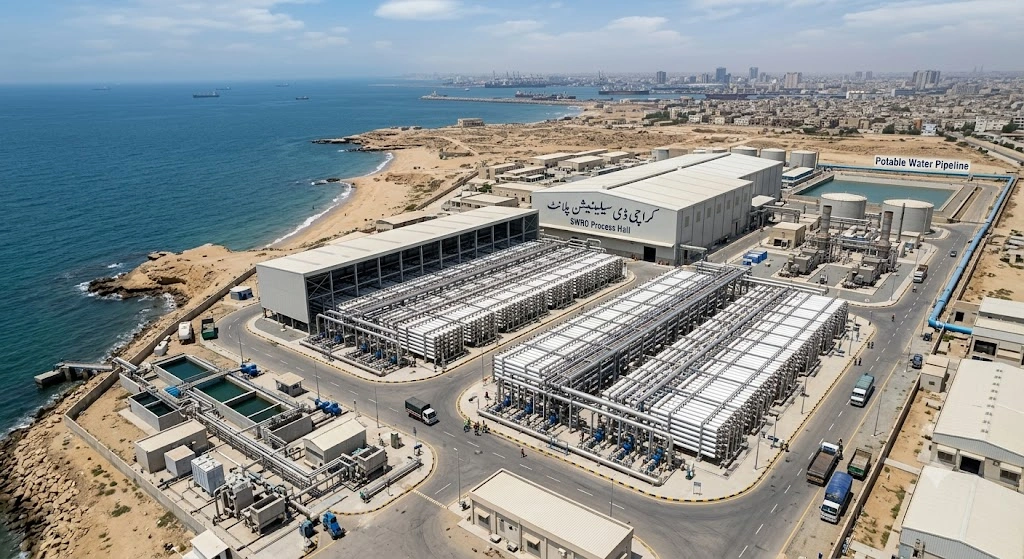
Feed water TDS for seawater typically ranges from 32,000 to 45,000 mg/L. Karachi’s Arabian Sea coastline is the primary context for seawater RO in Pakistan, with applications in municipal supply augmentation, coastal industrial facilities with no viable freshwater alternative, and large-scale power generation plants requiring process water.
Seawater RO systems recover 35 to 50% of feed water as product — meaning for every 100 litres you pump, you produce 35 to 50 litres of purified water and discharge 50 to 65 litres as brine. Energy consumption at full seawater salinity runs 3.5 to 5 kWh per cubic metre of product water, even with energy recovery devices.
Brackish Water RO
Brackish water is the more immediately relevant application for most Pakistani industries and municipalities. Groundwater TDS across Punjab’s agricultural zones, Sindh’s inland areas, and Balochistan’s rural regions commonly runs between 1,500 and 8,000 mg/L — well above WHO drinking water guidelines of 600 mg/L TDS but far below seawater salinity.
Brackish water RO systems operate at dramatically lower pressures, achieve 70 to 85% recovery rates, and consume 0.5 to 2.5 kWh per cubic metre — making them cost-competitive with alternative treatment options for many Pakistani applications. Industries in Faisalabad drawing on high-TDS groundwater for process water, textile mills in Sheikhupura dealing with scaling from hard brackish feed, and municipalities in southern Punjab serving communities without surface water access are the primary brackish water RO market in Pakistan.
| Parameter | Seawater RO | Brackish Water RO |
|---|---|---|
| Typical Feed TDS | 32,000 – 45,000 mg/L | 1,500 – 10,000 mg/L |
| Operating Pressure | 55 – 70 bar | 10 – 30 bar |
| Recovery Rate | 35 – 50% | 70 – 85% |
| Energy Consumption | 3.5 – 5 kWh/m3 | 0.5 – 2.5 kWh/m3 |
| Pre-treatment Complexity | High | Moderate |
| Cost per m3 Product Water | USD 0.80 – 2.50 | USD 0.30 – 0.80 |
| Primary Pakistan Application | Karachi coastal/industrial | Inland industry, municipalities |
| Brine Disposal Challenge | High | Moderate |
Water Desalination Cost Pakistan: What Does It Actually Cost to Build and Run?
Water desalination cost in Pakistan breaks into capital expenditure and operating expenditure, and both must be evaluated against your specific feed water, volume requirements, and energy cost structure before any investment decision makes sense.
Capital Expenditure
A small brackish water RO system producing 50 to 100 m3 per day for an industrial facility in Lahore or Faisalabad typically requires a capital investment of Rs. 35 lakh to Rs. 80 lakh, covering pre-treatment, membranes, high-pressure pump, control system, and installation. A mid-scale municipal brackish water plant at 500 to 1,000 m3 per day runs Rs. 2 crore to Rs. 6 crore. Seawater RO plants at municipal scale — 5,000 m3 per day and above — require capital investment starting at USD 3 million to USD 8 million, excluding land, civil works, brine outfall infrastructure, and grid connection.
These figures are directional. Actual costs depend on source water chemistry, pre-treatment requirements, membrane selection, site conditions, and energy infrastructure at the location.
Operating Expenditure
The dominant operating cost in RO desalination is energy. At Pakistan’s industrial electricity tariff of approximately Rs. 30 to Rs. 38 per kWh, a brackish water system consuming 1.5 kWh per m3 adds Rs. 45 to Rs. 57 per m3 in energy costs alone. Membrane replacement — typically every 3 to 7 years depending on feed water quality and pre-treatment effectiveness — adds Rs. 8 to Rs. 20 per m3 amortized. Chemical costs for scale inhibitor, antiscalant, and biocide dosing add Rs. 5 to Rs. 15 per m3.
Total operating costs for well-designed brackish water RO in Pakistan typically run Rs. 70 to Rs. 150 per m3. For context, packaged bottled water in Pakistan retails at Rs. 300 to Rs. 600 per m3 — meaning industrial RO-produced water offers a significant cost advantage over purchased water for quality-critical applications.
WCSP provides detailed site-specific cost modelling for RO desalination projects, based on actual source water analysis rather than generic estimates.
Is Desalination the Right Answer for Pakistan’s Water Shortage?
Desalination reverse osmosis in Pakistan addresses specific water scarcity problems very effectively — but it is not a universal solution, and applying it where simpler treatment would suffice wastes capital and operating budget.
The cases where desalination makes unambiguous sense in Pakistan:
Coastal Karachi with no viable alternative freshwater source. Industries on the Arabian Sea coast drawing process water from seawater or from groundwater with seawater intrusion above 5,000 mg/L TDS have no practical alternative to RO desalination. The technology is mature, the cost is manageable at scale, and the energy infrastructure in Karachi’s industrial zones can support the load.
Inland brackish groundwater above 2,000 mg/L TDS. Textile mills in Sheikhupura, beverage plants in Multan, and pharmaceutical manufacturers in Lahore drawing on groundwater that exceeds WHO TDS guidelines face a treatment requirement that brackish water RO resolves reliably. Softening alone cannot remove dissolved salts. Ion exchange is cost-prohibitive at volume. Brackish water RO is the right tool.
Municipal supply in areas with no surface water access. Communities in southern Punjab, interior Sindh, and parts of Balochistan sit on brackish aquifers with no nearby canal or river supply. Brackish water RO municipal plants — funded through government schemes or public-private partnerships — represent the most scalable solution to safe drinking water access in these regions.
The cases where you should consider alternatives first:
If your groundwater TDS is below 1,000 mg/L and your primary contaminants are hardness, iron, or biological, conventional softening, ultrafiltration, and UV disinfection will achieve your water quality target at a fraction of RO’s capital and operating cost. WCSP’s water treatment consultancy evaluates all viable technology options before recommending RO — because oversizing the solution is a cost the client carries for the plant’s entire operational life.
EXPERT INSIGHT — FROM WCSP’S PROJECT EXPERIENCE:
The most common mistake WCSP encounters in desalination project evaluations is selecting membrane type and operating pressure based on neighbouring facility specifications rather than on actual feed water analysis. Two boreholes 500 metres apart in southern Punjab can have dramatically different TDS, hardness, silica, and biological loads — and a system designed for one will underperform, scale, or fail prematurely on the other. Commission a comprehensive source water analysis before any design conversation begins. The cost is Rs. 15,000 to Rs. 40,000. The cost of a mismatched system is multiples of the capital investment.
Energy and Brine: The Two Challenges RO Desalination Must Solve
Two operational constraints shape the viability of any desalination reverse osmosis Pakistan project beyond the basic cost-per-m3 calculation: energy availability and brine disposal.
Energy
RO desalination is energy-intensive relative to conventional water treatment. Seawater RO at 3.5 to 5 kWh per m3 places a significant load on Pakistan’s constrained electricity grid, which already operates with significant load-shedding in industrial zones across Punjab and Sindh. Facilities planning seawater RO at scale should evaluate diesel generation backup requirements and their cost implications for operating economics.
Solar-powered RO is gaining traction in Pakistan as solar panel costs continue to fall. The International Renewable Energy Agency reports that the cost of utility-scale solar PV has fallen over 85% in the past decade globally. Pakistan’s solar irradiance — among the highest in South Asia — makes solar-coupled RO economically viable for remote locations in Balochistan and Sindh where grid power is expensive or unavailable. WCSP has designed solar-integrated RO systems for off-grid industrial and municipal applications, and the energy economics now support this configuration at systems above 50 m3 per day.
Brine Disposal
Every RO system produces a concentrate stream carrying rejected salts at 2 to 3 times the feed water concentration. For seawater RO near Karachi, brine disposal to the Arabian Sea through a properly designed outfall diffuser is the standard approach, subject to Sindh EPA environmental impact assessment requirements.
For inland brackish water RO in Punjab or Sindh, brine disposal is more complex. Discharge to municipal drains is subject to NEQS TDS limits of 3,500 mg/L — a threshold that brackish water RO brine typically exceeds. Options include evaporation ponds on available land, zero liquid discharge systems that further concentrate the brine to a solid or near-solid state, or blending with lower-TDS streams to dilute below discharge limits. WCSP’s Zero Liquid Discharge service integrates with RO concentrate management to achieve regulatory compliance at inland locations where brine discharge is constrained.
What Does a Desalination RO Plant Installation Look Like in Pakistan?
Understanding the implementation sequence for a desalination reverse osmosis Pakistan project helps you plan realistically — both for timeline and for the decisions you will need to make at each stage.
Stage 1: Source Water Characterization. Collect and analyze representative samples from your feed water source — borehole, seawater intake, or municipal connection. Parameters should cover TDS, major ions including calcium, magnesium, sodium, sulphate, chloride, and bicarbonate; silica; iron and manganese; biological load; SDI (Silt Density Index) for membrane fouling potential assessment. This analysis drives every downstream design decision.
Stage 2: Feasibility and Technology Selection. Based on source water data and your volume and quality requirements, evaluate RO against alternative or complementary treatment options. Determine recovery rate targets, brine management approach, and energy strategy. A WCSP feasibility study at this stage prevents expensive design changes later.
Stage 3: Pre-treatment and Membrane System Design. Engineer the pre-treatment train to achieve the feed water quality your selected RO membranes require — typically SDI below 5 for spiral-wound polyamide membranes. Design the membrane array, interstage pressure, and concentrate recirculation configuration to optimize recovery and minimize energy consumption.
Stage 4: Procurement and Civil Works. Source membranes, high-pressure pumps, pressure vessels, instrumentation, and chemical dosing systems. Manage civil works for foundation, inlet and outlet pipework, and chemical storage. Timelines typically run 4 to 8 months for mid-scale projects from contract award to commissioning.
Stage 5: Commissioning, Performance Testing, and Operator Training. Commission against design parameters, verify membrane rejection rates, confirm recovery targets, and establish chemical dosing set points. Train facility operators on daily monitoring, chemical handling, membrane cleaning protocols, and alarm response. WCSP provides structured commissioning and training programs as part of every project delivery.
WCSP’s Role in Pakistan’s Desalination and RO Sector
WCSP has designed, supplied, and commissioned RO systems across Pakistan’s industrial and municipal sectors since 2007. Our projects span brackish water treatment for textile manufacturers in Faisalabad and Lahore, process water production for pharmaceutical plants in Karachi, high-purity water systems for beverage manufacturers in Gujranwala, and municipal supply augmentation projects in water-stressed districts of Punjab and Sindh.
Our approach to desalination reverse osmosis Pakistan projects is built on three commitments:
Source-matched design. We begin every project with comprehensive feed water analysis. No two groundwater sources in Pakistan are identical, and designing against actual data rather than regional averages prevents the membrane fouling, scaling, and underperformance that characterize systems designed on assumptions.
Full technology integration. WCSP does not supply membranes and leave the client to manage the system. Our installations include pre-treatment engineering, automation and SCADA integration for continuous performance monitoring, and preventive maintenance programs that protect membrane life and sustain recovery rates across the system’s operational lifetime.
Lifecycle cost transparency. We model capital and operating costs against your specific electricity tariff, source water quality, and volume requirements before any design is finalized — so you know what the system actually costs to run, not what the equipment costs to buy.
Contact WCSP’s engineering team at /contact-us/ to discuss your desalination or brackish water treatment requirement and receive a site-specific feasibility assessment.
Conclusion
Pakistan’s water scarcity is not a future scenario — it is a present operational constraint that factories, municipalities, and industrial clusters are already managing at significant cost. Desalination by reverse osmosis is one of the most powerful tools available for expanding usable water supply, but its value depends entirely on matching technology to source water conditions.
Four things to carry forward from this analysis: first, distinguish between your feed water challenge before specifying a solution — seawater and brackish water are fundamentally different engineering problems with very different cost structures. Second, pre-treatment is not optional — it is the investment that determines whether your membrane system performs for five years or fails in eighteen months. Third, energy cost is the dominant operating variable for any RO system — evaluate solar integration seriously if your facility sits outside reliable grid coverage. Fourth, brine management must be planned before installation, not after — particularly for inland locations where NEQS TDS limits constrain direct discharge.
If you are evaluating desalination reverse osmosis Pakistan options for your facility or municipality, the starting point is a comprehensive source water analysis. Everything else follows from that data.
FAQ SECTION
1. How much does a desalination reverse osmosis plant cost in Pakistan?
A small brackish water RO plant producing 50 to 100 m3 per day costs Rs. 35 lakh to Rs. 80 lakh in Pakistan, including pre-treatment, membranes, and installation. Mid-scale municipal plants at 500 to 1,000 m3 per day run Rs. 2 crore to Rs. 6 crore. Seawater RO at municipal scale starts above USD 3 million. Operating costs for brackish water RO typically range from Rs. 70 to Rs. 150 per m3 depending on energy tariffs and feed water quality.
2. What is the difference between seawater RO desalination and brackish water treatment in Pakistan?
Seawater RO treats feed water at 32,000 to 45,000 mg/L TDS using pressures of 55 to 70 bar and is relevant primarily for Karachi coastal applications. Brackish water RO treats inland groundwater at 1,500 to 10,000 mg/L TDS using 10 to 30 bar, achieves 70 to 85% water recovery, and costs significantly less to operate. Most Pakistani industrial and municipal applications involve brackish rather than seawater desalination.
3. Is desalination by reverse osmosis viable for solving Pakistan’s water shortage?
Desalination reverse osmosis is viable and cost-effective for Pakistan’s coastal areas near Karachi and for inland industries dealing with brackish groundwater above 2,000 mg/L TDS. It is not the optimal solution for every scenario — where TDS is below 1,000 mg/L and primary contaminants are hardness or biological, conventional softening and ultrafiltration may deliver the same result at lower cost. A source water analysis is the essential first step before any technology selection.
4. How long does it take to install a reverse osmosis desalination plant in Pakistan?
A mid-scale brackish water RO plant producing 200 to 500 m3 per day typically takes 4 to 8 months from contract award to commissioning in Pakistan. This includes procurement of membranes and equipment (often 8 to 16 weeks for import lead times), civil works for foundations and pipework, installation, and commissioning. Smaller factory-scale systems of 50 m3 per day or less can be delivered and commissioned in 8 to 14 weeks in straightforward site conditions.
5. What happens to the brine waste from RO desalination plants in Pakistan?
Seawater RO brine near Karachi is typically discharged to the Arabian Sea through a designed outfall diffuser, subject to Sindh EPA environmental impact assessment. For inland brackish water RO plants, brine TDS typically exceeds NEQS discharge limits of 3,500 mg/L, requiring evaporation ponds, zero liquid discharge systems that reduce concentrate to solid or near-solid form, or dilution with lower-TDS streams before discharge. Brine management planning is essential before inland RO system design is finalized.
6. How does solar energy integration affect RO desalination costs in Pakistan?
Solar-powered RO significantly reduces operating costs for off-grid or partially grid-connected facilities in Pakistan. The International Renewable Energy Agency reports an 85% reduction in solar PV costs globally over the past decade. In Pakistan’s high-irradiance regions including Balochistan and Sindh, solar-coupled RO systems above 50 m3 per day now achieve energy costs 40 to 70% below diesel generation or unreliable grid supply, making desalination viable in locations where grid energy economics previously made it prohibitive.