Pakistan’s textile sector exports over $16 billion worth of goods annually, according to the Pakistan Bureau of Statistics — and a growing share of those buyers are now asking a question Pakistani exporters are not yet prepared to answer: what is your water footprint, and what are you doing about it?
The blue economy water credits framework is the mechanism through which that question becomes a commercial opportunity rather than a compliance burden. Industries that quantify, reduce, and verify their water impact do not just satisfy auditors. They qualify for green bonds, unlock preferential export terms with EU buyers under the EU Corporate Sustainability Reporting Directive, and build the water resilience that Pakistan’s tightening freshwater availability will demand within this decade.
Blue economy water credits in Pakistan are still in early-stage development as a formal market — but the underlying infrastructure of water stewardship, ESG water management, and verified reduction reporting is being built right now by the facilities that understand what is coming. This article explains how the framework works, which technologies generate credit-eligible water savings, and how Pakistani industry can position itself to profit from sustainability rather than pay for it.
What Is the Blue Economy and Why Does It Matter for Pakistani Industry?
The blue economy is an economic framework that assigns measurable value to sustainable water use — treating water not as a free industrial input but as a finite resource whose responsible management generates both operational savings and tradeable sustainability value.
The concept extends beyond oceans and fisheries, where it originated, to encompass all economic activities that depend on water — including manufacturing, agriculture, and municipal services. For Pakistan’s industrial sector, the blue economy framework matters for three reasons that converge simultaneously.
First, Pakistan’s freshwater stress is reaching the point where water-intensive industries face genuine supply-side risk. The World Bank classifies Pakistan among the world’s most water-stressed countries, with per capita availability declining from approximately 5,000 cubic metres in 1947 to around 1,000 cubic metres today — approaching the absolute scarcity threshold of 500 cubic metres. Industries that treat water as a costless input are pricing a resource that is becoming scarce, which means they are underpricing their operational risk.
Second, Pakistan’s primary export markets — the European Union, the United Kingdom, and the United States — are implementing supply chain sustainability disclosure requirements that extend to water. The EU’s Corporate Sustainability Reporting Directive, effective from 2024 for large EU companies and cascading to their supply chains, requires disclosure of water withdrawal, consumption, and recycling metrics. Pakistani textile exporters supplying H&M, Inditex, or Marks and Spencer will face contractual water reporting requirements within procurement cycles already underway.
Third, Pakistan’s State Bank has begun developing a green taxonomy and green financing framework. Facilities that can demonstrate verified water stewardship — the foundation of a blue economy water credits position — will qualify for preferential green financing instruments that their non-reporting competitors will not access.
How Do Water Sustainability Credits Actually Work for Pakistani Manufacturers?
Water sustainability credits translate physical water performance — litres conserved, cubic metres recycled, water bodies restored — into a verified unit that can be reported, traded, or used to demonstrate compliance with ESG water management commitments.
The mechanism is analogous to carbon credits but applied to water. An industrial facility measures its baseline water consumption per unit of production (water intensity), implements conservation or treatment measures that reduce that intensity, and obtains third-party verification of the reduction. The verified reduction becomes a credit that the facility can use for ESG disclosure, include in sustainability reports to export customers, apply toward green financing eligibility criteria, or in developing markets, sell to other entities seeking to offset their water impact.

Green & Blues
Who Issues and Verifies Water Credits
Several internationally recognised frameworks currently govern water credit and stewardship verification. The Alliance for Water Stewardship (AWS) Standard provides the most rigorous site-level water stewardship certification framework, accepted by major European and North American brands in their supplier sustainability programmes. The Water Footprint Network’s accounting methodology provides the measurement basis. The CEO Water Mandate, a UN Global Compact initiative, provides the reporting structure through which large companies and their supply chains disclose water stewardship progress.
For Pakistani industrial facilities, the practical entry point is AWS Level 1 certification — which requires a documented water balance, a site-level water risk assessment, and implementation of a water stewardship plan. WCSP’s real-time water monitoring and automation systems provide the continuous measurement infrastructure that AWS certification requires.
Which ESG Water Management Metrics Are Pakistan’s Export Buyers Actually Measuring?
Understanding what your buyer’s sustainability team actually measures is the difference between a credible water stewardship position and a glossy report that their compliance team discards in under a minute.
The metrics that matter in active EU and UK buyer sustainability audits for Pakistan’s textile sector — verified through procurement specifications that WCSP’s engineering team has reviewed — are specific and quantifiable.
Water intensity: litres of water consumed per kilogram of finished product, measured at the facility boundary and verified against production records. The apparel industry’s global average is approximately 100 litres per kilogram of fabric; leading sustainable manufacturers are achieving 40–60 litres per kilogram through closed-loop treatment and reuse systems.
Wastewater discharge quality: COD, BOD, heavy metals, and colour against ZDHC (Zero Discharge of Hazardous Chemicals) Wastewater Guidelines — a standard that is now contractually mandatory for suppliers to over 100 global apparel brands, and which is stricter than Pakistan’s NEQS on several parameters.
Water recycling rate: percentage of process water that returns to production after treatment, rather than being discharged. Facilities achieving recycling rates above 70% qualify for preferred supplier status under several major brand sustainability programmes.
Groundwater stress contribution: whether your facility draws from a groundwater basin classified as water-stressed, and what water saving measures you have implemented to reduce that contribution.
WCSP’s environmental monitoring programmes track all four categories, generating the documented evidence base that buyer sustainability audits require.
Pro Tip — Expert Insight from WCSP’s ESG Water Advisory Team
The mistake we see most often among Pakistani export manufacturers preparing for ESG water audits is treating water reporting as a paperwork exercise rather than an engineering exercise. You cannot report a water intensity figure that you have not measured. You cannot claim a recycling rate that your treatment system does not actually achieve. Buyers’ compliance teams are increasingly conducting on-site verification visits alongside document audits — and a facility that reports 60% water recycling but has a single-pass water system with no treatment infrastructure fails that verification immediately. Build the water management infrastructure first. The ESG report writes itself from the data your monitoring system generates.
The Green Economy Water Treatment Technologies That Generate Credit-Eligible Savings
Not every water treatment investment generates credit-eligible savings — the reduction must be measurable, attributable, and additional to business-as-usual performance. These are the technologies that consistently generate verifiable water savings in Pakistan’s industrial sector.
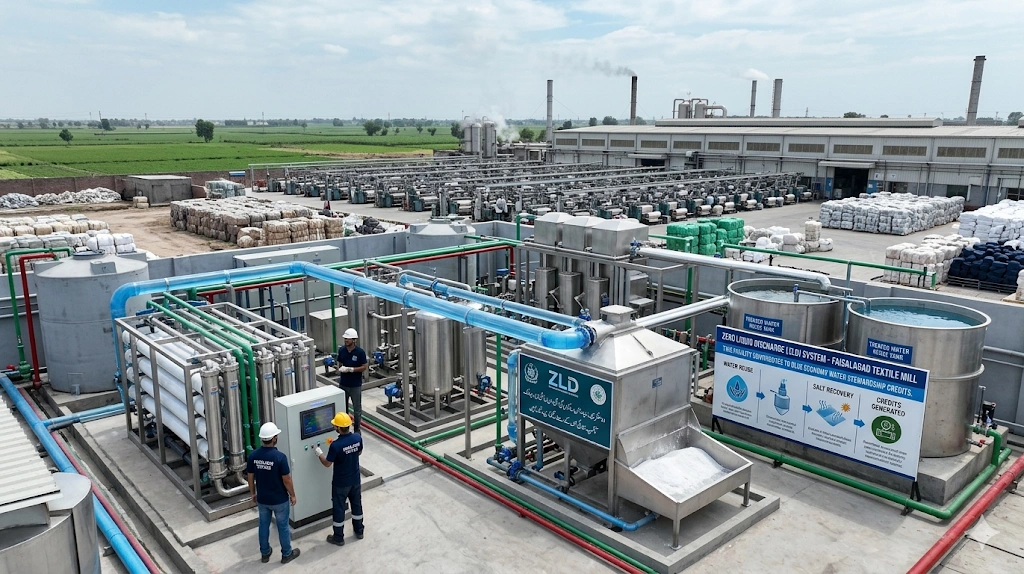
Zero Liquid Discharge systems represent the highest level of water recovery, returning 95% or more of process water back to the production cycle and generating a concentrated residual for further processing or disposal. For textile dyeing operations in Faisalabad and Gujranwala — which are under the most acute buyer sustainability scrutiny and the highest NEQS enforcement pressure simultaneously — ZLD is the technology that delivers the water intensity reduction and discharge elimination that both regulatory compliance and ESG water management require. WCSP’s ZLD systems are designed to produce water recycling documentation in a format directly compatible with AWS and ZDHC audit requirements.
Membrane Bioreactor systems, which WCSP deploys for industrial wastewater treatment across multiple sectors, achieve effluent quality that enables direct process water reuse — reducing freshwater intake proportionally to the volume reused. For a textile mill treating 1,000 m³/day of process wastewater and returning 700 m³/day to production after MBR treatment, the verified freshwater saving of 700 m³/day accumulates to over 250,000 m³/year — a water credit position of significant commercial value under AWS accounting methodology.
Reverse Osmosis combined with water recycling generates TDS-controlled process water from wastewater streams, eliminating the need for fresh groundwater abstraction for applications requiring low-TDS feed. WCSP’s RO systems for industrial water recycling track influent and permeate volumes continuously, generating the metered data records that third-party verifiers require.
Real-time monitoring and automation systems underpin every credit-generating technology by providing the continuous, tamper-evident data record that transforms operational water savings into verified, reportable, and tradeable sustainability credits.
How Pakistani Textile and Food Exporters Can Access Green Financing Through Water Stewardship
Green financing instruments linked to ESG water management performance are now accessible to Pakistani industrial borrowers — but the qualification criteria require documented water stewardship performance that most facilities currently cannot demonstrate.
Pakistan’s State Bank of Pakistan issued its Green Banking Guidelines in 2017 and has progressively developed a green taxonomy that includes water conservation and wastewater treatment as qualifying green activities. Commercial banks including Habib Bank, MCB, and Bank Alfalah have launched green financing facilities that offer preferential interest rates for qualifying environmental investments. The interest rate differential for green-certified projects has typically ranged from 50 to 150 basis points below standard commercial lending rates — a material saving on the capital cost of treatment infrastructure investment.
| Financing Instrument | Issuing Institution | Qualifying Water Activities | Key Documentation Required |
|---|---|---|---|
| Green Banking Facilities | SBP-regulated commercial banks | ZLD, MBR, water recycling, RO for reuse | Water audit report, treatment system specifications, monitoring plan |
| IFC Climate Finance | International Finance Corporation | Industrial water efficiency, wastewater reuse | Water balance, baseline and projected intensity, third-party verification |
| ADB Water Financing | Asian Development Bank | Municipal and industrial water conservation | Full feasibility study, environmental assessment, performance bonds |
| Export Green Premium | EU buyer sustainability programmes | AWS certification, ZDHC compliance | On-site audit report, continuous monitoring data, annual disclosure |
| Blue Bond Issuance | Emerging market capital markets | Portfolio-level water stewardship | Aggregated verified savings, third-party audit, annual reporting |
For Pakistani textile exporters in Lahore and Faisalabad targeting EU market access, the most immediately accessible financial benefit is not direct credit trading — that market is nascent in Pakistan — but the export contract premium and preferred supplier status that AWS-aligned water stewardship documentation delivers. A ZDHC-compliant wastewater treatment system, verified by an accredited third party, can be the deciding factor in a supply contract award between two otherwise equivalent Pakistani manufacturers.
Building Your Blue Economy Water Position: A Practical Roadmap for Pakistani Industries
The gap between recognising blue economy water credits as an opportunity and realising commercial value from that position is a structured implementation programme. Here is what that programme looks like in practice for a mid-scale Pakistani industrial facility.
The foundation is a water balance audit — a complete accounting of every water input, every process use, every loss, and every discharge across your facility boundary. Without this, you do not know your baseline, and without a baseline, you cannot measure or claim any reduction. WCSP conducts water balance audits as the first phase of any water stewardship or green financing engagement.
Next, identify your highest-impact reduction opportunities. For most Pakistani textile and food processing facilities, the largest water savings come from process water recycling after treatment, cooling water optimisation, and elimination of single-pass water use in dyeing and washing operations. The technologies that deliver these savings — MBR, ZLD, RO recycling systems — also generate the continuous monitoring data that credit frameworks require.
Then select your verification framework based on your primary market. If your target is EU buyer compliance, AWS certification and ZDHC wastewater compliance are the relevant standards. If you are seeking SBP green financing, the bank’s internal green taxonomy documentation requirements apply. If you are positioning for IFC or ADB green financing, their specific environmental and social performance standards govern the verification process.
Finally, implement real-time monitoring infrastructure at every metering point your chosen verification framework requires. Quarterly manual sampling is insufficient for most credible verification programmes. Continuous online monitoring of water volumes, flow rates, and key quality parameters provides the auditable data record that third-party verifiers and buyer compliance teams rely on.
WCSP supports the full pathway — from water balance audit through technology installation to monitoring system integration and documentation for AWS, ZDHC, and SBP green financing applications.
CONCLUSION
The financial logic of blue economy water management has flipped. Water stewardship used to cost Pakistani industry money — compliance infrastructure, treatment systems, reporting overhead. It now generates money — through green financing cost reductions, export contract premiums, preferred supplier status with high-value international buyers, and reduced regulatory risk in an enforcement environment that is tightening year by year.
Four things to do now: commission a water balance audit to establish your measurable baseline; identify which treatment investments deliver both operational savings and credit-eligible water performance; select a verification framework aligned to your primary export market or financing target; and implement continuous monitoring infrastructure that generates the auditable data your chosen framework requires.
Blue economy water credits in Pakistan represent an emerging commercial infrastructure that the best-positioned industrial facilities are building now. The water stewardship performance you establish in the next three years will determine your access to green financing, your position in export supplier rankings, and your regulatory standing as Pakistan’s water governance framework tightens.
Ready to upgrade your water treatment system? Contact WCSP’s expert team today at watercareservices.org/contact-us/ — and get a water stewardship assessment that maps your facility’s blue economy potential against the specific markets and financing instruments relevant to your operation.
Explore next: Zero Liquid Discharge for Pakistani Industry: When the Investment Makes Sense — and Wastewater Treatment for Agriculture: How Treated Water Can Solve Pakistan’s Irrigation Crisis.
FAQ
1. What are blue economy water credits and how do they work in Pakistan?
Blue economy water credits in Pakistan are verified sustainability units that industrial facilities earn by reducing freshwater consumption, recycling wastewater, or improving discharge quality. They are measured against a documented baseline using frameworks like the Alliance for Water Stewardship Standard, then verified by accredited third parties. Businesses use them for ESG reporting to export buyers, green financing qualification, and preferred supplier status with international brands.
2. How can Pakistani textile factories benefit from ESG water management programmes?
Pakistani textile exporters with documented water stewardship programmes — including verified recycling rates, ZDHC-compliant wastewater discharge, and continuous monitoring data — qualify for preferred supplier status with EU and UK brands, access green financing at preferential interest rates from SBP-regulated banks, and reduce their regulatory exposure to Pakistan EPA enforcement. ESG water management converts a compliance cost into a competitive commercial advantage in export markets.
3. What is the Alliance for Water Stewardship standard and is it recognised in Pakistan?
The Alliance for Water Stewardship Standard is an internationally recognised framework for site-level water stewardship certification, requiring a documented water balance, water risk assessment, and a stewardship implementation plan. It is accepted by over 100 global brands in their supplier sustainability programmes, including major EU apparel buyers. Pakistani industrial facilities can pursue AWS certification through accredited certification bodies, with WCSP’s monitoring systems providing the data infrastructure AWS Level 1 requires.
4. Can Pakistani industries access green financing for water treatment investments?
Yes. Pakistan’s State Bank green banking guidelines and the green taxonomy framework allow SBP-regulated commercial banks to offer preferential financing for qualifying water conservation and wastewater treatment investments. Interest rate differentials of 50 to 150 basis points below standard commercial rates are typical for green-certified projects. International financing through IFC and ADB is also accessible for qualifying industrial water efficiency and wastewater reuse projects with appropriate documentation.
5. What water treatment technologies generate verifiable blue economy water credits?
Technologies that generate measurable, auditable water savings eligible for blue economy water credit frameworks include Zero Liquid Discharge systems (up to 95% water recovery), Membrane Bioreactor systems (enabling direct process water reuse), Reverse Osmosis water recycling, and real-time monitoring systems that provide the continuous data record verification requires. The combination of treatment technology plus metered monitoring is what converts operational savings into creditable, reportable sustainability performance.
6. How long does it take for a Pakistani factory to get water stewardship certification?
An AWS Level 1 water stewardship certification typically requires 12 to 18 months from initial water balance audit to certification award — covering audit, gap analysis, implementation of required measures, and third-party verification. Achieving ZDHC wastewater compliance, a prerequisite for many EU buyer programmes, typically requires 6 to 12 months depending on the starting point of your treatment infrastructure. WCSP’s end-to-end water stewardship programme supports the full timeline from baseline to verified certification.