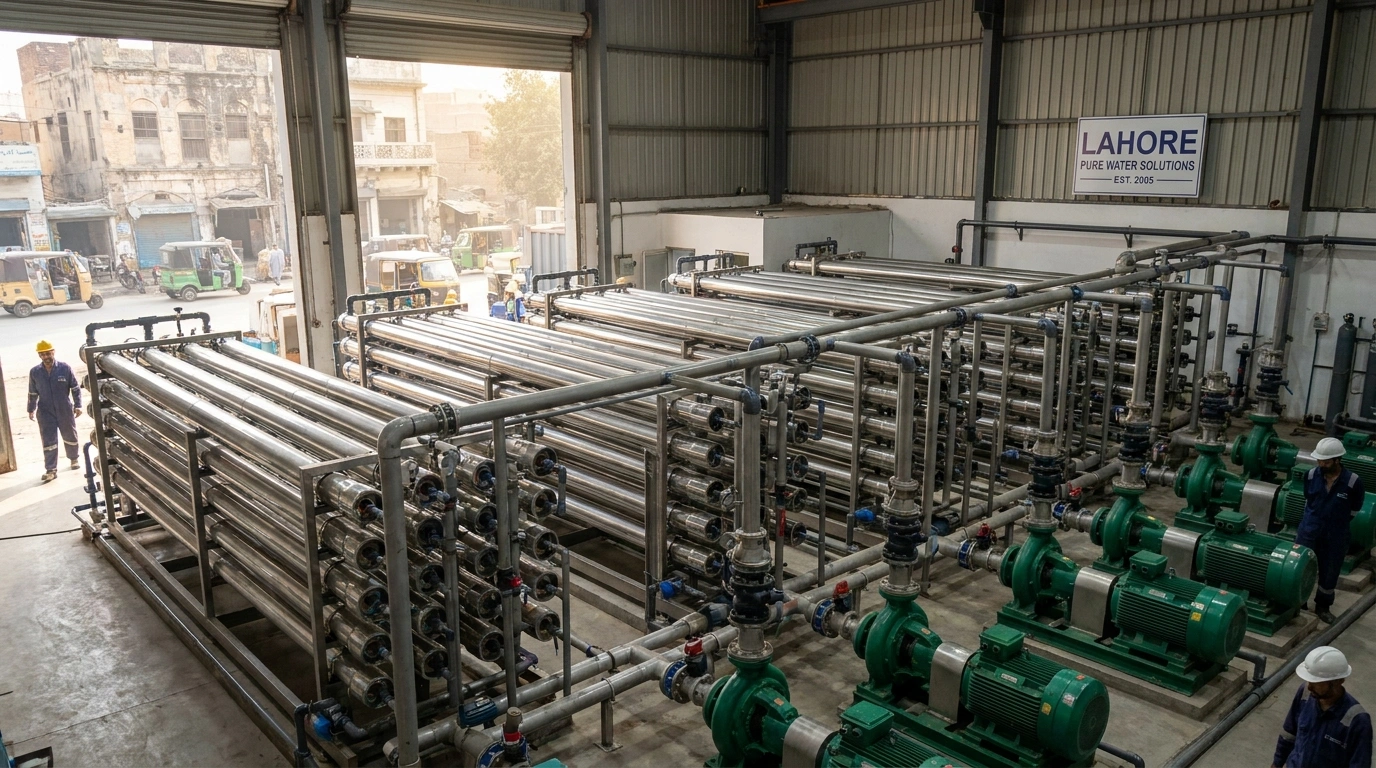
That question keeps a lot of factory managers and entrepreneurs stuck — not because the technology is mysterious, but because the numbers vary wildly, and most vendors give you a quote without explaining what drives it. Pakistan’s industrial water treatment market is growing fast: according to the Global Water Intelligence report (2024), Asia-Pacific now accounts for over 38% of new industrial RO installations worldwide, with South Asian demand rising sharply due to tightening discharge regulations and groundwater depletion. In Pakistan alone, NEQS-driven compliance pressure has pushed hundreds of factories to evaluate water treatment investments in the last three years.
This article breaks down the real reverse osmosis plant cost in Pakistan for 2026 — not ballpark guesses, but a structured breakdown by system capacity, application type, and local installation variables. Whether you are sizing a plant for a bottled water startup in Lahore, a textile dyeing unit in Faisalabad, or a pharmaceutical facility in Karachi, you will leave here knowing exactly what drives cost and how to avoid overpaying.
Let us get into it.
What Determines Reverse Osmosis Plant Cost in Pakistan?
The price range for RO systems in Pakistan is genuinely wide — and that is not a cop-out. A 500 LPH domestic-commercial unit and a 500 m3/day industrial plant are both called “RO systems,” yet their cost difference can exceed 100x. The variables that matter most are:
Capacity is the single biggest cost driver. Systems are sized in liters per hour (LPH) or cubic meters per day (m3/day). Moving from 500 LPH to 5,000 LPH does not multiply cost by ten — it multiplies it by roughly three to four, because major components like high-pressure pumps, membrane housings, and control systems scale non-linearly.
Feed water quality comes second. Groundwater in cities like Gujranwala and Sialkot often carries high Total Dissolved Solids (TDS) exceeding 1,500 ppm, plus iron, manganese, and hardness. That means pre-treatment — multimedia filtration, iron removal, softening — before a single membrane is installed. Pre-treatment can add 20 to 40% to your total project cost.
Recovery rate and reject management matter especially in water-scarce regions. A standard single-pass RO recovers 50 to 75% of feed water; the rest is reject or brine. In industrial settings where municipal water costs are rising, designing for higher recovery — or integrating reject water reuse — changes both equipment and civil cost.
Automation and instrumentation vary dramatically. A manually operated RO skid with basic pressure gauges costs far less than a fully automated system with SCADA, real-time TDS monitoring, flow logging, and remote alerts — the kind WCSP deploys for pharmaceutical and food-grade clients.
Membrane type and brand origin round out the key variables. Imported membranes from Dow FilmTec, Toray, or Hydranautics carry premium pricing; locally assembled systems using Chinese OEM membranes cost 30 to 50% less upfront but may require more frequent replacement.
Reverse Osmosis Plant Cost Breakdown by Capacity — 2026 Pakistan Pricing
Below is a structured cost reference for Pakistani buyers in 2026. Figures reflect installed costs, including pre-treatment, membrane skid, high-pressure pump, electrical panel, piping, and basic commissioning. Civil works are excluded unless noted.
What Does RO Plant Installation in Lahore and Other Cities Actually Cost?
Installation cost in Lahore, Karachi, Faisalabad, and other major cities varies by site conditions, not by city alone. The biggest local variable is civil infrastructure — whether a dedicated plant room exists, whether the incoming water supply is pressurized, and the distance between the water source and the treatment skid.
In Lahore and Karachi, where WCSP has completed dozens of commercial and industrial projects, civil preparation for a mid-size industrial RO plant (10,000 to 25,000 LPH) typically adds PKR 200,000 to 800,000 on top of equipment cost. This covers:
Concrete base or skid platform installation Inlet and outlet piping to holding tanks Electrical supply and earthing for high-pressure pump Reject water drain line or return-to-process plumbing
In Sialkot and Gujranwala — both dominated by surgical, leather, and electroplating industries — NEQS compliance pressure is particularly high, and pre-treatment requirements are heavier due to groundwater contamination. WCSP’s RO system projects in these cities typically include iron removal filters and antiscalant dosing systems as standard, pushing installation packages 15 to 25% above national baseline.
In Faisalabad’s textile belt, high-volume RO systems are often integrated with upstream softening and downstream effluent treatment — sometimes requiring coordination with WCSP’s wastewater treatment division for combined project delivery.
Expert Insight from WCSP: After 17+ years in Pakistan’s water treatment sector, the most common mistake we see is clients sizing their RO plant for today’s production volume, not tomorrow’s. A textile unit in Faisalabad that installs a 10,000 LPH system and expands capacity 18 months later faces expensive retrofitting. We always recommend building in at least 25 to 30% future capacity headroom at the design stage — the incremental membrane and housing cost is minimal, but the long-term savings are substantial.
How Does Pre-Treatment Affect Your RO Plant Budget?
Pre-treatment is where most budget surprises hide. Membranes are precision components; they fail prematurely when feed water contains suspended solids, chlorine, iron, hardness, or biological contaminants above tolerance thresholds. Pre-treatment protects your membrane investment and extends system life from the industry average of 3 to 5 years per membrane element to 5 to 7 years with proper upstream conditioning.
Common pre-treatment stages for Pakistani groundwater and municipal supply:
Multimedia Filtration removes TSS and turbidity. Cost: PKR 50,000 to 200,000 depending on vessel size.
Iron and Manganese Removal is critical for Gujranwala and Lahore groundwater users. Birm or greensand filter media, with backwash automation. Cost: PKR 80,000 to 250,000.
Water Softening (Ion Exchange) protects membranes from calcium and magnesium scaling. For industrial systems, duplex softeners with automatic regeneration are standard. Cost: PKR 100,000 to 500,000.
Antiscalant Dosing System injects scale inhibitor into feed water. Low capital cost (PKR 30,000 to 80,000) but critical for systems in high-hardness zones.
5-Micron Cartridge Filtration serves as the final pre-membrane guard. Relatively inexpensive (PKR 15,000 to 50,000) but often the first system to fail when upstream pre-treatment is undersized.
WCSP’s water treatment design approach always begins with a comprehensive feed water analysis before specifying pre-treatment. Skipping this step is the fastest way to spend money twice.
Commercial RO System Price vs. Industrial RO System — Where Is the Line?
The terms “commercial” and “industrial” get used loosely by vendors, which causes real confusion when you are budgeting. Here is how WCSP defines the distinction:
A commercial RO system typically serves facilities with low-to-moderate water demand where water quality — not volume — is the primary driver. Think hospitals, hotels, schools, bottled water startups, and water ATM businesses. Commercial systems generally run between 500 and 5,000 LPH, use single-pass membrane configurations, and require minimal automation beyond basic pressure and TDS monitoring.
An industrial RO system serves manufacturing processes where water is a production input — not just a utility. Textile dyeing requires specific TDS and conductivity. Pharmaceutical manufacturing requires water meeting WHO or BP (British Pharmacopoeia) standards. Beverage factories require microbiologically compliant product water. These applications demand multi-stage RO, continuous monitoring, Clean-in-Place (CIP) capability, and often downstream polishing via ultrafiltration or UV disinfection.
The cost gap reflects this complexity. A commercial 2,000 LPH system installed in a Lahore clinic might cost PKR 650,000. A pharmaceutical-grade 2,000 LPH system with the same membrane capacity but compliant instrumentation, CIP integration, and validation documentation can cost PKR 2,500,000 or more. You are not paying for more membranes — you are paying for reliability, compliance, and traceability.
WCSP’s commercial RO solutions and industrial water treatment systems are designed around these distinctions from the ground up.
What Are the Ongoing Operating Costs of an RO Plant in Pakistan?
Capital expenditure gets all the attention, but operating cost determines your five-year financial reality. For a mid-size industrial RO system in Pakistan, ongoing costs fall into four categories:
Energy: High-pressure pumps are the dominant energy consumer. A 10,000 LPH system typically runs a 7.5 to 15 kW pump. At Pakistan’s current industrial electricity tariff of approximately PKR 45 to 55 per kWh (NEPRA, 2024), daily energy cost for continuous operation ranges from PKR 8,000 to 20,000. Energy-efficient pump selection and variable frequency drives (VFDs) can reduce this by 20 to 35%.
Membrane Replacement: Membranes typically require replacement every 3 to 5 years under normal operating conditions. A 10,000 LPH system uses 12 to 24 membrane elements. Imported DOW FilmTec elements cost PKR 25,000 to 45,000 each; Chinese OEM equivalents run PKR 8,000 to 18,000 each. Budgeting PKR 300,000 to 800,000 every 4 years for membrane replacement is realistic for a mid-size plant.
Consumables: Antiscalant chemicals, cartridge filters, and softener salt represent ongoing monthly costs of PKR 15,000 to 60,000 depending on system size and feed water quality.
Maintenance and AMC: WCSP offers Annual Maintenance Contracts covering scheduled service, membrane performance checks, and emergency call-out. AMC pricing for mid-size industrial systems typically ranges from PKR 150,000 to 400,000 per year — significantly less than the cost of an unplanned membrane replacement or pump failure.
How to Evaluate Water Purification Plant Proposals from Vendors in Pakistan?
Most Pakistani buyers evaluate RO proposals primarily on upfront price. That is a mistake that costs far more in the medium term. Here is the framework WCSP recommends for evaluating competing proposals:
Step 1 — Confirm the design basis. Does the proposal specify the feed water TDS, temperature, recovery rate, and permeate TDS guarantee? A proposal without these numbers is not a proposal — it is a quote with no engineering behind it.
Step 2 — Check membrane brand and count. Verify the number of membrane elements, their brand origin, and the expected permeate flow at stated conditions. Vendor datasheets should match the stated capacity under your specific feed water conditions, not idealized lab conditions.
Step 3 — Audit the pre-treatment scope. Is softening, iron removal, and multimedia filtration included? Or does the proposal assume “city supply” quality feed water that your actual source will not match?
Step 4 — Clarify automation level. What monitoring does the system include? Is there automatic shut-down on high pressure or low flow? Remote monitoring capability? These matter for operational continuity.
Step 5 — Evaluate the warranty and after-sales support. A low-cost vendor with no service infrastructure in your city is a liability. WCSP operates from Lahore with service capacity across Punjab, Sindh, and KP.
Step 6 — Request site references. A credible water treatment company should be able to provide at least three verified installation references in your industry category.
WCSP’s water purification plant design and supply process follows a structured engineering review before any proposal is submitted.
Does Your RO Plant Need to Comply with NEQS Regulations in Pakistan?
If your RO plant is part of an industrial water treatment or effluent reuse system, Pakistan’s National Environmental Quality Standards (NEQS) absolutely apply to your discharge and process water. The Pakistan Environmental Protection Act (PEPA) 1997 and its 2012 amendments empower provincial EPAs to audit industrial facilities and impose fines for non-compliant effluent quality.
For facilities in Punjab (including Lahore, Faisalabad, Gujranwala, Sialkot), the Punjab EPA conducts routine inspections. Textile mills, tanneries, and electroplating units face the highest compliance scrutiny. RO reject or brine water cannot be discharged directly without treatment in most industrial zones.
WCSP’s integrated approach connects RO system design with downstream wastewater treatment — ensuring that reject water is either reused in process, treated to NEQS standards before discharge, or directed into a Zero Liquid Discharge framework for zero-discharge compliance. This is particularly relevant for facilities seeking ISO 14001 certification or operating in export-facing supply chains where international buyers now audit environmental compliance as part of their sourcing decisions.
WCSP’s environmental compliance services support clients through NEQS documentation, EPA inspection preparation, and ongoing effluent quality monitoring.
CONCLUSION
Getting your RO plant specification and budget right the first time is entirely achievable — but only if you approach it with the right information and the right partner.
Here are four takeaways to carry forward. First, reverse osmosis plant cost in Pakistan ranges from PKR 150,000 for a basic commercial system to PKR 25 million or more for a large industrial plant — capacity, pre-treatment requirements, and automation level are the three primary cost drivers. Second, pre-treatment is not optional: skipping or undersizing it shortens membrane life and raises your five-year total cost significantly. Third, operating cost — energy, membranes, consumables, AMC — can exceed capital cost within five years, so evaluate proposals on lifecycle cost, not just sticker price. Fourth, NEQS compliance is not a future concern; if your facility discharges industrial effluent or uses water in a regulated process, your RO system design needs to account for it now.
Ready to upgrade your water treatment system? Contact WCSP’s expert team today at /contact-us/ and get a site-specific design recommendation backed by 17 years of water treatment expertise in Pakistan.
Related topics to explore next: — How to Design a Zero Liquid Discharge System for Textile Factories in Pakistan — Water Softening Plant Cost and ROI for Industrial Facilities in Lahore
FAQ SECTION
1: What is the average reverse osmosis plant cost in Pakistan in 2026?
The average reverse osmosis plant cost in Pakistan in 2026 ranges from PKR 150,000 for a small commercial system to over PKR 25 million for a large industrial plant. Key cost drivers include system capacity in LPH or m3/day, feed water quality, pre-treatment requirements, membrane brand, and automation level. Always request an itemized proposal that separates equipment from installation.
2: How much does RO plant installation cost in Lahore for a factory?
RO plant installation in Lahore for an industrial facility typically costs PKR 2 million to 10 million depending on capacity and site conditions. Civil preparation — plant room, piping, electrical supply — adds PKR 200,000 to 800,000 on top of equipment cost. Feed water quality in Lahore often requires softening and iron removal pre-treatment, which should be included in any site-specific proposal.
3: What is the commercial RO system price range in Pakistan?
Commercial RO system prices in Pakistan range from PKR 400,000 to 2,500,000 for systems between 1,000 and 5,000 LPH. Systems for hospitals, hotels, and water shops fall in the lower range with basic instrumentation. Pharmaceutical-grade or food-grade commercial systems cost significantly more due to compliance instrumentation, CIP capability, and validation documentation requirements.
4: How long do RO membranes last in Pakistani industrial conditions?
RO membranes in Pakistani industrial conditions typically last 3 to 5 years with standard pre-treatment, or 5 to 7 years with optimized pre-treatment and regular antiscalant dosing. Feed water with high TDS, iron, hardness, or biological load shortens membrane life. Scheduled pressure and TDS monitoring, along with annual cleaning cycles, are essential for maximum membrane lifespan.
5. Does a water purification plant in Pakistan need NEQS approval?
Any water purification plant that generates reject or brine water, or that processes industrial effluent, must comply with Pakistan’s National Environmental Quality Standards under PEPA 1997. Provincial EPAs in Punjab, Sindh, and KP conduct facility inspections. Facilities in regulated industries — textile, tanneries, pharma, food processing — should integrate RO system design with downstream effluent treatment to ensure full NEQS compliance.
6: How much do RO plant operating costs add up to annually in Pakistan?
Annual operating costs for a mid-size industrial RO plant in Pakistan typically range from PKR 1.2 million to 4 million, covering energy (the largest cost at current NEPRA tariffs), consumables such as antiscalant and cartridge filters, scheduled maintenance, and periodic membrane replacement provisions. An Annual Maintenance Contract with a certified provider like WCSP reduces unplanned downtime costs and protects your membrane investment.