How many hours did your water treatment plant operate at suboptimal dosing last month? If you cannot answer that question precisely, your plant is almost certainly wasting money on excess chemicals, running membrane systems harder than necessary, or flying blind on effluent quality until a compliance failure forces your attention. The gap between knowing and not knowing is now measurable in hundreds of thousands of rupees annually.
McKinsey and Company estimates that AI water treatment optimization in industrial and municipal water systems can reduce operating costs by 15 to 25 percent and cut unplanned downtime by up to 40 percent. These are not theoretical projections. They are averages drawn from deployments across Asia, the Middle East, and increasingly Pakistan’s own industrial corridor.
This article covers what AI and machine learning actually do inside a water treatment plant, which applications deliver the highest return in Pakistan’s industrial context, what it costs to implement, and how to evaluate whether your operation is ready. No hype — only what works, and what the evidence shows.
What AI Water Treatment Optimization Actually Means in Practice
Strip away the marketing language and AI water treatment optimization is fundamentally about replacing static, rule-based control logic with adaptive systems that learn from operating data and adjust process parameters automatically. A conventional water treatment plant operates on fixed setpoints: if pH drops below 6.8, add caustic. If turbidity exceeds 5 NTU, increase coagulant. These rules work — until the feedwater changes, the load spikes, or the instrument drifts.
Machine learning models take a different approach. Instead of fixed rules, they build statistical models of how your specific plant responds to specific inputs — feedwater TDS, temperature, flow rate, organic load, seasonal variation — and use those models to predict the optimal process response in real time. The system does not just react to what has happened; it anticipates what is about to happen and adjusts proactively.
In a Pakistan textile ETP running continuous production across three shifts, this distinction is material. Manual operators adjust dosing reactively, often 15 to 30 minutes after the process condition has already shifted. An ML-driven dosing control system running on sensor data at one-minute intervals makes those adjustments continuously, without human delay. The result is tighter effluent quality, lower chemical consumption, and a more consistent compliance record — all at once.
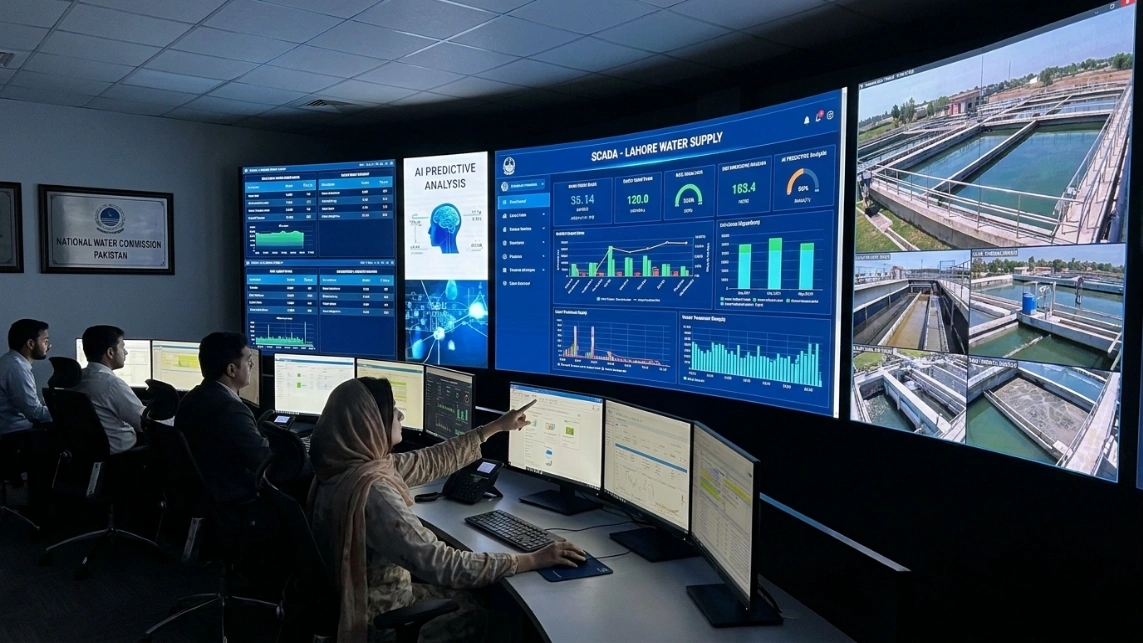
WCSP’s automation and real-time monitoring systems provide the sensor infrastructure and SCADA connectivity that forms the foundation for AI-driven process control. Without reliable, calibrated real-time data, machine learning models have nothing to learn from.
Predictive Maintenance for Water Treatment: The Highest-ROI AI Application
Of all the machine learning applications available to water treatment operators in 2026, predictive maintenance for water treatment systems consistently delivers the fastest return on investment. The reason is straightforward: a pump failure, blower failure, or membrane integrity breach in a critical treatment stage does not just cost the price of the part — it costs production downtime, potential compliance violations, emergency contractor callouts, and the knock-on cost of operating without the failed component.
Predictive maintenance uses continuous vibration, temperature, current draw, and pressure differential data from plant equipment to train anomaly detection models. These models learn what normal equipment behaviour looks like and flag deviations before they become failures. A centrifugal pump bearing that is beginning to fail typically shows a detectable vibration signature 100 to 300 operating hours before it seizes. An ML model monitoring that signature can alert your maintenance team to schedule a bearing replacement during planned downtime — not during a Saturday night production run.
Real results from the field
The International Water Association’s 2025 Digital Water Report documents case studies from water utilities and industrial operators in Southeast Asia and South Asia where predictive maintenance reduced reactive maintenance events by 55 to 70 percent. For a large textile complex in Faisalabad running three MBR trains continuously, eliminating even two unplanned blower failures per year translates to PKR 1.5 to 4 million in avoided downtime and emergency repair cost, depending on production loss calculations.
WCSP’s energy management and automation services include sensor integration and SCADA data logging that can feed directly into predictive maintenance platforms. The prerequisite is a minimum of six to twelve months of clean operational data — which most well-instrumented plants already have, sitting unused in historian databases.
Six AI Applications Delivering Measurable Results in Water Treatment
The table below maps specific machine learning applications to treatment stages, performance outcomes, and Pakistan industry use cases. Use it to identify where AI adds the most value in your specific operation.
| AI Application | What It Does | Treatment Stage | Measurable Benefit | Pakistan Use Case |
| Predictive Dosing Control | ML model adjusts coagulant and disinfectant dose in real time based on feedwater quality sensors | Pre-treatment / primary | 15–30% chemical cost reduction | Textile ETP, municipal WTP |
| Membrane Fouling Prediction | Analyses pressure differential trends to predict fouling 12–48 hrs before it occurs | RO / UF / MBR stage | 20–35% reduction in unplanned downtime | RO plants in Karachi, Lahore pharma |
| Predictive Maintenance | Vibration, temperature, and flow data fed to ML models to flag pump/blower failures before they happen | Whole plant | 40–60% reduction in reactive maintenance | Industrial ETPs, ZLD systems |
| Energy Optimisation | AI schedules high-load equipment (blowers, pumps) to avoid peak tariff hours while meeting treatment targets | Aeration, pumping | 10–20% energy cost saving | MBR plants, large municipal WTPs |
| Effluent Quality Forecasting | Predicts output TDS, BOD, TSS 2–4 hrs ahead, enabling proactive process adjustment before NEQS breach | Secondary / tertiary | Near-zero NEQS violation events | NEQS-monitored factories, Punjab EPA |
| Anomaly Detection | Neural networks flag abnormal sensor readings that indicate instrument failure, bypass events, or contamination | All stages | Faster incident response, audit trail | Compliance-critical industries |
Source: Application performance ranges derived from International Water Association Digital Water Report 2025 and WCSP operational project data.
| Expert Insight — From WCSP’s 17+ Years in Pakistan Water Treatment
The most common mistake we see when Pakistan industries explore AI for their water plants is starting with the wrong layer of the stack. They want machine learning dashboards before they have reliable sensor data. A machine learning model trained on faulty or infrequently calibrated sensor readings will produce confident but wrong recommendations — which is worse than no model at all. The correct sequence is: instrument properly first, collect six to twelve months of clean data, then layer the analytics. The second observation: AI dosing optimisation gives the fastest visible return in plants with high chemical costs and variable feedwater quality — which describes the majority of Pakistan’s industrial ETPs. A textile mill in Lahore drawing from a common effluent channel with fluctuating dye load and pH is exactly the application where ML-driven dosing outperforms a human operator on every shift. |
How Machine Learning Improves Membrane System Performance
Membrane systems — whether reverse osmosis, ultrafiltration, or MBR — are the most capital-intensive components in most modern water treatment plants. They are also the components most sensitive to operating conditions. Fouling, scaling, and biofouling reduce membrane permeability, increase trans-membrane pressure, force early cleaning cycles, and shorten membrane life.
Machine learning approaches membrane management differently from conventional rule-based systems. Rather than initiating a clean-in-place cycle when trans-membrane pressure crosses a fixed threshold, an ML model analyses the rate of pressure rise, the feedwater quality trend, the temperature profile, and the time since the last cleaning event to predict when fouling will reach the threshold — typically 12 to 48 hours in advance. This transforms CIP scheduling from reactive to proactive.
What this means for RO plant operators in Pakistan
Pakistan’s groundwater presents a particularly challenging membrane environment. High TDS, elevated silica, iron, and manganese content — common across Punjab and Sindh aquifers — create complex fouling profiles that a fixed cleaning schedule handles poorly. A Lahore pharmaceutical plant or a Karachi food-grade water facility running RO on groundwater at 1,200 to 1,800 ppm TDS benefits enormously from an ML model that can distinguish silica fouling from biofouling and recommend the correct cleaning chemistry and timing for each event.
According to the Water Environment Federation’s 2024 Membrane Technology Report, AI-managed membrane systems extend membrane replacement intervals by 20 to 35 percent compared to conventional scheduled maintenance approaches. At PKR 150,000 to 600,000 per RO membrane element replacement depending on diameter and specification, this extension delivers significant capital deferral.
WCSP’s reverse osmosis systems are designed with monitoring points and historian connectivity that support ML-based fouling prediction. Our CIP systems include automated chemical preparation and dosing that can integrate with intelligent scheduling platforms.
Digital Water Management Systems: What the Full Stack Looks Like
A complete digital water management system integrates hardware sensors, communication infrastructure, SCADA, data historians, and analytics software into a unified operational intelligence platform. Understanding the layers helps you assess what you have, what you need, and where AI adds the most value.
Layer 1: Sensors and instrumentation
Online analysers for pH, dissolved oxygen, turbidity, conductivity, TDS, flow rate, and level form the data foundation. For AI applications, sensor quality and calibration frequency are non-negotiable. A minimum of four-week calibration intervals and redundant sensors on critical measurement points are required to produce the data quality that ML models need.
Layer 2: SCADA and data historian
SCADA systems collect sensor data, control actuators, and store operational data in historians. The historian is the training dataset for every ML model you will ever run on your plant. WCSP’s automation and monitoring systems use industry-standard SCADA platforms with open data interfaces — ensuring that data is accessible for analytics applications without proprietary lock-in.
Layer 3: Analytics and machine learning
This is where AI lives. ML models for dosing optimisation, predictive maintenance, fouling prediction, and anomaly detection run on the historian data via cloud or edge computing platforms. Cloud deployment reduces capital cost but requires reliable internet connectivity. Edge computing runs models on-site on industrial hardware — preferable for Pakistan’s industrial context where connectivity can be unreliable.
Layer 4: Decision support and reporting
The output of AI models feeds into operator dashboards, maintenance work order systems, and regulatory compliance reports. For Pakistan EPA and NEQS reporting, automated effluent quality reporting with tamper-evident data logging eliminates manual data entry errors and provides an auditable compliance record. WCSP’s environmental monitoring services include this reporting layer as a standard component of digital monitoring installations.
AI Water Treatment Optimization in Pakistan: Where the Sector Stands in 2026
Pakistan’s water treatment sector is at an inflection point. Pilot deployments of AI-driven process control and predictive maintenance are operational at several large industrial sites in Punjab and Sindh. The technology is proven. The economics work. The constraint is not technology — it is awareness, implementation capacity, and the upfront cost of building the sensor and connectivity infrastructure that AI requires.
Pakistan’s National Water Policy 2018 identifies digitalisation of water management as a priority sector. The Ministry of Climate Change’s water sector reform programme has earmarked funding for digital water management infrastructure at municipal treatment facilities in Lahore, Karachi, and Faisalabad. Several large textile groups with ISO 14001 environmental management certification are now including AI water management KPIs in their sustainability reporting.
The most significant adoption barrier for mid-size Pakistan industries is not cost — it is the absence of clean historical data. A factory that has been running its ETP on manual control without a data historian cannot immediately deploy ML models. The path forward requires 6 to 12 months of disciplined data collection from properly instrumented systems before any meaningful ML model can be trained on that plant’s specific operating patterns.
For new ETP installations and plant upgrades, WCSP designs data-ready infrastructure from the ground up — historian-connected SCADA, correctly positioned online analysers, and open data interfaces that allow future AI overlay without rip-and-replace. This future-proofing approach adds a modest cost premium to a new installation but eliminates the much larger cost of retrofitting instrumentation later.
What Does AI-Enabled Water Treatment Cost to Implement in Pakistan?
Cost depends heavily on what infrastructure already exists and what level of AI capability you are implementing. The ranges below reflect current Pakistan market conditions and WCSP project experience.
Sensor and instrumentation upgrades for a mid-scale industrial ETP — online pH, conductivity, turbidity, flow, and DO analysers with SCADA connectivity — typically run PKR 1.5 to 4 million depending on analyser specification and installation complexity. This is the foundational investment that everything else builds on.
A basic predictive maintenance overlay using commercially available IIoT sensor kits on key rotating equipment, connected to a cloud analytics platform, adds PKR 800,000 to 2.5 million. This is the fastest-payback AI application for most Pakistan industrial plants.
A full ML-driven dosing optimisation system — including sensor integration, model development, SCADA interface, and operator dashboard — runs PKR 3 to 8 million for a mid-scale installation. This investment typically pays back within 18 to 30 months through chemical cost reduction and compliance improvement, based on Pakistan chemical pricing in 2026.
A complete digital water management system covering predictive maintenance, dosing optimisation, membrane management, and automated NEQS compliance reporting for a large industrial complex runs PKR 10 to 25 million or above, depending on plant size and system complexity. For operations with annual chemical costs above PKR 15 million or significant regulatory exposure, this scale of investment is straightforwardly justified.
How to Start Your AI Water Treatment Journey Without Wasting Budget
The right approach is incremental. You do not need to deploy every AI application simultaneously. Start where the pain is greatest and where clean data already exists.
- Step 1: Conduct an instrumentation audit. Map every measurement point in your plant, the age and calibration status of each analyser, and what data is currently being logged and retained. This tells you what you can work with immediately.
- Step 2: Install a data historian if you do not have one. Even 12 months of good operational data from a properly instrumented plant gives ML models enough to begin generating useful insights. This is not optional.
- Step 3: Deploy predictive maintenance on your highest-criticality rotating equipment first. This is the fastest ROI application and requires only vibration and temperature sensors — no process chemistry knowledge required.
- Step 4: After six months of data collection, apply ML-driven dosing optimisation to your highest-cost chemical dosing point. For most Pakistan ETPs, this is coagulant or disinfectant dosing.
- Step 5: Expand to membrane fouling prediction once you have at least 12 months of clean pressure differential and permeate quality data from your RO or MBR systems.
- Step 6: Commission automated NEQS compliance reporting as your final layer — this is where digital water management pays compliance dividends and reduces regulatory risk.
WCSP’s automation team provides instrumentation audits, SCADA upgrades, and data-ready ETP design for Pakistan industries across Lahore, Karachi, Faisalabad, Sialkot, and Gujranwala. We also work with third-party AI analytics vendors where appropriate and can recommend platforms matched to your plant’s specific technology stack and budget.
The Gap Between a Smart Plant and a Reactive One Is Now a Competitive Disadvantage
Pakistan’s industrial water treatment sector is splitting into two groups: plants running on real-time data with adaptive process control, and plants running on fixed setpoints and manual adjustment. The gap between them — in chemical cost, compliance performance, energy efficiency, and equipment life — is widening every year.
Four things to act on now. First, AI water treatment optimization is not a future technology — it is operational today in Pakistan’s industrial sector, and the entry cost has dropped significantly. Second, the prerequisite for all AI applications is clean, continuous sensor data — invest in instrumentation before you invest in analytics. Third, predictive maintenance delivers the fastest ROI of any AI application in water treatment and can often be justified on its own merits within 18 months. Fourth, new plant installations and major upgrades should be designed data-ready from day one — retrofitting instrumentation later costs three to five times more than doing it correctly upfront.
Ready to upgrade your water treatment system? Contact WCSP’s expert team today at watercareservices.org/contact-us/ to discuss how digital water management can reduce your operating costs and strengthen your compliance position.
Frequently Asked Questions
1. What is AI water treatment optimization and how does it work?
AI water treatment optimization uses machine learning algorithms connected to real-time sensors to automatically adjust chemical dosing, predict equipment failures, and maintain effluent quality within compliance limits. The system learns from historical operating data to anticipate process changes and respond proactively — reducing chemical waste, cutting downtime, and improving NEQS compliance without constant manual adjustment.
2. How much money can AI save on industrial water treatment in Pakistan?
Based on McKinsey and Company estimates and WCSP project data, AI-driven process control reduces chemical costs by 15 to 30 percent and cuts unplanned maintenance costs by 40 to 60 percent. For a mid-size industrial ETP spending PKR 15 million annually on chemicals and maintenance, total savings of PKR 3 to 6 million per year are realistic within 12 to 18 months of full deployment.
3. What is predictive maintenance in water treatment plants?
Predictive maintenance in water treatment plants uses continuous sensor data from pumps, blowers, and membranes — vibration, temperature, pressure differential, and current draw — to train machine learning models that detect early signs of equipment failure. The system alerts maintenance teams 100 to 300 hours before a failure occurs, enabling planned repair during scheduled downtime rather than emergency response during production.
4. Does AI water treatment technology work for small and mid-size factories in Pakistan?
Yes. Entry-level AI water treatment optimization using IIoT predictive maintenance sensors and cloud analytics platforms is now accessible at PKR 800,000 to 2.5 million for a focused deployment on critical rotating equipment. The prerequisite is reliable sensor instrumentation and a data historian. WCSP designs data-ready systems for small and mid-size Pakistan facilities across Lahore, Faisalabad, and Karachi.
5. How long does it take to implement a digital water management system in Pakistan?
A phased implementation typically starts with instrumentation and SCADA upgrades, which take 8 to 16 weeks. Six to twelve months of data collection follows before ML models are trained on site-specific operational patterns. Full deployment of dosing optimisation, predictive maintenance, and compliance reporting typically completes within 18 to 24 months of project initiation, depending on existing infrastructure.
6. What data does a water treatment plant need before deploying machine learning?
Machine learning models require a minimum of 6 to 12 months of continuous, clean data from calibrated sensors logging at intervals of one minute or less. Key parameters include pH, conductivity, turbidity, flow rate, dissolved oxygen, trans-membrane pressure for membrane systems, and equipment vibration and temperature data. Poor-quality or infrequently calibrated sensor data will produce unreliable model outputs.