Your boiler is scaling up. Your heat exchanger efficiency is dropping. Your maintenance team is spending weekends descaling equipment that should run for years without intervention. The culprit, almost always, is the wrong water treatment technology for the application — and the most common version of that mistake is installing a water softener where a demineralization plant was needed.
According to the International Water Association, scale deposits on heat transfer surfaces reduce thermal efficiency by 10 to 25% per millimetre of buildup — translating directly into higher fuel consumption and shorter equipment life. In Pakistan’s industrial sector, where gas prices have risen sharply and boiler efficiency directly impacts unit cost of production, this is not a minor inconvenience.
The question of demineralization vs water softening is one of the most frequently misunderstood decisions in industrial water management. This article explains what each technology actually does, where each fits, and how to determine which one your plant needs — without oversimplifying the chemistry or padding the answer.
What Is the Core Difference Between Demineralization and Water Softening?
The simplest way to distinguish these two technologies is by what they remove from water. A water softener is an ion exchange system that selectively removes calcium and magnesium ions — the minerals responsible for hardness — and replaces them with sodium ions. The total dissolved solids content of the water does not change significantly. Conductivity remains high. Silica, chlorides, sulphates, and all other dissolved salts remain in the water.
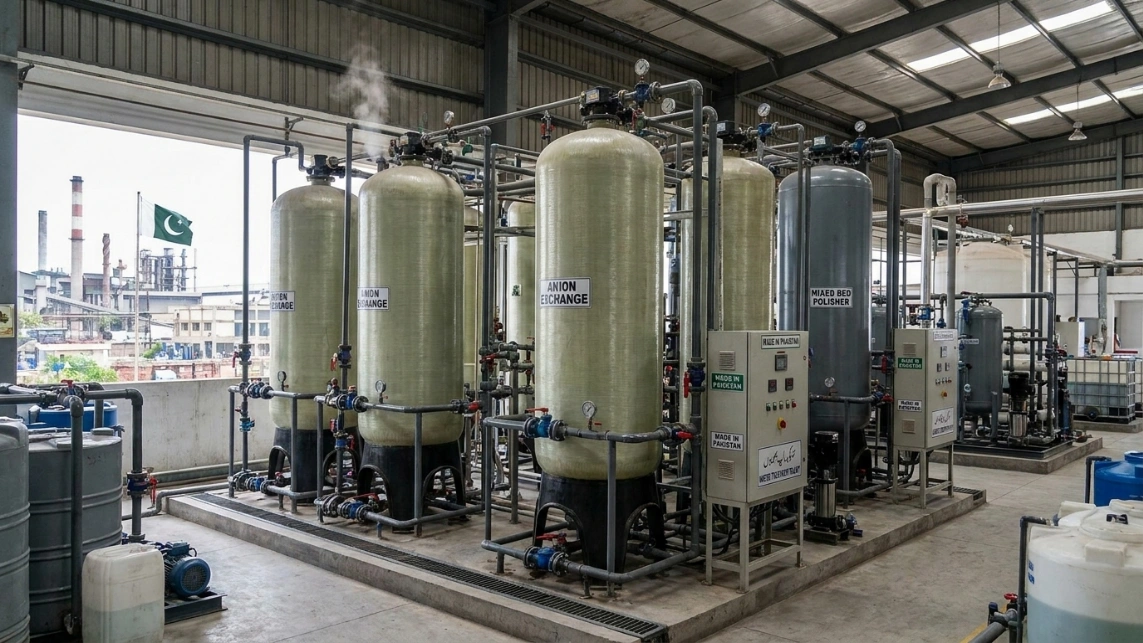
A demineralization plant, commonly called a DM plant, uses two-stage ion exchange to remove virtually all dissolved ionic species from water. The cation exchange resin removes positively charged ions such as calcium, magnesium, sodium, and potassium. The anion exchange resin removes negatively charged ions including sulphates, chlorides, nitrates, and bicarbonates. The result is water with a TDS typically below 1 part per million — effectively mineral-free.
Mixed-bed demineralization goes a step further, combining cation and anion resin in a single vessel to produce water with conductivity below 0.1 microsiemens per centimetre. This is the grade required for pharmaceutical water-for-injection preparation, electronics manufacturing rinsing, and supercritical boiler feed applications.
So the fundamental distinction is this: softening removes hardness. Demineralization removes everything. Which one you need depends entirely on the application.
When Does a Water Softener Do the Job — and When Does It Fall Short?
A water softener is the right choice when your primary concern is preventing calcium carbonate and magnesium hydroxide scale formation in applications that do not require low TDS. The technology is mature, reliable, low-cost to operate, and easy to maintain.
Applications where a softener is sufficient
Cooling tower makeup water is the most common industrial softener application in Pakistan. Lahore and Faisalabad groundwater typically has hardness of 300 to 600 mg/L as calcium carbonate, which causes rapid chiller and heat exchanger scaling. Softening this water to below 50 mg/L hardness eliminates scale without any need for TDS reduction.
HVAC systems, domestic hot water circuits, laundry operations, and low-pressure steam boilers operating below 10 kg/cm2 are all appropriate softener applications. Many textile mills in Gujranwala and Sialkot use softeners to protect their dyeing equipment from hardness-related fabric staining and scale on steam lines.
Where a softener creates problems
The critical failure mode of a softener in the wrong application is this: it does not reduce TDS. A high-pressure boiler operating above 20 kg/cm2 requires feedwater with TDS below 1 ppm to prevent silica and other salt deposits on turbine blades and superheater tubes. Feeding softened water into such a boiler is like treating a fever with a bandage — the underlying problem is untreated.
Pharmaceutical manufacturers in Karachi and Lahore who require purified water or water-for-injection under WHO GMP guidelines cannot use a softener as a standalone solution. The conductivity and TOC requirements of pharmaceutical-grade water demand full demineralization, typically followed by distillation or ultrafiltration.
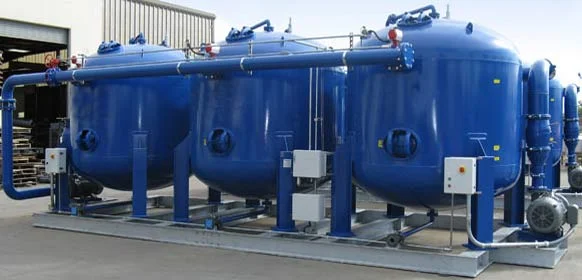
Water Softening Plant
What Does an Industrial Demineralization Plant Actually Do?
A standard two-bed DM plant processes water through two sequential ion exchange vessels. The first vessel contains strong acid cation resin in hydrogen form. As water passes through, all cations — calcium, magnesium, sodium, potassium, iron — are exchanged for hydrogen ions. The water leaving this vessel is acidic and contains free mineral acids.
The second vessel contains strong base anion resin in hydroxyl form. The mineral acids and all anions are exchanged for hydroxyl ions. Hydrogen and hydroxyl ions combine to form water molecules. The effluent from a properly functioning two-bed system has TDS below 5 ppm and conductivity below 10 microsiemens per centimetre.
Regeneration: the operating cost you need to plan for
DM plants require periodic regeneration with chemicals — hydrochloric acid for the cation bed and sodium hydroxide (caustic soda) for the anion bed. Regeneration frequency depends on feedwater TDS and treated water volume. In Pakistan’s groundwater conditions, where source TDS commonly ranges from 500 to 2,000 ppm, a well-designed DM plant will require regeneration every 8 to 24 hours under continuous industrial operation.
The cost of acid and caustic is the primary operating expense of a DM plant. For plants processing 50 cubic metres per hour, chemical costs typically run PKR 8,000 to 25,000 per regeneration cycle depending on feedwater quality and resin type. WCSP’s demineralization plant designs incorporate optimised resin bed sizing and automated regeneration controls to minimise chemical consumption without compromising effluent quality.
Effluent from DM plant regeneration — spent acid and caustic — must be neutralised before discharge under NEQS requirements. WCSP’s systems include neutralisation sumps as standard to ensure compliance.
Demineralization vs Water Softening: Side-by-Side Comparison
Use this table to match your application to the right technology before you specify equipment.
| Criteria | Water Softener | DM Plant (Ion Exchange) | RO + DM Hybrid |
| What it removes | Calcium & Magnesium (hardness only) | All dissolved salts (cations + anions) | All TDS, dissolved gases, silica |
| Output TDS | Unchanged (only hardness reduced) | Near-zero (< 1 ppm) | < 10 ppm (RO stage), < 1 ppm after DM |
| Capital cost | Low (PKR 0.5–3M typical) | Medium–High (PKR 3–20M+) | High (PKR 8–30M+) |
| Operating cost | Low (salt & regeneration) | Medium (acid/caustic regeneration) | Medium–High (membranes + chemicals) |
| Boiler feed suitability | Low pressure only (< 10 kg/cm2) | Medium to high pressure boilers | High pressure & supercritical boilers |
| Regeneration chemicals | NaCl (common salt) | HCl + NaOH (acid + caustic) | None for RO stage; DM stage uses acid/caustic |
| Maintenance complexity | Low | Medium | High |
| Pakistan use case | Cooling towers, domestic, HVAC | Power plants, pharma, textile boilers | Pharma, electronics, food & beverage |
Note: RO systems are increasingly used as a cost-effective alternative or pre-treatment to DM plants in Pakistan, particularly where feedwater TDS exceeds 1,500 ppm. WCSP engineers both standalone DM plants and integrated RO plus DM hybrid systems based on feedwater characterisation data.
| Expert Insight — From WCSP’s 17+ Years in Industrial Water Treatment
The most expensive mistake we see consistently across Pakistan’s industrial sector is specifying a water softener for a high-pressure boiler application because the capital cost was lower. A softener costs less upfront, but it does nothing to reduce TDS or silica. Within 12 to 18 months, those plants are dealing with silica scaling on boiler tubes, reduced heat transfer, and eventually tube failures. Replacement boiler tubes and unplanned downtime cost far more than the DM plant they declined to purchase. Second observation: many plants undersize their DM systems by not accounting for peak demand and regeneration downtime. A DM plant that is regenerating cannot produce treated water. Always design for a standby vessel or a buffer storage tank sized for at least four hours of consumption. This is standard in WCSP’s plant designs and eliminates production stoppages during regeneration cycles. |
Which Industries in Pakistan Need a DM Plant vs a Water Softener?
The technology decision maps directly to your industry and process requirements. Here is how Pakistan’s major industrial sectors break down.
Power generation and high-pressure steam
Any boiler operating above 15 kg/cm2 requires demineralized boiler feed water treatment. Pakistan’s power sector — including captive power plants at cement factories, sugar mills, and large textile groups — universally specifies DM plants for boiler feed water. The Pakistan Boiler and Pressure Vessel Ordinance mandates feedwater quality standards that a softener cannot meet for medium and high-pressure applications.
Pharmaceutical manufacturing
WHO GMP and DRAP (Drug Regulatory Authority of Pakistan) guidelines require purified water with conductivity below 1.3 microsiemens per centimetre at 25 degrees Celsius. This is achievable only with a full demineralization train, typically RO followed by mixed-bed DM or EDI (Electrodeionization). Pharmaceutical plants in Karachi’s industrial zones and Lahore’s pharmaceutical clusters cannot use a softener as their primary treatment system.
Textile and food processing
The answer here depends on your specific process. Softening is sufficient for steam generation in low-pressure boilers and for washing water quality improvement. But process water used directly in dyeing, finishing, or food formulation often requires low TDS to avoid colour and taste interference. Many Faisalabad textile exporters now specify DM-treated process water to meet buyer quality audits for export markets. WCSP’s industrial demineralization plant solutions serve this segment across Punjab.
Beverage and drinking water production
Beverage factories and bottled water plants in Pakistan require controlled mineral content, not zero minerals. The approach here is usually RO — which reduces TDS to near zero — followed by controlled remineralisation to achieve target mineral balance. Standalone DM plants are rarely used for drinking water because the output lacks the mineral balance required for taste and regulatory compliance.
How RO Fits Into the Demineralization vs Softening Decision
Reverse osmosis is not a direct alternative to either demineralization or softening — but it is increasingly used as a pre-treatment stage or standalone solution that can replace a DM plant in certain applications. Understanding where RO fits prevents over-engineering and unnecessary cost.
RO membranes reject 95 to 99% of dissolved solids, including hardness ions, salts, silica, and heavy metals. For applications requiring TDS below 50 ppm — most industrial process water and boiler feed applications up to about 20 kg/cm2 — a high-rejection RO system can deliver the required quality without the chemical regeneration costs of a DM plant.
For higher-pressure boiler feed or pharmaceutical applications requiring TDS below 1 ppm, RO is used as a first-stage reduction followed by a polishing DM or EDI stage. This hybrid approach reduces the chemical consumption of the DM system because the resin handles a much lower TDS load from the RO permeate — typically 20 to 50 ppm — rather than raw groundwater at 500 to 2,000 ppm. WCSP designs integrated RO plus DM systems where feedwater analysis indicates this is the most cost-effective long-term configuration.
According to the Water Quality Association, RO plus DM hybrid systems reduce chemical consumption by 60 to 80% compared to standalone DM plants treating high-TDS groundwater. In Pakistan’s current chemical cost environment, this operational saving typically justifies the higher capital cost of the hybrid approach within two to three years.
What Does a Demineralization Plant Cost in Pakistan — Realistic Numbers
Capital cost ranges vary significantly based on feedwater TDS, treated water capacity, automation level, and resin quality. The figures below reflect WCSP project experience and are provided as orientation rather than quotation.
A basic two-bed DM plant producing 5 cubic metres per hour typically runs PKR 2.5 to 5 million for supply and installation, excluding civil works. A medium-capacity system at 20 to 50 cubic metres per hour for an industrial boiler or process application ranges from PKR 8 to 20 million. Mixed-bed or multi-stage systems for pharmaceutical or high-purity applications command PKR 15 to 40 million or above, depending on certification requirements.
A quality water softener for the same flow rates costs 40 to 60% less upfront. The cost comparison looks attractive until you calculate the five-year total cost of ownership: a DM plant’s higher capital cost is typically offset within two to three years by avoided equipment damage, reduced descaling maintenance, lower chemical cleaning frequency, and better boiler fuel efficiency.
WCSP provides detailed feasibility assessments with capital cost, operating cost, and ROI projections before any project commitment. This includes feedwater characterisation at our accredited laboratory, technology benchmarking, and regulatory compliance mapping. Reach out to WCSP’s engineering team to request an assessment for your facility.
How to Choose Between Demineralization and Water Softening for Your Plant
The decision reduces to four questions. Work through them in sequence and the answer becomes clear.
- Question 1: What is your boiler operating pressure? Below 10 kg/cm2, a softener is generally sufficient. Above 15 kg/cm2, you need demineralized boiler feed water treatment. Between 10 and 15 kg/cm2 is a grey zone — get a water analysis and consult a specialist.
- Question 2: Does your process require low TDS, or just low hardness? If you need TDS below 50 ppm for process quality or product consistency, a softener cannot help. You need a DM plant or RO system.
- Question 3: Do you have pharmaceutical, food, or export certification requirements? WHO GMP, FSSC 22000, and international buyer quality audits increasingly specify TDS limits and conductivity standards that only demineralization can meet.
- Question 4: What is your source water TDS? If your feedwater TDS exceeds 1,000 ppm, an RO plus DM hybrid is almost always more cost-effective long-term than a standalone DM plant. Get a full water analysis — not just a hardness test — before you specify anything.
WCSP offers complete water analysis and technology selection consultancy as the first step in any project. We assess source water quality, define application requirements, model the economics of each option, and recommend the solution that performs best over a ten-year horizon — not just the one with the lowest upfront cost.
The Right Technology Pays for Itself — the Wrong One Costs You Every Day
Choosing between demineralization vs water softening is not a matter of which is better — both are excellent technologies in their correct application. The mistake is deploying a softener where only a DM plant will do, or over-engineering a solution where softening would have served perfectly well at a fraction of the cost.
Four actionable takeaways. First, if you operate any boiler above 15 kg/cm2, a softener is not a compliant solution — you need demineralized boiler feed water treatment. Second, if your process requires TDS below 50 ppm, only a DM plant or RO system can deliver it. Third, for high-TDS Pakistan groundwater, an RO plus DM hybrid typically reduces chemical costs by 60 to 80% compared to a standalone DM plant. Fourth, the capital cost difference between a softener and a DM plant is almost always recovered within two to three years through better equipment life, lower maintenance, and improved energy efficiency.
Ready to upgrade your water treatment system? Contact WCSP’s expert team today at watercareservices.org/contact-us/ and we will assess your feedwater, your application, and your options — in detail, at no obligation.
Frequently Asked Questions
1. What is the main difference between demineralization and water softening?
Demineralization removes all dissolved salts from water, producing near-zero TDS output suitable for high-pressure boilers and pharmaceutical processes. Water softening only removes calcium and magnesium ions that cause hardness. The TDS and conductivity of softened water remain essentially unchanged. Demineralization vs water softening is fundamentally a question of how pure your application requires the water to be.
2. Can I use a water softener for my industrial boiler in Pakistan?
For low-pressure boilers operating below 10 kg/cm2, a softener is generally acceptable. For medium and high-pressure boilers above 15 kg/cm2, Pakistan’s boiler safety standards require demineralized feedwater. Feeding softened water into a high-pressure boiler risks silica and TDS scaling on superheater tubes, reduced heat transfer efficiency, and eventual tube failure.
3. How much does a DM plant cost in Pakistan?
A basic two-bed DM plant at 5 cubic metres per hour capacity typically costs PKR 2.5 to 5 million installed. Medium-capacity industrial systems at 20 to 50 cubic metres per hour range from PKR 8 to 20 million. Pharmaceutical-grade mixed-bed systems run PKR 15 to 40 million or above. WCSP provides detailed cost assessments after feedwater characterisation for your specific site.
4. Is reverse osmosis the same as demineralization?
No. Reverse osmosis rejects 95 to 99% of dissolved solids using membrane pressure, producing water with TDS of 10 to 50 ppm. Demineralization using ion exchange resins can achieve TDS below 1 ppm. For most industrial applications, RO alone is sufficient. For high-pressure boilers and pharmaceutical-grade water, an RO plus DM hybrid delivers the required purity at lower chemical cost than DM alone on high-TDS feedwater.
5. How often does a DM plant need to be regenerated in Pakistan?
Regeneration frequency depends on feedwater TDS and treated water volume. Pakistan groundwater commonly has TDS of 500 to 2,000 ppm. At these concentrations, a DM plant treating 20 to 50 cubic metres per hour typically requires regeneration every 8 to 16 hours. Automated regeneration controls — standard in WCSP’s DM plant designs — manage this process without operator intervention.
6. Which is better for a textile factory in Faisalabad — a DM plant or a water softener?
It depends on the application. For low-pressure steam generation and washing water, a softener is sufficient and more economical. For export-grade fabric processing that requires low-TDS process water to meet international buyer quality audits, a DM plant or RO system is necessary. Demineralization vs water softening in textile applications comes down to your export market requirements and boiler pressure specifications.