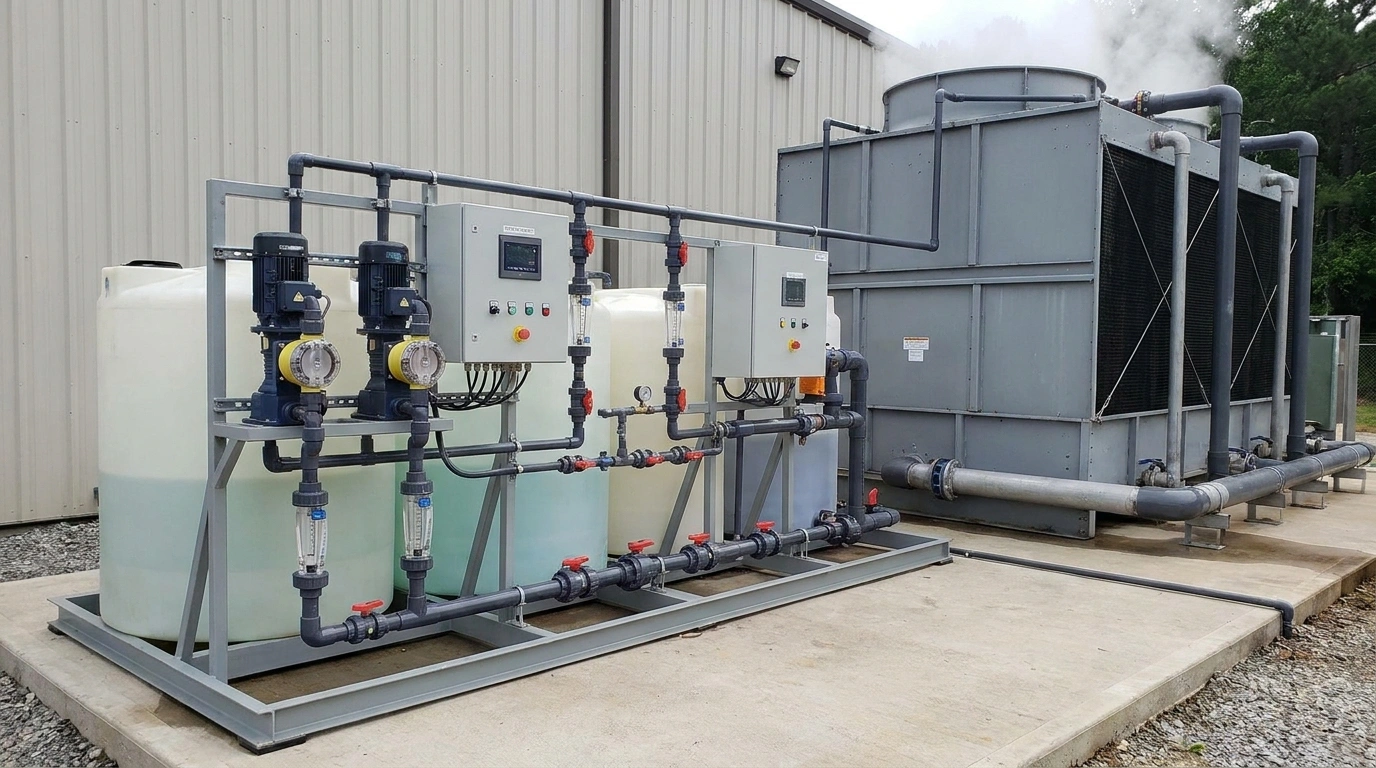
Your cooling tower is losing you money right now — and you may not see it yet. According to the US Department of Energy, a scale deposit just 1.6 mm thick on heat transfer surfaces reduces thermal efficiency by up to 12%. Multiply that across a large textile mill or beverage plant running 24 hours in Faisalabad’s summer heat, and the figure becomes a serious operational loss. Cooling tower water treatment is not a background maintenance item. It is a front-line engineering decision that directly affects your energy bills, equipment lifespan, and regulatory standing under Pakistan’s NEQS framework.
Three problems destroy cooling systems faster than anything else: scaling, corrosion, and microbial contamination — with Legionella being the most dangerous of the three. This article walks you through each threat, explains the chemistry behind it, and gives you a practical framework to control all three in Pakistan’s industrial environment.
Why Cooling Tower Water Is So Difficult to Manage
A cooling tower works by evaporating a fraction of the circulating water to dissipate heat. That evaporation is efficient for cooling but brutal for water quality. As water evaporates, dissolved minerals — calcium, magnesium, silica, bicarbonates — concentrate in the remaining water. This is measured by Cycles of Concentration (CoC): if your make-up water contains 200 mg/L of total dissolved solids and your circulating water reaches 1,000 mg/L, you are running at 5 CoC.
Most industrial cooling systems in Pakistan run between 3 and 6 CoC. Push beyond that without chemical control and you create the ideal conditions for three simultaneous failure modes. The water is mineral-saturated, oxygen-rich, and warm — a perfect environment for scale, corrosion, and biological growth. Understanding why this happens is the first step toward controlling it.
The Role of Cycles of Concentration
Managing CoC is a balance between water conservation and chemistry control. Running high CoC saves make-up water — critical in cities like Karachi and Multan where industrial water costs are rising. But each additional cycle compounds chemical concentration. WCSP’s water audit services help you find the optimal CoC for your specific make-up water chemistry, so you conserve water without sacrificing system integrity.
What Causes Cooling Tower Scaling and How to Prevent It
Scale forms when dissolved minerals exceed their solubility limits and precipitate onto surfaces. Calcium carbonate is the most common offender — it coats condenser tubes, heat exchanger surfaces, and fill media with a hard, insulating crust. Calcium sulphate and silica scaling are less common but harder to remove once established.
The Langelier Saturation Index (LSI) is the standard predictor of calcium carbonate scaling tendency. A positive LSI indicates supersaturation and scaling risk; a negative LSI indicates corrosive conditions. Your target is to keep the LSI between -0.5 and +0.5 through a combination of pH control, softening, and chemical scale inhibitors.
Effective cooling tower scaling prevention relies on phosphonate-based or polymer-based scale inhibitors dosed continuously into the circulating water. These compounds work by threshold inhibition — interfering with crystal growth at concentrations far below stoichiometric levels. For high-silica make-up water, which is common in groundwater sources across Punjab and Sindh, specialised silica dispersants are added to the treatment blend.
WCSP’s chemical dosing programmes are calibrated to your specific make-up water analysis, not generic formulas. For facilities with particularly hard source water, WCSP’s water softening systems are installed upstream of the tower make-up to reduce the scaling load before it enters the circuit.
In more than 17 years of industrial water treatment across Pakistan, the single most common mistake WCSP’s team sees is plant managers reducing or stopping inhibitor dosing during a planned shutdown — then restarting without a system flush. The concentrated, stagnant water left in the basin during downtime deposits scale and promotes biofilm in the first hours of restart. Always maintain a minimum dosing rate during shutdowns and perform a controlled blowdown before bringing the system back to full load.
Cooling Tower Corrosion: The Silent Equipment Killer
While scaling is visible and measurable, corrosion is often invisible until a pipe fails or a heat exchanger leaks. Corrosion in cooling water systems occurs through several mechanisms: electrochemical attack on carbon steel pipework, galvanic corrosion at dissimilar metal junctions, and microbiologically influenced corrosion (MIC) from sulphate-reducing bacteria.
The Ryznar Stability Index (RSI) complements the LSI in corrosion assessment. An RSI above 8 indicates aggressive, corrosive water; a well-controlled system targets an RSI between 6 and 7. Corrosion inhibitors — typically azole-based compounds for copper alloys and molybdate or ortho-phosphate formulations for steel — are dosed to form a protective film on metal surfaces.
Galvanic Corrosion in Mixed-Metal Systems
Many industrial cooling systems in Pakistan, particularly older textile and pharmaceutical plants in Lahore and Sialkot, use a mix of copper, galvanised steel, and carbon steel components. When these metals contact each other in conductive water, the less noble metal corrodes preferentially. Correct inhibitor selection must account for all metals present in the circuit — a single-metal inhibitor in a mixed-metal system can actually accelerate attack on unprotected surfaces. WCSP’s corrosion monitoring programme uses corrosion coupons and electrochemical probes to track metal loss rates and validate inhibitor effectiveness in real time.
Legionella Cooling Tower Control: Understanding the Real Risk
Legionella pneumophila is a waterborne bacterium that thrives in warm water between 25°C and 45°C — exactly the temperature range of most cooling tower circuits in Pakistan from April through October. The bacteria become a public health hazard when infected water droplets are aerosolised by the tower’s fans and drift into occupied areas. Legionnaires’ disease, the pneumonia caused by inhaling these droplets, carries a fatality rate of 5 to 10% even with treatment, according to the World Health Organization.
Pakistan’s industrial sector has historically underestimated this risk. Cooling towers in Karachi’s industrial estates, Gujranwala’s manufacturing clusters, and Lahore’s pharmaceutical parks all operate in conditions that favour Legionella proliferation without systematic control. Legionella cooling tower control is not optional if your tower has drift potential near occupied buildings.
Biocide Selection and Rotation
The primary control strategy is oxidising biocide dosing — chlorine, bromine, or chlorine dioxide — maintained at a free residual that keeps planktonic Legionella counts below the detection threshold. However, Legionella in biofilm is far more resistant than free-floating cells. Non-oxidising biocides such as isothiazolinone or glutaraldehyde are rotated into the programme quarterly to penetrate and disperse biofilm deposits. WCSP’s Legionella management service includes routine water sampling, culture testing, and a documented risk assessment — the framework required under international standards such as ASHRAE 188 and increasingly expected by multinational clients operating in Pakistan.
Industrial Cooling Water Chemicals: Choosing the Right Treatment Programme
No two cooling systems are identical. A cement plant in Gujranwala running river water through a counterflow tower faces completely different chemistry challenges from a pharma facility in Lahore using RO-treated water in a closed-circuit cooler. The table below compares key parameters across common treatment approaches to help you make an informed decision.
| Treatment Approach | Best For | Scale Control | Corrosion Control | Legionella Risk | Chemical Cost |
|---|---|---|---|---|---|
| All-organic inhibitor (phosphonate/polymer blend) | Hard groundwater, high CoC targets | Excellent | Good | Requires separate biocide | Medium |
| Molybdate-based programme | Mixed-metal systems, pharma/food | Good | Excellent | Requires separate biocide | High |
| Chlorine dioxide dosing | High Legionella risk sites, hospitals | Indirect (biofilm control) | Moderate | Excellent | Medium-High |
| Bromine-based biocide (BCDMH) | High-pH systems, seasonal operations | None direct | None direct | Very Good | Medium |
| Integrated all-in-one programme | Medium-sized industrial plants | Good | Good | Good | Medium |
Industrial cooling water chemicals should always be selected after a full water analysis — not off a catalogue. WCSP’s laboratory services provide the chemistry baseline that makes every treatment decision defensible.
How to Set Up a Cooling Tower Water Treatment Programme Step by Step
According to the Cooling Technology Institute, over 60% of cooling system failures are attributable to inadequate water treatment management rather than equipment defects. A systematic programme eliminates guesswork and gives you documented proof of compliance — increasingly important as Pakistan’s environmental enforcement under NEQS tightens.
Step one is a comprehensive baseline water analysis — both make-up water and circulating water — covering hardness, pH, alkalinity, silica, TDS, iron, copper, and Legionella culture. Step two is system inspection: check for dead legs, areas of stagnant flow, fouled fill media, and basin sediment — all of which are Legionella harbouring points. Step three is programme design: select inhibitor chemistry, biocide types, dosing rates, and blowdown set points based on your water analysis and CoC target.
Step four is chemical feed system installation. Automatic dosing controllers tied to conductivity sensors maintain treatment levels without manual intervention, eliminating the human error that causes most treatment failures. WCSP’s automation and real-time monitoring systems integrate directly with cooling tower controllers. Step five is ongoing monitoring: weekly on-site checks of pH, conductivity, inhibitor residual, and biocide levels, plus monthly Legionella sampling during warm months. Step six is documentation — every reading, every dosage, every service visit logged for NEQS compliance and client audits.
How Cooling Tower Water Treatment Connects to Broader Water Management
Your cooling tower does not operate in isolation. The quality of your make-up water determines your treatment chemistry requirements. If you are drawing from a municipal supply in Lahore, your carbonate hardness will differ significantly from a facility drawing from a bore well in Sialkot. Many industrial plants are now investing in pre-treatment — specifically water softening or partial demineralisation of make-up water — to give their chemical programmes a better starting point and reduce overall chemical consumption.
WCSP’s reverse osmosis and demineralisation systems are increasingly specified upstream of cooling towers in new industrial installations, particularly in the pharma and food and beverage sectors where water quality standards are most stringent. ZLD (Zero Liquid Discharge) systems are also being integrated with cooling tower blowdown streams in facilities under pressure to eliminate liquid discharge entirely — a regulatory direction that Pakistan’s EPA is actively encouraging in water-stressed regions. Ozone generators are another technology gaining traction as a supplementary biocide that reduces dependence on chemical halogens while providing excellent Legionella control and biofilm suppression.
Monitoring and Compliance: What Pakistan’s Regulations Require
Pakistan’s National Environmental Quality Standards (NEQS) set discharge limits for cooling tower blowdown water. Key parameters include TDS, temperature differential, pH, and chemical oxygen demand. Facilities discharging blowdown to municipal drainage or natural water bodies must demonstrate compliance through documented testing — a requirement that is increasingly enforced in industrial cities like Faisalabad, Lahore, and Karachi following stricter EPA inspections since 2022.
Beyond discharge compliance, multinational buyers and export certification bodies — particularly in textiles and food — are now conducting water treatment audits as part of supplier qualification. Having a documented, professionally managed cooling tower water treatment programme is no longer a compliance nicety; it is a commercial requirement. WCSP’s environmental monitoring services provide the independent testing data and compliance reports that satisfy both Pakistani regulators and international buyers.
Protecting your cooling system from scaling, corrosion, and Legionella starts with the right water chemistry and a programme built for your specific conditions. Your cooling tower water treatment programme should be documented, chemical-specific, and regularly tested — not reactive.
Four takeaways to act on today: get a baseline water analysis done before selecting any chemistry; implement automatic dosing control rather than manual dosing; rotate biocides quarterly to prevent biofilm resistance; and document every treatment record for NEQS compliance and client audits.
Ready to upgrade your water treatment system?