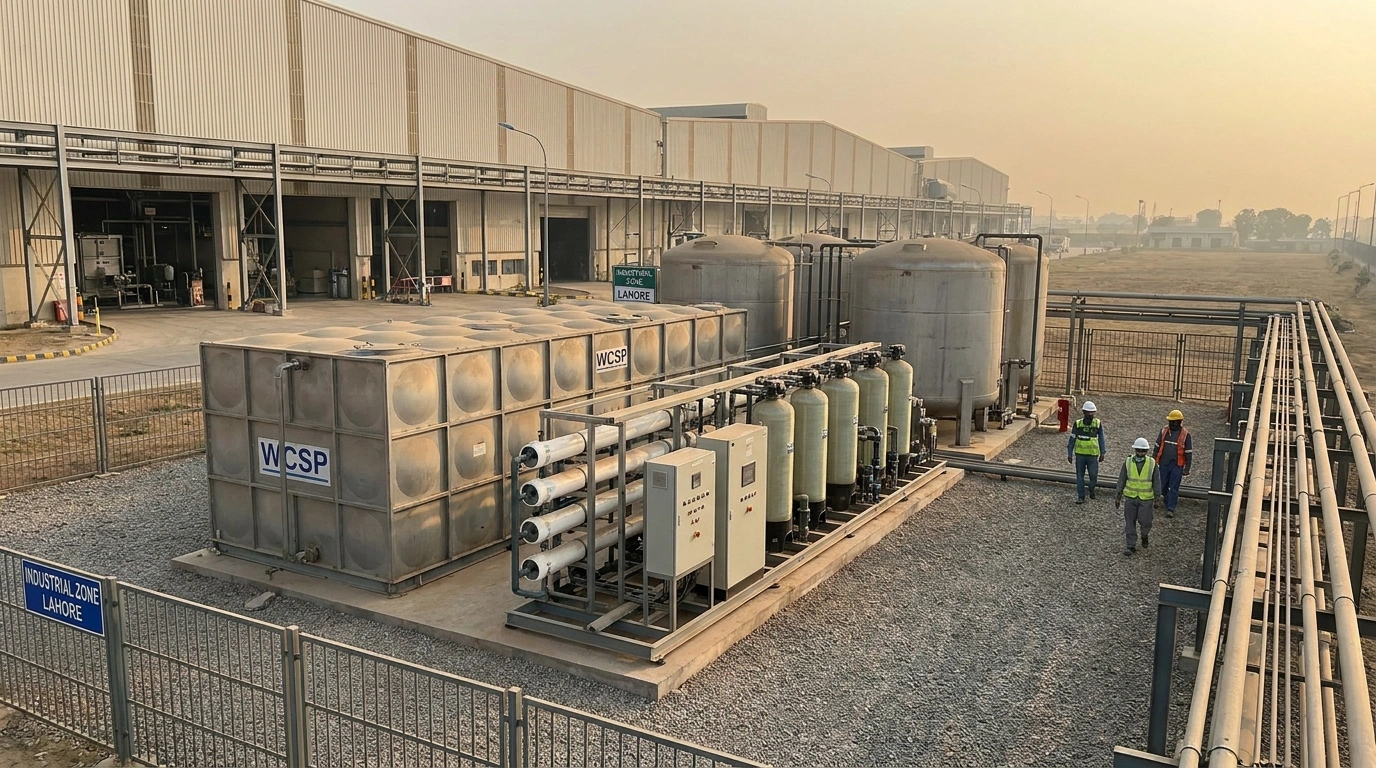
Pakistan’s industrial zones generate an estimated 900,000 cubic metres of untreated or partially treated wastewater every day, according to the Pakistan Environmental Protection Agency. Much of that discharge violates the National Environmental Quality Standards — and enforcement pressure is rising fast. If your facility is facing an EPA notice, expanding production, or opening a greenfield site, you cannot afford a two-year civil construction timeline for a conventional treatment plant.
That is exactly where a packaged wastewater treatment system changes the equation. It compresses engineering, fabrication, and commissioning into a single, deployable unit that connects to your existing infrastructure within weeks, not years.
This article explains what these systems are, which industries benefit most, how to evaluate the right technology, and when a packaged solution makes more financial sense than conventional construction. Whether you manage a textile mill in Faisalabad, a pharma plant in Karachi, or a beverage factory in Lahore, by the end of this guide you will know precisely what to ask your treatment partner.
What Exactly Is a Packaged Wastewater Treatment System?
A packaged wastewater treatment system is a complete treatment train — screening, biological treatment, clarification, and in many cases disinfection — factory-assembled onto a single skid, inside a containerized enclosure, or across a compact modular footprint. Unlike a conventional plant, which is designed and built on-site from raw materials, a packaged system is engineered once, fabricated under controlled conditions, tested at the factory, and then transported and installed at your site.
The core process inside these units varies by application. For high-strength organic effluent from food and beverage or dairy industries, Moving Bed Biofilm Reactor technology handles load fluctuations without destabilising the biology. For operations needing treated water clean enough to reuse — a textile mill in Sheikhupura cutting freshwater costs, for example — Membrane Bioreactor systems deliver filtration-quality effluent from a much smaller footprint than conventional activated sludge. Pharmaceutical plants in Karachi requiring ultra-low bacterial counts often combine MBR with UV Disinfection or Ozone treatment in the same packaged unit.
The key point: a packaged system is not a simplified or inferior version of a full plant. It is the same proven technology, deployed differently. The engineering rigour is identical. The footprint and installation timeline are dramatically shorter.
How Does a Containerized Treatment Plant Differ from a Conventional One?
The difference is not just size — it is the entire delivery model. A conventional wastewater treatment plant requires civil works, structural engineering, equipment procurement from multiple vendors, on-site installation, independent commissioning, and months of process optimisation before consistent results emerge. From concept to compliance, you are typically looking at 18 to 36 months and significant capital outlay on concrete, steel, and civil contractors.
A containerized treatment plant compresses that timeline to 8 to 16 weeks in most cases. Here is how the two models compare across the variables that matter to a plant manager or procurement head:
| Factor | Conventional Plant | Packaged / Containerized System |
|---|---|---|
| Design-to-commissioning time | 18–36 months | 8–16 weeks |
| Civil construction required | Extensive | Minimal to none |
| Scalability | Difficult — new civil works needed | Modular — add units as you grow |
| Relocation possible | No | Yes, fully relocatable |
| Upfront capital cost | High | Moderate (lower civil cost) |
| Operational complexity | High (multiple vendors) | Low (single integrated system) |
| NEQS compliance speed | Slow | Fast |
| Suitable for temporary operations | No | Yes |
| Remote or space-constrained sites | Difficult | Ideal |
Which Industries in Pakistan Benefit Most from Modular Effluent Treatment?
The short answer: any industry facing a gap between what they currently discharge and what Pakistan EPA expects them to discharge. But some sectors have structural reasons why modular effluent treatment fits especially well.
Textile mills in Faisalabad, Gujranwala, and Sialkot operate 24/7, generating high-volume dye effluent with strong colour, heavy BOD loads, and suspended solids — and face the strictest NEQS scrutiny of any sector. Packaged systems using Electrocoagulation followed by biological treatment and filtration handle colour removal efficiently within a compact footprint. Mills sharing a common effluent treatment plant often use containerized units as pre-treatment before sending combined flows to a central facility.
Pharmaceutical plants in Karachi and Lahore must meet both Pakistan EPA discharge standards and often internal GMP standards for process water reuse. A packaged MBR unit with integrated UV or Ozone Disinfection produces effluent quality that satisfies both requirements from a system that fits inside a standard 40-foot container footprint. Beverage and food processing operations in Lahore’s industrial estates face high organic loads and seasonal volume fluctuations. MBBR-based packaged systems tolerate these fluctuations without biological crash — a known failure point in conventional activated sludge during Ramadan production peaks followed by slowdowns.
Cement and mining operations in remote areas of Punjab and Balochistan typically have no access to centralised treatment infrastructure. A self-contained, skid-mounted compact water treatment unit powered by local generation is often the only viable option.
When Does a Packaged Wastewater Treatment System Make Financial Sense?
The financial case hinges on four factors: civil cost avoidance, compliance urgency, operational footprint, and scalability.
Civil cost avoidance is the largest single driver. A study by the Asian Development Bank on industrial wastewater infrastructure in South Asia found that civil construction accounts for 35 to 55 percent of the total cost of a conventional treatment plant. A packaged system eliminates most of that — no large-scale excavation, no months of concrete curing, no on-site civil supervision.
Compliance urgency matters because EPA enforcement penalties, production shutdowns, and licence cancellations carry immediate financial costs. When a Lahore-based food processing plant received a show-cause notice from PEPA, they needed a demonstrable compliance solution within 90 days. A packaged MBBR system with clarification and Chlorination disinfection was the only practical option — and it was operational within 11 weeks of order placement.
The most common mistake Pakistani industrialists make is treating a packaged system purchase the same way they treat equipment procurement — focusing only on capital cost without modelling the avoided cost of civil works, reduced commissioning time, and shorter time-to-compliance. When you add those three factors, the total cost of ownership for a packaged system is typically 20 to 35 percent lower than a conventional plant of equivalent capacity, particularly for facilities below 500 cubic metres per day.
Scalability is often overlooked. If your production is growing — or if you are entering a new product line that will change your effluent character — modular effluent treatment lets you add capacity in defined increments without over-engineering for peak future capacity on day one.
What Technologies Are Included in a Compact Water Treatment Unit?
The specific technology combination inside a packaged wastewater treatment system depends on your effluent characteristics, discharge or reuse targets, and operating environment. WCSP’s approach to technology selection typically follows this structure:
Primary treatment handles screening and flow equalisation — critical for industries with batch discharge patterns like food processing or pharmaceuticals. Without effective equalisation, biological stages receive shock loads that compromise performance.
Biological treatment is the core. MBBR is the most common choice for general industrial effluent because its carrier-based biomass handles load and composition fluctuations without the settling issues that plague conventional activated sludge. For stricter effluent quality — or where you need to recycle treated water back into your process — MBR technology combines biological treatment with ultra-fine membrane filtration in a single compact stage. WCSP’s MBR and MBBR systems are engineered specifically for Pakistan’s industrial load profiles.
Advanced treatment add-ons include Electrocoagulation for colour and heavy metal removal in textile effluent, the Fenton Process for recalcitrant chemical oxygen demand in pharmaceutical or agrochemical streams, and Zero Liquid Discharge configurations for operations that must achieve complete water recovery. ZLD is increasingly relevant for water-scarce industrial zones in Punjab where groundwater extraction is becoming constrained. UV Disinfection is the preferred final stage for systems where treated water will be reused; Ozone is selected where residual disinfection capacity and colour polishing are both required.
How Do You Select the Right Packaged System for Your Facility?
Selecting a packaged wastewater treatment system starts with characterisation, not equipment specifications. The single most common cause of underperforming treatment plants in Pakistan — packaged or conventional — is inadequate effluent characterisation at the design stage.
- Effluent characterisation: Sample across at least 5 operating days covering different shifts and product cycles. Measure BOD, COD, TSS, TDS, pH, colour, heavy metals, and any sector-specific parameters your EPA consent requires.
- Flow quantification: Establish average daily flow, peak hourly flow, and minimum flow. Over-sizing wastes capital; under-sizing creates compliance failures during production peaks.
- Discharge or reuse standard: Define your target — municipal drain, river, or process reuse. Each target implies a different treatment train and performance specification.
- Site constraints: Measure available footprint, ceiling height if indoors, proximity to electrical supply, and distance from your main effluent collection point.
- Regulatory requirements: Confirm which consents you need — EPA discharge consent, provincial approval, and any industry-specific permits. WCSP’s environmental compliance team advises on current NEQS thresholds for your sector.
- Total cost of ownership: Model capital cost, operating cost, and maintenance cost over a 10-year horizon. Do not compare systems on capital cost alone.
- Supplier capability: Verify that your technology partner provides local after-sales support, spare parts availability in Pakistan, and operator training.
Compliance, Monitoring, and Long-Term Performance
A packaged system that meets its design specification on commissioning day is not the end of the story. Sustained NEQS compliance requires ongoing operational discipline and proactive maintenance.
Pakistan’s NEQS standards set discharge limits across multiple parameters — BOD below 80 mg/L for most categories, TSS below 200 mg/L, and specific limits for colour, heavy metals, and pH depending on your sector. Provincial EPA authorities increasingly require continuous or periodic self-monitoring reports, and several industrial zones in Lahore, Karachi, and Faisalabad are moving toward real-time online effluent monitoring linked to regulatory databases.
WCSP integrates real-time monitoring and automation into packaged systems as standard practice — flow meters, online pH and turbidity sensors, and alarm systems that notify operators before a parameter breach, not after. Regular maintenance — membrane cleaning cycles in MBR systems, carrier media inspection in MBBR, UV lamp replacement, chemical dosing calibration — keeps operational costs predictable and avoids the expensive process failures that result from deferred maintenance.
Conclusion
A packaged wastewater treatment system is not a compromise — it is a faster, more flexible, and often more cost-effective path to genuine compliance and water efficiency. Here are four things to carry away from this article.
If your project timeline is under 12 months or your site has limited space, a conventional plant is probably the wrong choice. A packaged system delivers the same technology in a fraction of the time. Start with effluent characterisation — not equipment specifications. The right technology is determined by what your wastewater actually contains, not by what your neighbouring factory installed. The total cost of ownership — including avoided civil cost, faster compliance, and modular scalability — typically favours packaged systems for facilities processing below 1,000 cubic metres per day. And regulatory pressure in Pakistan is not easing: NEQS enforcement is stricter now than it was five years ago, and the trend is toward more frequent inspections and mandatory online monitoring.