Your electricity bill is one of the largest line items in your plant’s operating budget — and in most water treatment facilities, it does not have to be. According to the International Energy Agency, water and wastewater systems account for roughly 4 percent of global electricity consumption, with pumping and aeration alone responsible for over 70 percent of that load. For Pakistani industrial plants already under pressure from rising WAPDA tariffs and NEQS compliance costs, that is not a statistic — it is an opportunity.
The problem is clear: most water treatment plants in Pakistan were designed a decade or more ago, when energy was cheaper and automation was limited. Operators run pumps at fixed speeds, overdose chemicals manually, and rarely audit system performance against actual demand. The result? Inflated utility bills and underperforming systems that also risk regulatory penalties.
This guide gives you a practical, engineer-tested roadmap for building or upgrading toward an energy-efficient water treatment plant. You will see where savings are hiding in your current setup, which technologies deliver the fastest payback, and how WCSP’s 17-plus years of experience with industrial and municipal clients across Lahore, Faisalabad, Sialkot, and Karachi translates into measurable results for your facility.
Why Energy Costs in Water Treatment Plants Are Higher Than They Need to Be
Most plant managers focus on chemical costs and compliance — energy is treated as a fixed overhead. That mindset is expensive. In a typical reverse osmosis or MBR-based treatment facility, pumping systems account for 40 to 60 percent of total electricity use. Aeration for biological treatment adds another 25 to 35 percent. The rest goes to UV disinfection, instrumentation, lighting, and compressed air systems.
The Overdesign Trap
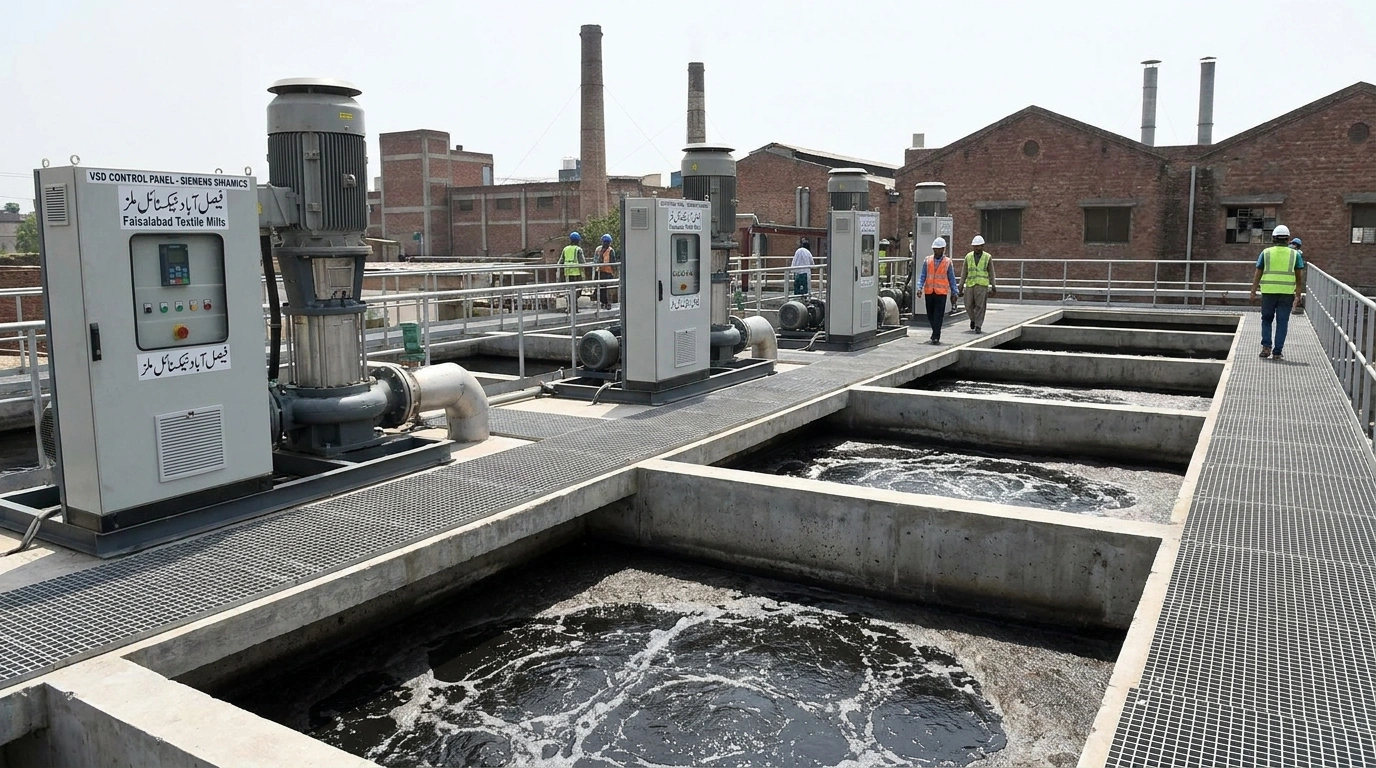
Here is the most common mistake WCSP’s engineers encounter during plant audits: pumps and blowers sized for peak demand running at full capacity around the clock, even during low-flow periods. A Faisalabad textile mill WCSP assessed in 2023 was running its feed pumps at 100 percent rated speed despite treating only 60 percent of design flow during off-peak hours. Installing variable speed drives reduced that facility’s annual pump energy consumption by 31 percent within the first year.
Fixed-speed operation ignores a fundamental law of physics: pump power consumption scales with the cube of its rotational speed. Cut the pump speed by 20 percent and you reduce power consumption by nearly 50 percent. This is the single fastest payback energy investment available to water treatment operators.
Poor maintenance compounds the problem. Fouled membranes force higher feed pressures. Air leaks in blower systems increase motor load. Corroded heat exchangers reduce thermal efficiency. None of these are compliance issues — until they become equipment failures that trigger both downtime and regulatory scrutiny.
Variable Speed Drives: The Fastest Energy Payback in Any Energy-Efficient Water Treatment Plant
If you audit your treatment plant and do nothing else, install variable speed drives — also called VFDs or variable frequency drives — on your pumps and blowers. This is the single highest-impact, lowest-risk intervention available, with payback periods commonly ranging from 12 to 24 months in Pakistani industrial settings.
VFDs work by adjusting motor speed to match actual process demand in real time. Instead of running a 75 kW feed pump at full speed and throttling flow with a valve — which wastes energy while creating mechanical wear — a VFD slows the motor to deliver exactly the required flow. The energy saved is real and cumulative: it compounds across every operating hour.
Where VFDs Deliver the Highest Return
The best candidates are raw water intake pumps, permeate pumps in RO systems, aeration blowers in MBR and MBBR systems, recirculation pumps in ZLD circuits, and sludge transfer pumps in biotreatment units. In pharma plants in Lahore and beverage factories in Karachi, WCSP has consistently seen 25 to 35 percent reductions in pump energy costs within 18 months of VFD installation.
The business case is straightforward. A single 55 kW pump running at full load for 20 hours per day at Pakistan’s current industrial electricity rate of approximately PKR 30 per kWh consumes roughly PKR 1.2 million per year. A VFD running that same pump at 80 percent average speed reduces consumption by 39 percent — saving approximately PKR 470,000 annually from one motor alone.
WCSP’s energy management and automation services include full VFD specification, installation, and SCADA integration, so savings are monitored continuously rather than estimated once at commissioning.
Optimizing Aeration: Where Biological Treatment Energy Efficiency Is Won or Lost
Aeration in biological treatment — whether you are running a membrane bioreactor, moving bed biofilm reactor, or conventional activated sludge — is where energy optimization becomes both an engineering challenge and an economic priority. Blowers powering fine-bubble diffusers are among the most power-hungry components in any wastewater system.
The key metric is specific aeration demand, which measures how much air is required to remove a kilogram of organic load. Plants that over-aerate — delivering more oxygen than the biomass can consume — waste electricity continuously. The fix is not always expensive: dissolved oxygen sensors linked to automated blower controls can reduce aeration energy by 20 to 30 percent without any hardware replacement beyond sensors and a control loop.
Fine-Bubble Diffusers vs. Coarse-Bubble: An Often-Missed Upgrade
Many older wastewater plants in Sialkot’s tannery belt and Gujranwala’s industrial estates still use coarse-bubble diffusers, which transfer oxygen at efficiencies of 10 to 15 percent. Fine-bubble ceramic or EPDM membrane diffusers achieve 25 to 35 percent oxygen transfer efficiency — meaning the same blower delivers more than twice the treatment performance per kilowatt consumed. The capital cost of a diffuser retrofit is modest, but the energy impact is significant and permanent.
WCSP’s MBR and MBBR installations routinely incorporate automated dissolved oxygen control and fine-bubble aeration as standard design elements, not as add-ons. If your existing biological system was designed before 2015, it is worth commissioning an aeration audit specifically.
| Expert Insight from WCSP — 17 Years in the Field
The most common mistake we see during plant audits is facilities running continuous aeration at a fixed rate, regardless of incoming load fluctuation. Industrial influent BOD can vary by 200 to 400 percent over a single shift in textile and food processing operations. Plants that do not respond to this variation with adaptive blower control are effectively paying to treat air — not wastewater. A straightforward dissolved oxygen control loop connected to a VFD-driven blower costs a fraction of what the energy savings recover in 12 months. We have implemented this configuration in over 40 plants across Punjab and Sindh. It is not experimental — it is standard practice that too many operators are still missing. |
Solar Integration: How to Power Your Water Treatment Plant With Renewables
Pakistan’s average solar irradiance of 5 to 5.5 kWh per square meter per day is among the highest in South Asia. For water treatment facilities that operate primarily during daylight hours — municipal plants, bottled water operations, and industrial effluent systems on day shifts — solar photovoltaic integration is now one of the most economically sound decisions available.
A grid-tied solar system sized to cover 30 to 50 percent of daytime load delivers electricity at a levelized cost well below the current WAPDA industrial tariff. For a plant consuming 300 kWh during daylight hours, a 150 kWp rooftop system — feasible on most plant buildings — can offset 40 to 50 percent of grid consumption in Punjab’s sunshine conditions.
The economics are increasingly favorable. Solar panel prices have fallen dramatically over the past five years. Net metering policy in Pakistan allows eligible grid-connected systems to export surplus generation, further improving project economics. Payback periods for properly designed systems have dropped to three to five years, with system lifespans of 25-plus years.
WCSP can integrate solar generation into your plant’s energy management system, combining solar monitoring with SCADA controls for water quality and process automation. This is particularly effective in Lahore’s Punjab Industrial Zones and along the Karachi Export Processing Zone where grid reliability is also a concern. Reducing grid dependency is both an energy savings and an operational resilience strategy.
Comparing Energy-Saving Strategies: Which Investment Delivers the Most Value?
Not every energy efficiency measure delivers the same payback timeline or operational benefit. The table below compares the five most impactful strategies based on WCSP’s field experience across industrial and municipal treatment plants in Pakistan.
| Strategy | Avg. Energy Saving | Payback Period | NEQS Compliant | Best For |
| Variable Speed Drives | 20-35% | 12-24 months | Yes | Pump-heavy plants |
| MBR Optimization | 15-25% | 18-30 months | Yes | Municipal / pharma |
| Solar PV Integration | 30-45% | 36-60 months | Yes | Large industrial plants |
| ZLD with Heat Recovery | 10-20% | 24-48 months | Yes | Textile / ZLD plants |
| AI-Based Dosing Control | 10-18% | 6-18 months | Yes | Chemical-intensive ops |
Your plant’s optimal starting point depends on current equipment configuration, load profile, and budget. WCSP recommends beginning with a structured energy audit to identify your top two or three highest-return opportunities before committing capital.
Smart Automation and Real-Time Monitoring: The Nervous System of Energy-Efficient Water Treatment
Manual operation and batch sampling are the enemies of energy efficiency. When operators dose coagulants based on visual judgment, adjust chlorine feed by schedule rather than demand, or let pumps run during low-load periods because no one noticed, energy and chemical costs accumulate invisibly. Automation changes this dynamic entirely.
SCADA systems — supervisory control and data acquisition — connect sensors, actuators, and process equipment into a unified monitoring and control environment. For water treatment, this means real-time visibility into flow rates, turbidity, dissolved oxygen, pH, conductivity, chlorine residual, membrane differential pressure, and energy consumption by subsystem. When you can see what each part of your plant is consuming in real time, you can manage it.
AI-Assisted Chemical Dosing
Advanced SCADA platforms now incorporate machine learning for chemical dosing optimization. Rather than dosing at a fixed rate, the system learns the relationship between influent quality and required coagulant or disinfectant dose, adjusting feed automatically. According to a 2022 Water Research Foundation study, AI-assisted dosing reduces chemical costs by 15 to 25 percent and eliminates both over-dosing and compliance-risk under-dosing.
For pharmaceutical plants in Lahore and beverage manufacturers in Karachi — where product water quality is non-negotiable — this level of control is not just an energy measure. It is a quality assurance tool that also reduces waste and chemical procurement costs.
WCSP’s real-time monitoring and automation services offer full SCADA integration, remote monitoring, and automated alarm management. Combined with CIP (clean-in-place) scheduling based on actual fouling data rather than fixed intervals, these systems have reduced total operational costs by 18 to 30 percent for clients across multiple sectors.
Membrane Maintenance: How Fouling Drives Up Energy Costs and How to Stop It
Fouled membranes are silent energy thieves. In reverse osmosis systems, progressive membrane fouling increases the feed pressure required to maintain permeate flow. A membrane operating at 150 percent of its clean pressure drop due to fouling is consuming up to 50 percent more pump energy than a well-maintained unit — while also producing lower-quality permeate and shortening membrane life.
The solution is not more aggressive cleaning — it is smarter cleaning. Proactive monitoring of normalized permeate flow, salt rejection, and differential pressure enables operators to trigger CIP cycles based on actual fouling state rather than fixed schedules. This reduces cleaning frequency, extends membrane life, and keeps operating pressure — and therefore energy consumption — consistently low.
For MBR systems treating municipal wastewater or complex industrial effluent in cities like Lahore or Faisalabad, membrane scouring aeration intensity is the key energy lever. Intermittent aeration — pulsed rather than continuous air supply to the membrane modules — has been shown in multiple studies to maintain equivalent fouling control with 30 to 50 percent less aeration energy.
WCSP’s membrane management protocols include normalized data tracking, cleaning chemical selection, and membrane replacement scheduling to keep your RO or MBR system operating at peak energy efficiency across its full service life.
Energy Audits and NEQS Compliance: How to Make Both Work Together
Pakistan’s National Environmental Quality Standards set discharge limits for wastewater quality — they say nothing about how efficiently your plant must treat that wastewater. But the two are more connected than most plant managers realize.
An energy-efficient water treatment plant is almost always a better-performing plant. When pumps operate at correct duty points, when aeration is matched to load, when membranes are clean, and when dosing is optimized — treatment quality improves alongside energy efficiency. Operators who invest in performance optimization routinely find that NEQS compliance becomes easier to maintain, not harder, because process consistency improves.
The Business Case for a Formal Energy Audit
A structured energy audit — conducted by engineers who understand both treatment process and energy systems — identifies current consumption by subsystem, benchmarks it against best-practice targets, and prioritizes interventions by return on investment. The International Water Association recommends treating energy performance as a key performance indicator alongside effluent quality and system availability.
For Pakistani industrial facilities facing both NEQS enforcement pressure and rising electricity costs, the combined business case is compelling: a plant that achieves 40 percent energy reduction while maintaining full regulatory compliance is both more profitable and more resilient than one that achieves compliance alone.
WCSP offers structured energy audits for industrial and municipal clients, combining process engineering expertise with energy management analysis. The audit output is a prioritized action plan with capital cost, projected savings, and payback period for each recommendation — not a generic report.
Conclusion
A 40 percent reduction in water treatment energy costs is not a theoretical target — it is a documented outcome achievable through systematic, technology-backed improvements. You do not need to replace your entire plant to get there.
Start here. Four actions that deliver measurable results:
- Install variable speed drives on your highest-load pumps and blowers — the payback is typically under two years at current Pakistani electricity tariffs.
- Commission an energy audit to benchmark your plant against best-practice performance targets and identify your top three savings opportunities.
- Upgrade to automated dissolved oxygen control and fine-bubble aeration if you operate a biological treatment system — this alone can cut aeration energy by 20 to 30 percent.
- Integrate real-time SCADA monitoring so energy consumption becomes visible, measurable, and manageable — not a fixed overhead.
Building an energy-efficient water treatment plant is ultimately about operational discipline supported by the right technology. Every percentage point of energy you recover is permanent margin improvement — not a one-time gain.
FAQ Section:
1. How much can an energy-efficient water treatment plant actually save on utility bills?
Most industrial and municipal water treatment plants in Pakistan can reduce energy costs by 25 to 40 percent through a combination of variable speed drives, optimized aeration, smart automation, and solar integration. The exact savings depend on current equipment age and operation practices, but WCSP’s audits consistently identify payback periods of 12 to 36 months on primary interventions.
2. What is the fastest payback energy upgrade for a water treatment plant in Pakistan?
Variable speed drives installed on feed pumps and blowers deliver the fastest energy payback — typically 12 to 24 months at current Pakistani industrial electricity rates. They reduce pump motor energy consumption by 20 to 40 percent by matching motor speed to actual process demand, eliminating the wasted energy of constant-speed operation against a throttled valve.
3. Does improving energy efficiency in a water treatment plant affect NEQS compliance?
No — properly implemented energy efficiency measures do not reduce treatment performance. In fact, an energy-efficient water treatment plant typically achieves more consistent NEQS compliance because optimized processes are more stable. Automated dosing control, for example, maintains chemical feed precisely at compliance levels rather than overdosing for safety margin.
4. How long does it take to complete a water treatment energy audit in Pakistan?
A structured energy audit for an industrial or municipal water treatment plant typically takes five to ten working days, depending on plant complexity and data availability. The audit covers energy consumption by subsystem, benchmarks against best-practice targets, and delivers a prioritized improvement plan with projected savings and capital costs for each recommendation.
5. Is solar power a practical option for water treatment plants in Pakistan?
Yes. Pakistan’s solar irradiance is among the highest in South Asia, making rooftop solar PV economically viable for treatment plants with significant daytime load. A well-designed grid-tied system can offset 30 to 50 percent of daytime electricity consumption with payback periods of three to five years under current tariff and net metering conditions.
6. Which industries in Pakistan benefit most from energy-efficient water treatment plant upgrades?
Textile mills in Faisalabad and Lahore, pharmaceutical manufacturers, beverage processors, and cement producers see the highest benefit due to their large and continuous treatment loads. Municipal water utilities in Karachi and Lahore also have significant savings potential given the scale of their pumping and treatment infrastructure.