
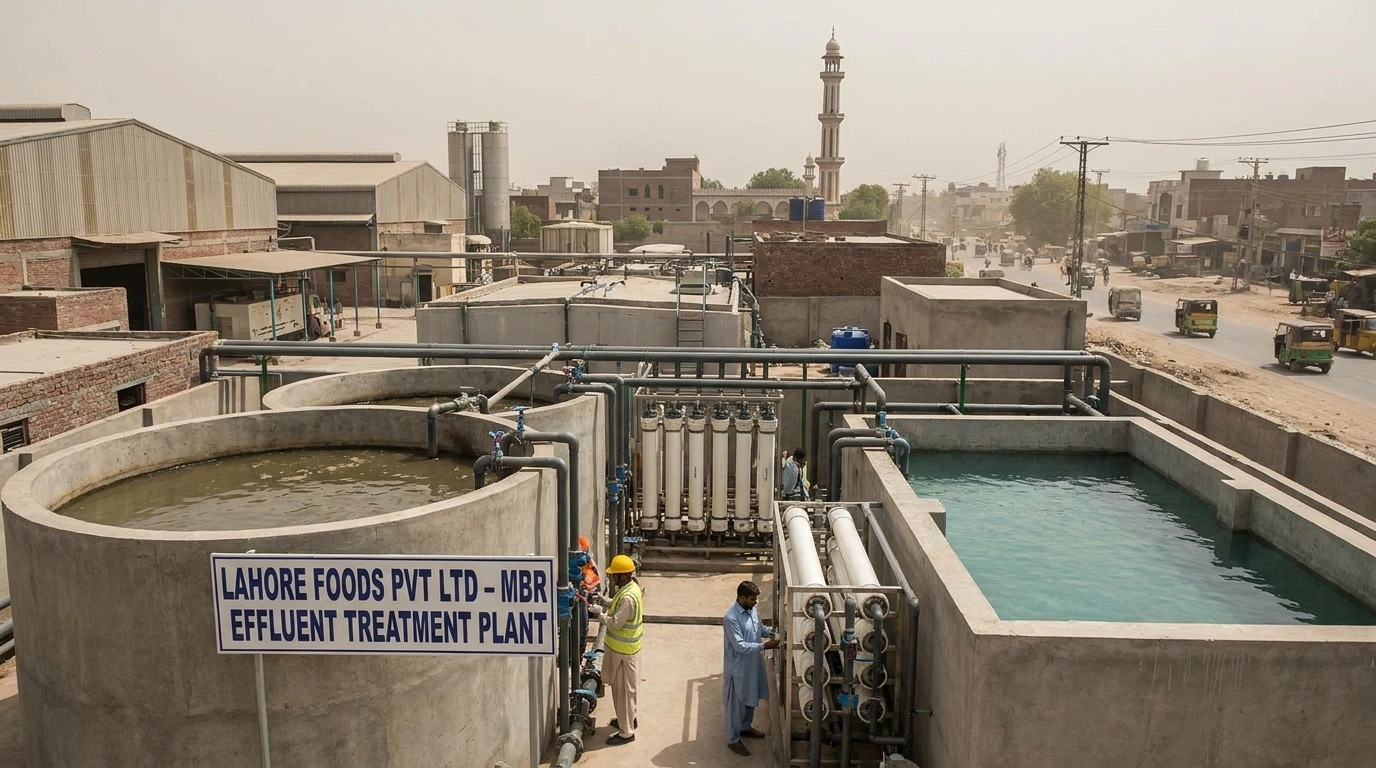
Not all wastewater is equal, and food and beverage effluent is among the most complex to treat. Understanding its composition is the first step to choosing the right system — and avoiding the mistake of applying a generic solution to a highly specific problem.
Effluent from food processing plants and beverage factories typically contains high concentrations of biodegradable organic matter, fats, oils and greases (FOG), suspended solids, sugars, proteins, cleaning chemicals from CIP processes, and significant variations in pH. A Lahore-based dairy might discharge wastewater with BOD levels of 1,500–4,000 mg/L, while a juice factory in Faisalabad can produce effluent with COD exceeding 6,000 mg/L during peak fruit-processing season.
Key Pollutant Characteristics by Sub-Sector
Dairy and beverage plants: High BOD, FOG, lactose, detergents from cleaning cycles. pH swings from alkaline CIP chemicals to acidic product residues.
Meat and poultry processing: Blood, grease, proteins, high ammonia nitrogen. Pathogen load is a major concern.
Confectionery and snack manufacturing: Sugar-rich effluent with high organic load, vegetable oils, starch.
Soft drink and juice bottling: Sugar, citric acids, flavouring agents, and high-volume wash water from line changeovers.
This variability means your treatment system must handle surge loads, shock pH, and diverse pollutant types — often within the same 24-hour production cycle.
Pakistan’s NEQS Standards: What Your Food Processing Plant Must Meet
Before you invest in any treatment technology, you need to know exactly what your discharge must look like. Pakistan’s National Environmental Quality Standards set binding thresholds for industrial effluent discharged into inland waters, sewers, and coastal zones.
For the food and beverage sector, the most critical NEQS parameters are:
- BOD (Biochemical Oxygen Demand): 200 mg/L maximum for inland water discharge
- COD (Chemical Oxygen Demand): 500 mg/L maximum
- Total Suspended Solids (TSS): 400 mg/L maximum
- Oil and Grease: 10 mg/L maximum
- pH: 6 to 10 range
- Total Dissolved Solids (TDS): 3,500 mg/L
- Temperature: not to exceed 40 degrees Celsius at point of discharge
Provincial EPAs in Punjab, Sindh, Khyber Pakhtunkhwa, and Balochistan may apply additional or stricter standards. Lahore’s Punjab EPA, for instance, has intensified inspection of food processing facilities in industrial estates including Kot Lakhpat, Sundar, and Quaid-e-Azam Industrial Park.
Failure to meet these standards can trigger fines under PEPA 1997, temporary operational shutdowns, and increasingly, criminal liability for plant management. If your last effluent quality test is more than six months old, you are flying blind.
| Expert Insight from WCSP’s 17+ Years of Field Experience
One of the most common and costly mistakes we see is food and beverage plants designing their treatment system around average daily flow rather than peak flow. A bottling plant in Gujranwala came to us after their system repeatedly failed during CIP cycles — the cleaning water more than doubled the hydraulic load for three hours each shift. Designing for peak flow, not average flow, is non-negotiable in this sector. |
The Right Food and Beverage Wastewater Treatment Technologies for Pakistan’s Industry
Choosing the wrong technology wastes capital, fails compliance, and creates operational headaches. Here is a clear breakdown of the technologies that deliver results for Pakistan’s food and beverage sector, matched to real operating conditions.
1. Dissolved Air Flotation (DAF) — The First Line of Defence
DAF systems are almost always the first treatment step for food and beverage effluent. They remove fats, oils, greases, and suspended solids before biological treatment. A well-designed DAF can reduce BOD by 30–40% and TSS by 60–80% before the effluent enters your main biological system. For Faisalabad textile and food hybrid industrial zones, DAF systems have become standard pre-treatment.
2. MBBR — Moving Bed Biofilm Reactor
MBBR technology uses plastic carrier media that hold biofilm to break down dissolved organic matter efficiently in a compact footprint. BOD removal rates of 90–95% are achievable. MBBR systems are particularly suitable for plants with space constraints — a common challenge in Karachi and Lahore’s older industrial estates. They also handle flow variations better than conventional activated sludge systems.
3. MBR — Membrane Bioreactor
MBR combines biological treatment with ultrafiltration membranes to produce effluent clean enough for reuse in non-potable applications such as cooling towers, toilet flushing, and landscape irrigation. BOD removal exceeds 96%, and TSS is virtually eliminated. WCSP’s MBR solutions have been deployed across food processing clients in Punjab and Sindh where water scarcity makes reuse a business imperative, not just a compliance checkbox.
4. Electrocoagulation
For plants dealing with high FOG content, emulsified oils, or heavy colour in effluent, electrocoagulation is a highly effective and chemical-free water disinfection and clarification method. It uses electrical current to destabilise and aggregate suspended particles without adding coagulant chemicals. This reduces chemical procurement costs and eliminates chemical dosing risks — a real operational advantage for food-grade facilities where contamination control is paramount.
5. Fenton Process
When COD levels are very high and include non-biodegradable compounds — common in fermentation-based food facilities and some beverage operations — the Fenton Process (hydrogen peroxide plus iron catalyst) provides powerful oxidative pre-treatment or polishing. COD reduction of 60–80% in a single pass is achievable, making downstream biological treatment far more efficient.
6. Reverse Osmosis and Zero Liquid Discharge
For plants in water-stressed regions or those targeting near-zero discharge, combining RO with evaporation and crystallisation achieves Zero Liquid Discharge. ZLD eliminates effluent entirely — producing only a dry solid for disposal — and recovers 90–95% of water for reuse. Capital costs are higher, but operational water savings and elimination of discharge penalties often produce payback within four to six years. WCSP’s ZLD solutions are operational at food sector clients in Sialkot and Gujranwala.
Technology Comparison Table
Treatment Technology Performance Comparison for Food & Beverage Wastewater
| Treatment Method | BOD Removal | COD Removal | TSS Removal | Water Recovery | Compliance (NEQS) |
| Conventional Activated Sludge | 85-90% | 75-85% | 80-90% | 40-55% | Partial |
| MBBR (Moving Bed Biofilm Reactor) | 90-95% | 85-92% | 88-95% | 55-70% | Full |
| MBR (Membrane Bioreactor) | 96-99% | 93-97% | 99%+ | 70-85% | Full |
| Electrocoagulation + RO | 88-93% | 85-92% | 92-97% | 60-75% | Full |
| ZLD (Zero Liquid Discharge) | 99%+ | 98%+ | 99%+ | 95-100% | Full + Reuse |
Source: WCSP field data and WHO Industrial Effluent Treatment Guidelines, 2022.
How Much Does Food Processing Water Treatment Cost in Pakistan?
Cost is the question every plant manager asks first, and it deserves a direct answer. There is no single figure that applies to all facilities — treatment costs depend on your daily flow volume, effluent strength, level of treatment required, and whether you are treating for discharge or reuse.
Here is a realistic cost framework based on WCSP’s project experience across Pakistan’s food and beverage sector:
Capital Cost Ranges
- Small facilities (up to 50 m3/day): PKR 8–25 million for a basic DAF + MBBR system
- Medium facilities (50–300 m3/day): PKR 25–80 million for full biological treatment with polishing
- Large facilities (300+ m3/day): PKR 80–200 million for MBR or ZLD systems with automation
Operational Cost Factors
- Energy: biological systems typically consume 0.3–0.8 kWh per m3 of treated water
- Chemicals: electrocoagulation and Fenton-based systems can reduce chemical costs by 40–60% versus conventional coagulation
- Sludge management: conventional systems produce 15–25 kg dry sludge per m3 of food wastewater; WCSP’s no-sludge bioremediation approach eliminates this cost
- Maintenance: annual maintenance typically runs 5–8% of capital cost
According to the World Bank’s Water in Food Processing report (2021), companies that invest in proper wastewater treatment reduce their total water costs by 20–35% over ten years through reuse and avoided penalties. For a medium-scale food plant in Pakistan, that translates to PKR 3–7 million in annual savings.
WCSP provides detailed feasibility studies and ROI projections before any project begins, so you invest with full visibility.
Beverage Industry Effluent: Special Considerations for Breweries, Juice Plants, and Dairy Producers
Beverage industry effluent deserves its own analysis because its characteristics differ significantly from generic food processing wastewater — and the treatment approach must follow.
Soft drink and juice bottling plants produce large volumes of rinse water with moderate BOD but significant sugar and organic acid content. Their real challenge is the CIP cleaning cycle: caustic soda and acids used to clean filling lines create sharp pH spikes that can overwhelm conventional biological systems not designed for equalization.
Dairy plants in Pakistan — concentrated around Lahore, Sahiwal, and Faisalabad — produce effluent rich in lactose, proteins, and fats. Lactose is highly biodegradable but creates explosive oxygen demand in receiving water bodies. Without adequate aeration and biological treatment, even a medium-sized dairy discharging into a drainage channel can devastate aquatic ecology and attract regulatory action.
Breweries and fermentation-based facilities carry the additional burden of high ammonia nitrogen and sometimes residual ethanol. These require nitrification-denitrification cycles in biological treatment — a capability built into advanced MBBR and MBR configurations but absent from simple conventional systems.
WCSP’s beverage industry wastewater solutions are designed around equalization tank sizing, shock load management, and real-time monitoring that responds automatically to pH and load variations — keeping your system compliant even during irregular production cycles.
Chemical-Free Water Disinfection: Why Forward-Thinking Food Plants Are Moving Away from Chlorine
Food and beverage facilities have a complex relationship with water disinfection. You need to disinfect wastewater before discharge, process water used in production, and sometimes rinse water on food contact surfaces. Chlorine has been the default for decades — but it is no longer the best option for most applications.
Chlorine-based disinfection produces disinfection byproducts including trihalomethanes (THMs) and haloacetic acids when it reacts with organic matter. In food processing environments, where organic load is high, chlorine demand fluctuates unpredictably and residual concentrations are difficult to control. This creates both safety risks and inconsistent disinfection performance.
UV Disinfection — The Clean Alternative
WCSP’s UV disinfection systems destroy pathogens by damaging their DNA without adding any chemicals to the water. UV is effective against bacteria, viruses, Cryptosporidium, and Giardia — all of concern in food processing effluent. Operating costs are low, maintenance is minimal, and there is zero risk of over-dosing or chemical residual. For food factories that also produce treated process water, UV is typically the recommended final disinfection step.
Ozone Generation — Powerful Oxidation Without Chemicals
Ozone is fourteen times more powerful than chlorine as a disinfectant and leaves no chemical residue. WCSP’s ozone generator installations are in active use at food and beverage facilities across Punjab and Sindh. Ozone also provides colour removal and organic oxidation — valuable for facilities treating coloured effluent from juice or beverage operations. The operational principle of chemical-free water disinfection through ozone is straightforward: ozone is generated on-site from air or oxygen, injected into the water stream, and decomposes naturally back to oxygen. No storage of hazardous chemicals. No transport risk.
How to Design a Food and Beverage Wastewater Treatment System That Actually Works
A treatment system that fails during peak production, requires constant manual intervention, or breaks down during monsoon season is not a solution — it is an expensive liability. Here is the systematic approach WCSP uses when designing food and beverage wastewater treatment systems for Pakistani industrial clients.
Step 1: Comprehensive Characterization
Before recommending any technology, WCSP conducts 24-hour composite sampling across a full production cycle, covering normal operation, CIP cycles, and production changeovers. Average and peak flow rates, full pollutant profile (BOD, COD, TSS, FOG, TKN, pH, TDS), and variability patterns all feed into system design.
Step 2: Treatability Testing
Bench-scale and sometimes pilot-scale treatability tests confirm which biological and physical-chemical processes achieve target removal efficiencies for your specific effluent. This step prevents the costly mistake of designing a system around theoretical performance data that does not match your actual wastewater.
Step 3: Technology Selection and System Design
Based on characterization and treatability data, WCSP selects the optimal treatment train. Most food and beverage systems include: equalization tank, DAF or coagulation-flocculation, biological treatment (MBBR or MBR), secondary clarification or membrane separation, disinfection (UV or ozone), and sludge management.
Step 4: Real-Time Monitoring and Automation
Modern food and beverage wastewater systems are not manually operated — they are automated. WCSP’s automation and real-time monitoring solutions provide continuous measurement of flow, pH, DO, turbidity, and key pollutant indicators, with automatic dosing adjustments and alarm systems. This eliminates operator error and ensures consistent compliance without adding headcount.
Step 5: Commissioning, Training, and Ongoing Support
A system is only as good as the team running it. WCSP provides full operator training, commissioning support, and annual maintenance programs so your team can operate the system confidently — and so performance does not drift over time.
NEQS Compliance Monitoring: What Your Plant Must Track and How Often
Owning a wastewater treatment system does not guarantee compliance. Compliance is a continuous operational discipline — and Pakistan’s regulatory environment increasingly expects food and beverage facilities to demonstrate it through documented, regular monitoring.
Under PEPA 1997 and provincial EPA regulations, food processing plants above certain production thresholds are required to maintain monitoring records and submit self-monitoring reports to their provincial EPA. WCSP’s environmental monitoring services cover all mandatory parameters and reporting formats required by NEQS.
The minimum monitoring frequency for most food and beverage facilities is:
- Daily: pH, temperature, flow volume
- Weekly: BOD, COD, TSS, oil and grease
- Monthly: TDS, heavy metals (if applicable), microbiological indicators
- Quarterly: Full NEQS parameter suite submitted to provincial EPA
WCSP’s environmental monitoring division operates accredited laboratories and field sampling services in Lahore, Karachi, Faisalabad, Gujranwala, and Sialkot. We help you build and maintain the compliance records that protect your business when regulators arrive — which, in 2024 and beyond, is increasingly often.
Build Compliance Into Your Plant — Not as an Afterthought, but as a Business Asset
Wastewater treatment is no longer just an environmental obligation for Pakistan’s food and beverage sector. It is a business continuity decision. Plants without functional, properly monitored treatment systems face EPA enforcement, customer audits, and the reputational damage that comes from visible non-compliance in an era when supply chain transparency is a commercial reality.
Four takeaways to act on today:
- Map your actual effluent characteristics — not what your process should produce, but what it actually discharges during normal operation and during CIP cycles.
- Evaluate your current system against NEQS thresholds using independent third-party sampling, not internal estimates.
- Consider MBR or MBBR-based food and beverage wastewater treatment if your current system is more than eight years old — the technology gap is significant and the operating cost advantage is real.
- Invest in automation and real-time monitoring so compliance is a system function, not a manual process dependent on a single operator.
The food and beverage industry in Pakistan is growing. Water access, regulatory pressure, and customer expectations will all tighten. The plants that invest in proper food processing water treatment infrastructure now will operate with lower water costs, stronger regulatory standing, and a genuine competitive advantage in export markets that scrutinize environmental credentials.
Frequently Asked Questions
Q1: What is the cost of a food and beverage wastewater treatment plant in Pakistan?
The cost of a food and beverage wastewater treatment system in Pakistan ranges from PKR 8 million for small facilities treating up to 50 m3/day, to PKR 200 million or more for large plants requiring MBR or ZLD systems. Operational costs typically run PKR 50–150 per m3 of treated water, depending on the technology used and energy prices.
Q2: What NEQS standards apply to food processing wastewater discharge in Pakistan?
Under Pakistan’s National Environmental Quality Standards, food processing plant effluent must not exceed BOD of 200 mg/L, COD of 500 mg/L, TSS of 400 mg/L, oil and grease of 10 mg/L, and must maintain pH between 6 and 10 before discharge to inland waters. Provincial EPAs may impose stricter limits in specific industrial zones.
Q3: Which wastewater treatment technology is best for a beverage factory?
Most beverage factory wastewater treatment trains begin with equalization and dissolved air flotation (DAF) to handle fats and variable loads, followed by MBBR or MBR biological treatment for BOD and COD reduction, and UV or ozone disinfection at the final stage. The right configuration depends on your effluent characteristics, available space, and whether you plan to reuse treated water on-site.
Q4: How long does it take to install an industrial food processing water treatment system?
A complete food processing water treatment system typically takes between 3 and 9 months from final design approval to commissioning, depending on system complexity and equipment procurement timelines. Simple MBBR systems for smaller plants can be operational in 3–4 months. Full MBR or ZLD systems for large facilities require 6–9 months. WCSP provides firm project timelines at feasibility stage.
Q5: Can food and beverage wastewater be treated and reused within the facility?
Yes. With MBR or RO-based food and beverage wastewater treatment, effluent quality can reach levels suitable for non-potable reuse in cooling towers, boiler make-up, floor washing, and landscaping. ZLD systems recover 90–95% of water for reuse, eliminating discharge entirely. Water reuse is particularly valuable for facilities in water-stressed areas like Karachi, Faisalabad, and Sialkot.
Q6: What happens if my food plant fails NEQS compliance inspections?
Non-compliance with NEQS standards can result in EPA notices requiring remediation within a specified timeframe, escalating fines under PEPA 1997, and in serious cases, operational shutdown orders. Repeat violations can lead to criminal liability for company directors. Beyond legal risk, non-compliance increasingly triggers disqualification from export contracts with buyers who require environmental certification from their supply chain partners.