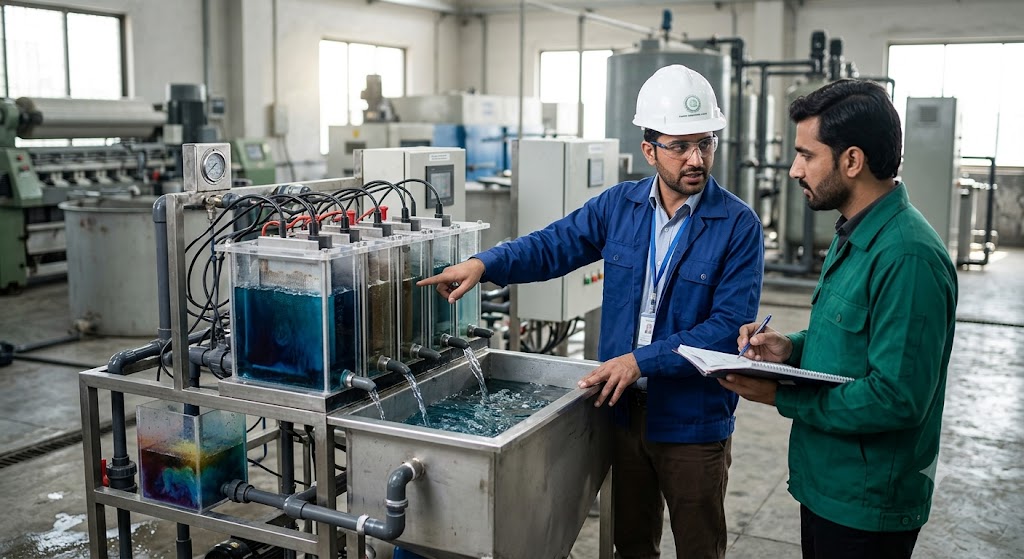
Color is the hardest parameter to remove from textile effluent, and it’s usually the first thing an EPA inspector notices — long before COD or BOD numbers even come into question. Many plants invest heavily in biological treatment only to find their discharge still fails color limits, because conventional biological systems simply weren’t designed to break down dye molecules efficiently. This is where electrocoagulation for dye removal has become one of the most practical answers for textile units across Pakistan.
This article looks at how electrocoagulation works specifically for dye-laden effluent, what real-world performance looks like based on a textile industry case study, and where it fits into a broader dye wastewater treatment strategy. If you’re weighing electrocoagulation against other pretreatment or standalone options, this should give you a clear, practical basis for that decision.
Why Dye Removal Is So Difficult
Textile dyeing effluent, particularly from reactive and disperse dyes commonly used in Pakistan’s textile sector, contains complex, chemically stable color compounds that resist standard biological breakdown. Conventional activated sludge systems can reduce BOD reasonably well but often leave visible color and a portion of COD untouched, because the microorganisms responsible for biological treatment aren’t effective against many synthetic dye structures. High salt content from dyeing and washing processes compounds the problem, since it can inhibit biological activity altogether at certain concentrations.
This combination — color resistant to biological breakdown, plus salt load that limits biological efficiency — is exactly why textile units frequently need a physicochemical pretreatment step before or alongside biological treatment.
How Electrocoagulation for Dye Removal Works
Electrocoagulation for dye removal uses an electric current passed through metal electrodes (typically iron or aluminum) submerged in the effluent. The current causes the electrodes to release metal ions, which react with the wastewater to form coagulant species. These destabilize suspended dye particles and colloidal matter, causing them to clump together (flocculate) and settle or float for easy removal.
The process works well for dye removal specifically because:
- Many dye molecules carry an electrical charge that responds directly to the coagulant ions generated
- It breaks down color-causing complexes rather than relying on biological digestion
- It requires minimal chemical dosing compared to conventional chemical coagulation, since the coagulant is generated in situ
- It can operate as a standalone pretreatment step or ahead of a biological stage like a Moving Bed Biofilm Reactor to protect downstream biological treatment from color and salt shock loads
Textile Industry Case Study: What Real Performance Looks Like
In a representative textile dyeing unit case, raw effluent characterized by high color intensity, elevated COD, and moderate-to-high TDS from reactive dyeing was treated using an electrocoagulation system ahead of biological polishing. The results followed a pattern typical of well-designed electrocoagulation applications for dye-heavy effluent:
Parameter | Raw Effluent (Typical Range) | After Electrocoagulation |
Color | High, visibly intense | Significantly reduced, often near-clear |
COD | Elevated | Substantially reduced |
Suspended solids | High | Sharply reduced |
Downstream biological load | High, inhibits microbial activity | Reduced, improving biological treatment stability |
The key outcome wasn’t just the color reduction itself — it was that the biological treatment stage downstream became noticeably more stable once electrocoagulation removed the majority of color and salt-linked inhibition. This is a pattern seen consistently across textile applications: electrocoagulation doesn’t just clean the water, it protects the performance of whatever treatment comes after it.
Electrocoagulation vs Conventional Chemical Coagulation
Plants evaluating dye wastewater treatment options in Pakistan often compare electrocoagulation against traditional chemical coagulation using alum or ferric chloride. Both approaches destabilize and remove dye particles, but the mechanisms and trade-offs differ:
Factor | Chemical Coagulation | Electrocoagulation |
Coagulant source | Added chemically, ongoing dosing cost | Generated in situ from electrodes |
Sludge volume | Often higher, chemical-heavy sludge | Generally lower, denser sludge |
Dosing consistency | Requires careful pH and dose control | Self-adjusting within a stable current range |
Operating cost driver | Chemical procurement and dosing | Electricity and electrode replacement |
Effectiveness on complex dyes | Variable, depends on dye chemistry | Generally strong across a wider range of dye types |
Neither option is universally “better” — the right choice depends on your electricity cost, effluent volume, and dye chemistry. For many textile units, electrocoagulation becomes more cost-effective as chemical coagulant prices rise, since electrode consumption is a more predictable, controllable operating cost.
Where Electrocoagulation Fits in a Complete Treatment Train
Electrocoagulation is rarely used as the only treatment step for textile effluent — it’s most effective as part of a broader system. A typical dye wastewater treatment sequence looks like this:
- Screening and equalization to remove solids and stabilize flow
- Electrocoagulation to remove the bulk of color and reduce biological inhibition
- Biological treatment (such as MBBR) to reduce remaining COD/BOD
- Polishing and disinfection to meet final NEQS discharge parameters
- Optional membrane or evaporation stage if water reuse or Zero Liquid Discharge is the end goal
Placing electrocoagulation early in this sequence is what allows the rest of the system, particularly biological treatment, to operate reliably instead of being overwhelmed by raw dye load.
Practical Considerations Before Adopting Electrocoagulation
Before committing to electrocoagulation for a textile facility, a few practical factors are worth evaluating:
- Electrode material selection (iron vs aluminum) should match your specific dye chemistry and target parameters — this is a decision best made after jar testing, not assumed generically.
- Electricity availability and cost directly affects operating economics, since the process is current-driven rather than chemical-driven.
- Sludge handling still needs a plan, even though electrocoagulation typically produces less sludge than chemical coagulation for equivalent color removal.
- Periodic electrode replacement is a predictable maintenance cost that should be built into your operating budget from day one, not treated as a surprise expense later.
FAQ
Q1. Is electrocoagulation effective for all types of textile dyes?
It performs well across a wide range of dye chemistries, particularly reactive and disperse dyes common in Pakistan’s textile sector, though effectiveness can vary by specific dye structure. Jar testing on your actual effluent is the most reliable way to confirm expected performance before full-scale design.
Q2. How does electrocoagulation compare to biological treatment alone for dye removal?
Biological treatment alone is generally weak against color removal because many dye compounds resist microbial breakdown. Electrocoagulation is typically used ahead of biological treatment specifically to remove color and reduce the load that would otherwise inhibit biological performance.
Q3. What is the main operating cost in an electrocoagulation system?
Electricity consumption and periodic electrode replacement are the two primary recurring costs. Unlike chemical coagulation, there’s no ongoing coagulant procurement, which makes operating costs more predictable once the system is calibrated to your effluent characteristics.
Q4. Can electrocoagulation alone achieve NEQS compliance for textile effluent?
In most cases, no — it’s highly effective for color and a portion of COD removal, but a complete treatment train including biological treatment and polishing is usually needed to meet all NEQS discharge parameters reliably.
Conclusion
Electrocoagulation for dye removal has proven to be one of the most reliable pretreatment options for textile effluent in Pakistan, largely because it targets what biological treatment struggles with most: persistent color and salt-linked inhibition. Used as part of a complete treatment train, it stabilizes downstream biological performance and helps textile units meet dye wastewater treatment requirements more consistently. WCSP has designed and commissioned electrocoagulation systems for textile clients across Pakistan since 2007, bringing hands-on experience with the dye chemistries most common in the local industry.