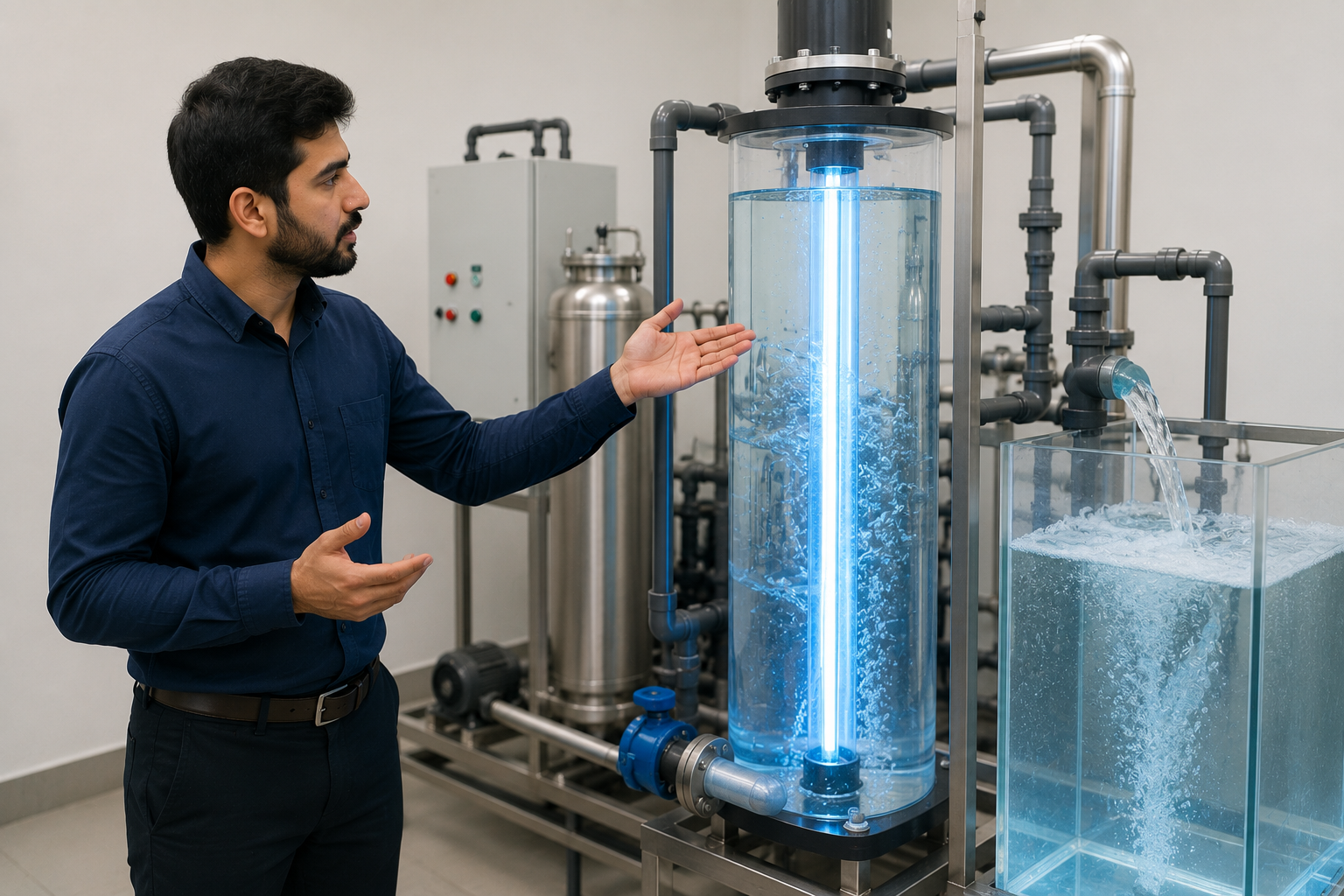
Not every industrial effluent responds well to biological treatment, no matter how well-designed the system is. Some wastewater streams contain compounds that are toxic to microorganisms, resistant to biological breakdown, or simply too concentrated for a biological process to handle reliably. When plant managers hit this wall, the Fenton process is often the technology that gets them past it.
This article explains how the Fenton process works, why chemical oxidation wastewater treatment sometimes outperforms biological systems, and — just as importantly — when biological treatment is still the better and more economical choice. If you’re trying to figure out which approach fits your effluent, this comparison should give you a clear, practical answer.
What the Fenton Process Actually Does
The Fenton process is an advanced oxidation process (AOP) that uses a combination of hydrogen peroxide and an iron catalyst to generate hydroxyl radicals — highly reactive species capable of breaking down complex organic pollutants that biological systems can’t touch. Unlike biological treatment, which relies on microorganisms metabolizing pollutants over time, the Fenton process works through a fast chemical reaction, typically completing oxidation within a controlled reaction time of under an hour under the right conditions (correct pH, dosing, and temperature).
The process runs in a few distinct stages:
- pH adjustment — the reaction typically needs an acidic environment (around pH 3–4) for the iron catalyst to work effectively
- Reagent dosing — hydrogen peroxide and iron salts are added in carefully controlled ratios based on the pollutant load
- Oxidation reaction — hydroxyl radicals break down complex organic molecules into simpler, more biodegradable, or fully mineralized compounds
- Neutralization and coagulation — pH is raised again, causing iron to precipitate out along with a portion of the oxidized pollutants, which are then removed as sludge
Why Biological Treatment Sometimes Fails
Before deciding on chemical oxidation, it’s worth understanding exactly why biological systems struggle with certain effluent types:
- Toxicity to microorganisms — effluent containing heavy metals, certain solvents, or high concentrations of specific chemicals can kill or inhibit the biomass a biological system depends on.
- Non-biodegradable or refractory compounds — some industrial chemicals, certain dyes, and pharmaceutical intermediates resist microbial breakdown regardless of retention time.
- High COD-to-BOD ratio — a low BOD relative to COD signals that much of the organic load isn’t readily biodegradable, meaning biological treatment alone will leave significant residual COD.
- Shock loads — sudden spikes in concentration or flow, common in batch-process industries, can crash a biological system that needs stable conditions to function.
Pharmaceutical, specialty chemical, and certain textile effluents in Pakistan frequently show one or more of these characteristics, which is exactly why they’re the industries where the Fenton process shows up most often.
Fenton Process vs Biological Treatment: A Direct Comparison
Factor | Biological Treatment | Fenton Process (Chemical Oxidation) |
Best suited for | Biodegradable organic load, stable flow | Toxic, refractory, or non-biodegradable pollutants |
Treatment time | Hours to days (retention-based) | Typically under an hour for the reaction itself |
Sensitivity to toxic shock loads | High — can crash the biological system | Low — chemical reaction isn’t affected by toxicity to microbes |
Sludge output | Moderate, biological sludge | Higher, chemical (iron) sludge requiring disposal |
Operating cost driver | Aeration energy, nutrient dosing | Hydrogen peroxide and iron reagent cost |
Footprint | Larger, due to retention time needed | Generally smaller, faster reaction kinetics |
pH sensitivity | Moderate | High — requires precise pH control for both reaction and neutralization |
Neither technology is universally superior — the right choice depends entirely on your effluent’s chemical characteristics. In many cases, the most effective and cost-efficient solution isn’t choosing one over the other, but combining them.
When to Combine Fenton Process with Biological Treatment
For effluent with a mix of biodegradable and refractory pollutants, using the Fenton process as a pretreatment step ahead of biological treatment is often the most cost-effective configuration. Chemical oxidation breaks down the toxic or resistant compounds first, converting some of them into simpler, more biodegradable intermediates, which makes the effluent far more suitable for a downstream biological stage such as a Moving Bed Biofilm Reactor.
This combined approach reduces reagent consumption compared to using Fenton process oxidation alone to achieve full treatment, since the biological stage handles the remaining, now-biodegradable load at a much lower operating cost than continuing chemical oxidation to completion. It’s a pattern seen frequently in pharmaceutical effluent treatment, where a purely biological system would fail on toxicity, and a purely chemical system would be far more expensive than necessary.
Cost Considerations for Chemical Oxidation Wastewater Treatment
Chemical oxidation wastewater treatment using the Fenton process has a different cost structure than biological treatment, and this matters for budgeting:
- Reagent cost (hydrogen peroxide and iron salts) scales directly with pollutant concentration, so highly loaded effluent streams cost proportionally more to treat.
- Sludge disposal is a meaningful ongoing cost, since the iron-based sludge generated needs proper handling and disposal, distinct from biological sludge.
- pH adjustment chemicals for both the acidic reaction stage and the subsequent neutralization step add to operating costs and need to be budgeted alongside the primary reagents.
- Lower capital cost for reaction tanks compared to the larger retention volumes biological systems require, since Fenton’s reaction time is much shorter.
For effluent streams that are genuinely toxic or non-biodegradable, the higher reagent cost of Fenton treatment is usually still lower than the cost of an oversized or repeatedly failing biological system trying to handle the same load.
Industries Where Fenton Process Makes the Most Sense
Based on typical effluent characteristics, the Fenton process tends to be most valuable for:
- Pharmaceutical manufacturing, where active pharmaceutical ingredients and process chemicals are often toxic to biomass
- Specialty and industrial chemical production, where effluent frequently contains non-biodegradable compounds
- Textile units with high refractory dye load, particularly when electrocoagulation alone doesn’t fully address COD from complex dye chemistries
- Landfill leachate and industrial sites with historically contaminated water requiring aggressive oxidation before any biological or discharge step
Practical Considerations Before Choosing Fenton Process Treatment
- Jar testing is essential — reagent dosing needs to be calibrated to your specific effluent, since generic dosing assumptions rarely hold across different industrial streams.
- pH control equipment must be reliable, since both the reaction and neutralization stages depend on precise pH management to work correctly and safely.
- Sludge handling capacity should be planned for from the start, not treated as an afterthought once the system is running.
- Combine with biological treatment where possible to control reagent costs, rather than defaulting to full chemical oxidation for effluent that’s only partially refractory.
FAQ
Q1. Is the Fenton process more expensive than biological treatment?
Generally, yes, on a per-cubic-meter basis, primarily due to reagent costs. However, for toxic or non-biodegradable effluent where biological treatment would fail or require significant oversizing, Fenton process treatment is often the more cost-effective and reliable overall solution.
Q2. Can the Fenton process be used for all types of industrial wastewater?
No — it’s best suited for effluent that’s toxic, refractory, or has a high COD-to-BOD ratio indicating poor biodegradability. For effluent that’s readily biodegradable, biological treatment is usually the more economical choice, either alone or combined with Fenton as pretreatment.
Q3. Does the Fenton process replace biological treatment entirely?
Not typically. It’s most cost-effective when used as a pretreatment step to break down refractory compounds, with biological treatment handling the remaining biodegradable load afterward. Full chemical oxidation to completion is usually only necessary for effluent that’s almost entirely non-biodegradable.
Q4. What is the main operating cost in a Fenton process system?
Hydrogen peroxide and iron reagent consumption is the primary recurring cost, scaling directly with pollutant concentration. Sludge disposal and pH adjustment chemicals for both the reaction and neutralization stages add to this ongoing operating expense.
Conclusion
The Fenton process earns its place in a wastewater treatment strategy specifically where biological treatment struggles — toxic, refractory, or highly concentrated effluent that microorganisms simply can’t break down efficiently. For many industrial sites, particularly pharmaceutical and specialty chemical facilities, combining chemical oxidation wastewater treatment with a downstream biological stage delivers the most reliable and cost-effective outcome. WCSP has designed Fenton process and advanced oxidation systems for Pakistani industrial clients since 2007, matching treatment technology to each site’s actual effluent characteristics rather than a one-size-fits-all approach