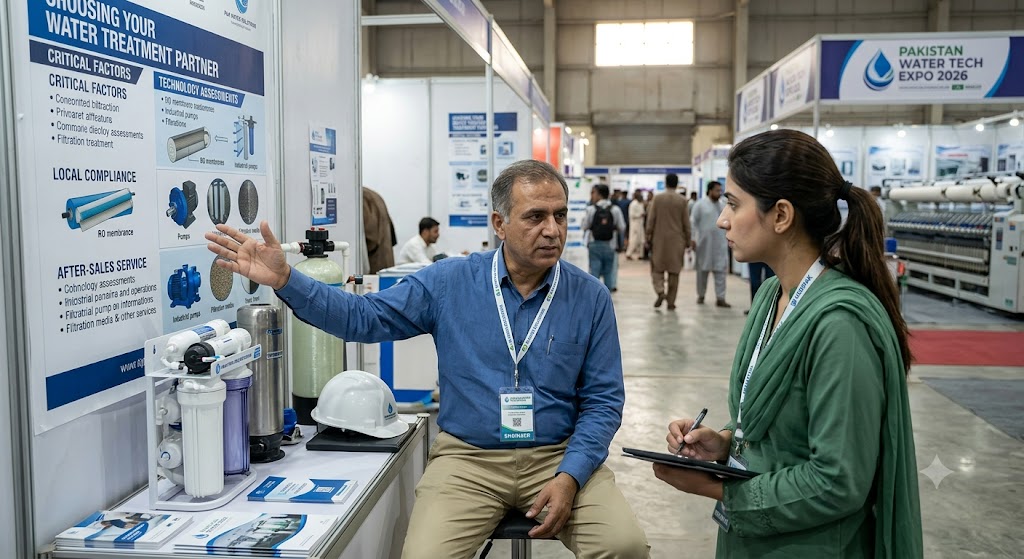
Selecting the right water treatment company in Pakistan often happens under pressure — a compliance deadline may be approaching, an EPA notice may have arrived, or your existing system may have failed one too many times. This pressure is exactly why many plants end up choosing a provider that seemed reliable during the meeting but failed to deliver once the system was operational. Understanding how to choose the right partner — instead of simply picking the cheapest quote — is ultimately what determines whether your water or wastewater treatment system performs reliably for the next decade.
This checklist walks through the eight factors that matter most when evaluating a water treatment company Pakistan-based industries can actually depend on — from technical capability and certifications to service response and long-term cost. Use it to compare vendors on substance, not just on price.
1. Relevant Technical Experience, Not Just General Experience
“Years in business” isn’t the same as relevant experience. A company that has spent a decade installing residential filtration units isn’t automatically qualified to design an industrial effluent treatment plant for a textile dyeing unit or a pharmaceutical facility. When evaluating how to choose a provider, ask specifically:
- Have they designed systems for your industry (textile, food & beverage, pharma, or municipal)?
- Can they show reference projects with similar effluent characteristics to yours?
- Do they understand the specific NEQS parameters relevant to your sector?
A vendor with genuine experience will ask you detailed questions about your feed water or effluent before quoting — not the other way around.
2. Certifications and Regulatory Standing
Certifications are not just paperwork; they indicate whether a company follows recognized engineering and quality standards in its design and fabrication process. Look for ISO certifications relevant to quality management and environmental management, and confirm the company is registered and in good standing to operate in Pakistan. A credible water treatment company Pakistan businesses trust will be transparent about its certifications and happy to share documentation without being asked twice.
3. Technology Fit, Not Just Technology Availability
Many companies offer a wide menu of treatment technologies — RO, MBBR, MBR, electrocoagulation, ozone systems — but offering something isn’t the same as recommending the right thing for your specific water profile. The right partner will explain why a particular technology fits your situation instead of defaulting to whatever they happen to sell most.
Evaluation Question | Why It Matters |
Did they test or characterize your water/effluent before recommending a technology? | Prevents mismatched, underperforming systems |
Can they explain trade-offs between options (e.g. MBBR vs conventional activated sludge)? | Signals real engineering judgment, not a sales script |
Do they size equipment for your actual flow and load, not generic assumptions? | Undersized systems fail under real operating conditions |
For example, a food & beverage plant with high organic load and space constraints may be better served by a Moving Bed Biofilm Reactor than a conventional activated sludge system, since MBBR typically achieves comparable treatment efficiency in a smaller footprint. A company that recommends the same standard package regardless of your specific constraints hasn’t actually evaluated your site.
4. In-House Design and Fabrication Capability
Ask whether the company designs and fabricates its own systems or simply assembles and resells imported packages. In-house capability generally means faster turnaround on custom modifications, better spare parts availability, and engineers who genuinely understand how your specific system was built — which matters enormously when something needs troubleshooting two years down the line.
5. Post-Installation Service and Support
This is where many vendors quietly fall short. A plant that runs perfectly during commissioning but has no real support structure afterward creates ongoing risk. Ask potential providers:
- What is their typical response time for breakdowns or performance issues?
- Do they offer a formal Service Level Agreement with defined response and resolution commitments?
- Can they provide remote or on-site troubleshooting, and how quickly?
- Do they offer ongoing operator training, not just a one-time handover?
A system is only as reliable as the support behind it. Companies that treat commissioning as the finish line, rather than the starting point of an ongoing relationship, tend to leave clients stranded exactly when it matters most.
6. Total Cost of Ownership, Not Just Installation Price
The lowest quote is rarely the lowest total cost. When comparing providers, look beyond capital cost to:
- Energy consumption of the proposed system under normal operating conditions
- Chemical and consumable costs (antiscalants, membrane cleaning chemicals, biological nutrients)
- Expected membrane or media replacement frequency
- Sludge handling and disposal costs, particularly relevant for wastewater systems
A system priced 15–20% higher upfront but with meaningfully lower energy consumption or longer membrane life often costs less over a 5-year period. Ask any shortlisted vendor for realistic operating cost estimates alongside their capital quote, not just the equipment price.
7. Compliance and Documentation Support
Regulatory compliance in Pakistan increasingly requires ongoing documentation — discharge monitoring reports, water quality test records, and evidence of system performance for EPA submissions. A capable provider should support this process directly, not leave you to figure it out after installation. Confirm whether the company provides:
- Standard operating procedures and system documentation
- Support with EPA reporting formats and NEQS parameter tracking
- Access to reliable water testing kits or testing support for ongoing self-monitoring
8. Track Record with Comparable Clients
Finally, ask for references from clients in your industry, ideally of a similar scale. A company that has successfully served large multinational food & beverage or textile operations, alongside smaller municipal or commercial clients, demonstrates it can scale its engineering approach to different needs rather than applying a one-size-fits-all template. Genuine client references — ones you can actually call — are worth more than any brochure.
Putting the Checklist Together
# | Checklist Item | Red Flag to Watch For |
1 | Relevant technical experience | No industry-specific reference projects |
2 | Certifications & regulatory standing | Reluctance to share documentation |
3 | Technology fit | Same recommendation regardless of your water profile |
4 | In-house design/fabrication | Fully outsourced with no engineering ownership |
5 | Post-installation service | No SLA or defined response times |
6 | Total cost of ownership | Quote covers equipment only, no OPEX estimate |
7 | Compliance & documentation support | No help with EPA/NEQS reporting |
8 | Track record with comparable clients | No verifiable references |
Running through this list with two or three shortlisted vendors, side by side, usually makes the right choice obvious — the gaps tend to show up quickly once you’re asking specific questions instead of comparing quotes alone.
FAQ
Q1. How do I know if a water treatment company in Pakistan is genuinely qualified for industrial projects?
Ask for reference projects specific to your industry, verify their certifications, and confirm whether they characterize your water or effluent before recommending a technology. A qualified provider will ask detailed technical questions rather than offering a generic package upfront.
Q2. What’s the biggest mistake companies make when choosing a water treatment provider?
Choosing based on the lowest capital cost alone, without evaluating operating costs, service support, or technology fit. This often leads to higher long-term expenses and unreliable performance once the system is running under real conditions.
Q3. Should I choose a company that offers many different treatment technologies, or a specialist?
A company offering multiple technologies is fine, as long as they can clearly explain why a specific technology fits your situation rather than defaulting to one option. Genuine engineering judgment matters more than the breadth of their technology menu.
Q4. Is post-installation support really that important for a new water treatment plant?
Yes — most plant issues emerge after commissioning, not during it. A provider without a clear service structure, response times, or ongoing support leaves you exposed exactly when problems are most likely to occur.
Q5. How much does certification actually matter when choosing a provider?
Certifications indicate the company follows recognized quality and environmental management standards in its design and fabrication process. While not a guarantee of performance on their own, they’re a meaningful filter for narrowing down credible providers.
Conclusion
Choosing a water treatment company in Pakistan comes down to evaluating substance over price: relevant experience, the right technology fit, genuine post-installation support, and transparent total cost of ownership. Vendors who can’t answer specific technical questions about your water profile, or who avoid discussing long-term operating costs, are worth treating with caution. WCSP has served Pakistan’s industrial and municipal sectors with certified, engineering-led water and wastewater solutions since 2007, and welcomes the kind of detailed questions this checklist encourages.