Pakistan’s textile mills, beverage plants, and municipal water authorities are sitting on a disinfection time bomb — and most of them already know it. Chlorine-treated water linked to trihalomethane formation has drawn increasing scrutiny from the Pakistan Environmental Protection Agency, and NEQS compliance officers in Lahore, Faisalabad, and Karachi are asking harder questions than ever before.
According to the World Health Organization, disinfection byproducts from chlorine treatment are classified as potential human carcinogens, with long-term exposure linked to bladder and colorectal cancers. That is not a theoretical risk. That is the water coming out of treatment systems that were designed 30 years ago and never upgraded.
This article explains exactly why forward-looking facility managers across Pakistan are switching to ozone generator water treatment — how it works, where it wins, where it costs more upfront, and how to evaluate whether it is the right move for your plant. By the end, you will have the technical grounding and practical framework to make that decision with confidence.
Why Chlorine Is No Longer the Gold Standard for Industrial Water Disinfection
For decades, chlorine was the default choice. Cheap, available, and proven — it made sense when the alternative was untreated water. But “better than nothing” is not the same as good enough, and Pakistan’s regulatory environment is tightening fast.
The core problem with chlorine is what it creates when it reacts with organic matter naturally present in source water. These reactions produce trihalomethanes and haloacetic acids — collectively called disinfection byproducts, or DBPs. In high-volume industrial applications like beverage manufacturing or pharmaceutical water systems in Karachi and Gujranwala, where water passes through extensive pipe networks, DBP concentrations compound over time.
There is also the handling problem. Chlorine gas and sodium hypochlorite are hazardous materials. A chlorine storage room in a Lahore food processing plant carries real worker safety liability. Procurement chains for liquid chlorine in Punjab are also inconsistent, creating operational risk.
The Regulatory Shift You Cannot Ignore
Pakistan’s National Environmental Quality Standards currently regulate residual chlorine in drinking water and industrial effluent discharge. As local EPA enforcement capacity improves — particularly in Punjab and Sindh — plants relying on legacy chlorination systems will face increasing audit exposure. Facilities that proactively switch to chemical-free alternatives like ozone water purification systems are building a compliance buffer that chlorine-dependent competitors simply do not have.
WCSP’s wastewater and drinking water compliance teams have seen this pattern across dozens of industrial audits since 2007. The plants that moved early on disinfection technology are the ones with the cleanest compliance records today.
What Is an Ozone Generator and How Does It Actually Work
An ozone generator produces O3 — ozone — by passing oxygen through either a corona discharge chamber or a UV lamp at high intensity. The resulting ozone is then dissolved into a water stream through a venturi injector or fine-bubble diffuser system, creating an ozone water purification system that attacks microbial contaminants directly.
Ozone’s disinfection mechanism is fundamentally different from chlorine’s. Where chlorine disrupts cell metabolism, ozone ruptures cell walls and oxidizes viral protein coats — a faster and more complete kill. The U.S. EPA rates ozone as 1.5 times more effective than chlorine against common waterborne pathogens, and significantly more effective against chlorine-resistant organisms like Cryptosporidium and Giardia, which are a documented concern in Pakistan’s surface water sources.
The Contact Chamber: Where the Work Happens
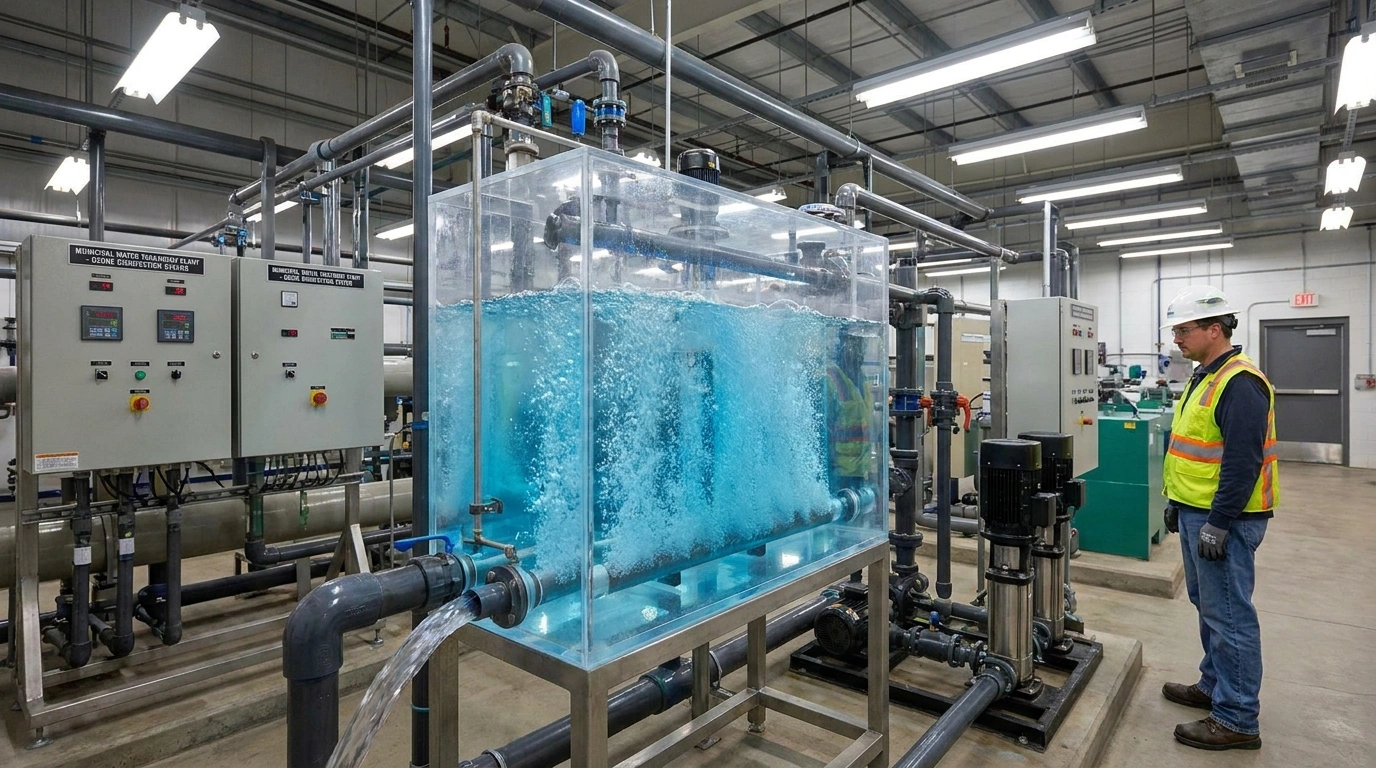
After injection, ozone-saturated water flows through a contact chamber — typically a baffled tank designed to maximize contact time between ozone and the water being treated. Residence times of 4 to 10 minutes at a dissolved ozone concentration of 0.4 to 1.0 mg/L achieve the 4-log (99.99%) pathogen reduction required under most international drinking water standards.
After the contact period, ozone reverts to oxygen through natural decomposition — no chemical neutralization step required, no residual to manage. What remains is cleaner water and ordinary O2.
WCSP designs and installs complete ozone water purification systems, including the generator, contact chamber, off-gas destruction unit, and integration with your existing pipeline and monitoring infrastructure.
Ozone vs Chlorine Disinfection: A Direct Performance Comparison
Here is how the two technologies compare across the criteria that matter most to industrial operators and municipal water managers in Pakistan.
| Parameter | Ozone Generator System | Chlorine Disinfection |
|---|---|---|
| Disinfection Effectiveness | Excellent — kills bacteria, viruses, protozoa | Good — less effective vs. Cryptosporidium |
| Disinfection Byproducts | None (reverts to O2) | Trihalomethanes, haloacetic acids |
| Chemical Storage Required | No | Yes — hazardous material handling |
| Taste and Odor Impact | Improves taste and odor | Can add chemical taste/smell |
| Operating Cost (ongoing) | Low — electricity only | Moderate — recurring chemical purchases |
| Capital Cost | Higher upfront | Lower upfront |
| NEQS/EPA Compliance Risk | Very Low | Increasing scrutiny |
| Residual Disinfection | Requires post-treatment chlorine or UV | Provides residual in distribution system |
| Maintenance Complexity | Moderate — requires trained staff | Low — simpler chemistry |
| Suitable for Pakistan Context | Yes — especially beverage, pharma, municipal | Yes — but compliance trajectory is adverse |
The one genuine limitation of ozone systems is that ozone provides no residual disinfection protection in distribution pipelines after the contact chamber. For municipal water systems with long distribution networks — as found in Lahore and Karachi — a low-dose residual chlorine dose or UV polishing step is often combined with the ozone stage to cover post-treatment recontamination risk. This hybrid approach gives you the best of both technologies.
Where Ozone Generator Water Treatment Delivers the Strongest ROI
Not every plant gets equal value from switching to ozone. The facilities where ozone water treatment delivers the clearest return on investment share a set of common characteristics — and most Pakistani industrial facilities meet at least two or three of them.
Beverage and bottled water manufacturers in Lahore, Sialkot, and Faisalabad are the clearest beneficiaries. These facilities sell a product that people drink. Any chemical taste or odor from chlorination directly affects product quality. Ozone treatment improves taste and odor profiles while delivering superior microbial safety — a product quality argument that pays for itself in reduced returns and brand protection.
Pharmaceutical plants operating under WHO-GMP or ISO 22716 standards — common in Karachi’s industrial estates — face strict limits on chemical residuals in process water. Ozone’s zero-residual profile often eliminates the need for costly activated carbon polishing steps currently used to remove chlorine before water enters production lines.
Food processing facilities in Gujranwala processing meat, dairy, or ready-to-eat products operate under stringent microbial load requirements. Ozone’s superior kill rate against E. coli, Listeria, and Salmonella makes it the stronger technical choice, and documented ozone use strengthens food safety audit outcomes.
According to a 2022 market analysis by Global Water Intelligence, facilities that switch from chlorination to ozone treatment report a 30 to 45 percent reduction in chemical operating costs within the first two years, with full capital recovery typically achieved in 4 to 7 years depending on system scale and local electricity costs.
WCSP’s ozone generator installations have served beverage producers, food manufacturers, and municipal operators across Punjab and Sindh. Each project begins with a site-specific feasibility study that calculates payback period against your actual water volume, contamination profile, and current chemical spend.
Pro Tip: The Mistake Pakistani Plants Make When Evaluating Ozone Systems
Most procurement teams evaluate ozone vs chlorine on capital cost alone — and then decide ozone is too expensive. That is the wrong calculation.
Run a 5-year total cost of ownership comparison that includes chemical procurement, storage compliance costs, staff safety training for hazardous chemical handling, and the insurance premium differential between a chemical-free plant and one storing chlorine gas or concentrated hypochlorite. In WCSP’s experience across 17-plus years of industrial water projects in Pakistan, the 5-year TCO for ozone systems is competitive with — or lower than — chlorination in facilities treating more than 200 cubic meters per day. Below that threshold, UV disinfection may be the better entry point, with ozone added as volume scales.
Step-by-Step: How to Evaluate Whether Your Plant Is Ready to Switch
Before commissioning a system, run through this assessment sequence. It will save you from over-specifying equipment or under-designing the contact chamber for your actual contamination load.
Step 1: Conduct a baseline water quality audit. You need turbidity, TOC (total organic carbon), microbial load, and pH data on your source water. Ozone demand scales with organic load — high TOC means you need more ozone per liter, which affects generator sizing and operating cost.
Step 2: Define your flow rate requirements. Ozone systems are sized in grams of ozone per hour. Your peak daily flow rate and peak hourly demand determine the generator capacity you need.
Step 3: Map your distribution system. If you have long pipe runs after treatment — as most municipal systems do — plan for a hybrid design with a low-dose chlorine or UV residual stage downstream of the ozone contact chamber.
Step 4: Assess electrical infrastructure. Ozone generators require stable three-phase power. Fluctuating supply — common in some industrial zones in Punjab — requires a voltage stabilizer in the system design.
Step 5: Identify your off-gas management requirement. Ozone off-gas from the contact chamber must be destroyed before venting. A catalytic destruct unit is standard. Make sure this is included in any quote you receive.
Step 6: Request a technology-specific proposal from a licensed installer. Insist on a proposal that includes contact chamber design, system integration, commissioning support, and operator training — not just the generator unit alone.
WCSP’s engineering team handles all six steps as part of a single integrated project scope, from feasibility audit through commissioning and operator certification.
Chemical-Free Water Disinfection: What “Chemical-Free” Actually Means for Compliance
The phrase “chemical-free water disinfection” appears frequently in technology marketing, and it deserves clarification — because regulators and auditors will ask precise questions.
Ozone is a chemical in the strict sense — O3 is a molecule with defined chemistry. What “chemical-free” means in the context of ozone water purification systems is more precisely “disinfection without persistent chemical residuals or synthetic chemical dosing.” Ozone is generated on-site from air or oxygen, leaves no chemical residue in the treated water, and produces no synthetic byproducts.
This distinction matters for three specific compliance contexts in Pakistan. First, under NEQS effluent standards, facilities discharging treated water are assessed for residual chlorine and DBPs. Ozone-treated water eliminates this exposure. Second, pharmaceutical and food facilities seeking ISO or WHO-GMP certification find that zero-residual disinfection simplifies the water quality documentation required for certification audits. Third, bottled water operations seeking export market access — particularly to Gulf Cooperation Council countries — face importing country standards that increasingly restrict chlorine residuals in packaged drinking water. Ozone treatment aligns cleanly with these requirements.
WCSP’s UV disinfection and ozone disinfection systems are regularly specified for facilities pursuing export certification. If your facility is targeting international market access, this is a conversation worth having early in your plant design or upgrade process.
Ozone Generator Water Treatment in Pakistan’s Municipal Sector
Municipal water authorities in Pakistan operate some of the most under-resourced treatment infrastructure in South Asia. The combination of aging chlorination systems, inconsistent chemical supply chains, and growing populations in secondary cities like Gujranwala, Sialkot, and Multan is creating a treatment capacity crisis that incremental chlorination upgrades cannot solve.
Ozone treatment’s scalability makes it genuinely applicable at the municipal level — not just for large metropolises, but for Water and Sanitation Agencies operating mid-scale treatment plants in the 5,000 to 50,000 cubic meter per day range. A modular ozone system can be phased in alongside existing infrastructure, allowing a WASA authority to upgrade disinfection capacity without decommissioning the entire plant simultaneously.
According to the Pakistan Council of Research in Water Resources, waterborne disease attributable to inadequate disinfection costs Pakistan’s economy an estimated PKR 112 billion annually in healthcare expenditure and lost labor productivity. Municipal investment in superior disinfection technology is not an environmental expenditure — it is an economic one.
WCSP works with municipal bodies on technology selection, project financing structures, and operator training programs that make advanced water treatment accessible beyond the private industrial sector.
Conclusion
The shift from chlorine to ozone generator water treatment is not a trend — it is a technical and regulatory progression that Pakistan’s most forward-looking facilities are already executing. Here is what you should take away from this analysis.
Ozone outperforms chlorine on pathogen kill rate, disinfection byproduct profile, and long-term chemical operating cost. The upfront capital is higher, but the 5-year total cost of ownership is competitive at any significant treatment volume. For beverage, pharmaceutical, food processing, and municipal applications, the product quality and compliance benefits are immediate and documentable.
Chemical-free water disinfection through ozone is not just about environmental positioning — it is about building a plant that passes audits, meets export standards, and does not carry the liability of a legacy chlorination system into an increasingly regulated future.
FAQ Section:
1: What is ozone generator water treatment and how does it work?
Ozone generator water treatment uses electrically generated ozone gas dissolved into water to destroy bacteria, viruses, and chemical contaminants. The ozone ruptures microbial cell walls more effectively than chlorine, then reverts to ordinary oxygen within minutes. No chemical residuals remain in the treated water, making it a clean and compliant disinfection method for industrial and municipal systems.
2: How does ozone vs chlorine disinfection compare in terms of safety and effectiveness?
Ozone is approximately 1.5 times more effective than chlorine as a disinfectant and kills chlorine-resistant organisms like Cryptosporidium that chlorine cannot reliably neutralize. Unlike chlorine, ozone produces no trihalomethanes or haloacetic acids — disinfection byproducts classified as potential carcinogens. The tradeoff is that ozone provides no residual protection in distribution pipes, so long networks may require a supplemental low-dose residual stage.
3: What is the cost of installing an ozone water purification system in Pakistan?
Installation costs for ozone water purification systems in Pakistan vary by treatment capacity, typically ranging from PKR 2.5 million for small commercial systems to PKR 25 million or more for large industrial or municipal installations. While upfront costs exceed chlorination, chemical-free operation means ongoing costs are limited to electricity. Facilities treating over 200 cubic meters per day typically recover full capital cost within 4 to 7 years.
4: Is ozone disinfection compliant with Pakistan’s NEQS water quality standards?
Yes. Ozone-treated water produces no regulated disinfection byproducts and leaves no chemical residuals, which places it in strong alignment with NEQS drinking water and effluent discharge standards. As Pakistan’s EPA enforcement capacity increases, ozone-treated systems face significantly lower compliance risk than legacy chlorination plants, particularly for facilities subject to regular environmental audits in Punjab and Sindh.
5: Can ozone generators replace chlorine completely in a municipal water system?
Ozone generators can replace chlorine as the primary disinfection stage in a municipal plant, but most municipal systems retain a low-dose chlorine or UV residual step for distribution network protection. This hybrid design — ozone as the primary treatment, chlorine or UV as a residual booster — gives municipal water authorities superior pathogen control with minimal chemical exposure, and is standard practice in modern international water treatment design.
6: How long does it take to install an ozone water treatment system?
A complete ozone generator water treatment installation typically takes 6 to 14 weeks from project award to commissioning, depending on system scale, site preparation requirements, and equipment lead times. Smaller packaged systems for commercial or light industrial use can be commissioned in as little as 3 to 4 weeks. WCSP includes operator training and a commissioning verification period in all project scopes to ensure the system performs to design specification from day one.