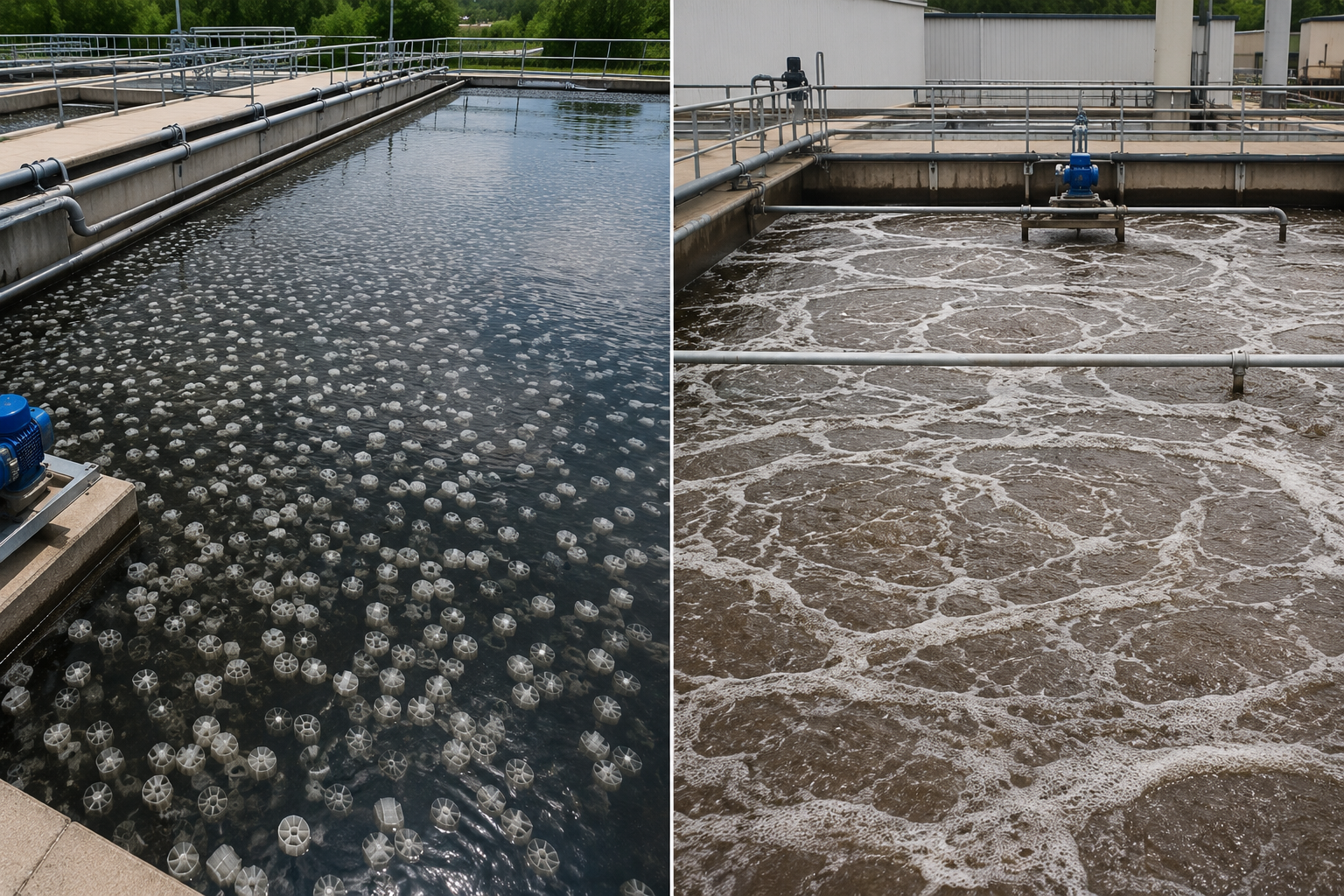
When you’re setting up or upgrading an effluent treatment plant, MBBR vs Activated Sludge is one of the first — and most expensive — decisions you’ll make. Both are biological wastewater treatment systems, both meet NEQS discharge standards when designed correctly, and both are widely used across Pakistan’s textile, food and beverage, and pharmaceutical sectors. But they differ sharply in capital cost, land requirement, sludge output, and long-term operating expense.
This article breaks down MBBR vs Activated Sludge side by side — what each system actually does, where the real cost differences show up, and which one fits your industry, budget, and available plot size. By the end, you’ll know which system makes financial sense for your specific situation, not just which one is more “modern.”
What Is MBBR and How It Works
Moving Bed Biofilm Reactor (MBBR) technology uses small plastic carriers — usually a few centimeters in diameter — that float freely inside an aeration tank. Bacteria grow as a biofilm on the surface of these carriers, and this biofilm does the actual work of breaking down organic pollutants in the wastewater. Because the carriers provide a huge amount of surface area in a small tank volume, an MBBR system can handle a heavier organic load in a smaller footprint than older biological methods.
The carriers stay inside the tank (held back by a screen), which means the treatment process doesn’t depend on settling and recycling large volumes of biomass the way Activated Sludge does. This is the main reason Moving Bed Biofilm Reactor projects have become popular across Pakistan’s industrial zones, especially where land is limited or expensive.
What Is Activated Sludge and How It Works
The Activated Sludge Process (ASP) is the older, more established method. Wastewater is mixed with a concentrated culture of bacteria (the “activated sludge”) in an aeration tank, where the bacteria consume organic pollutants. The mixture then flows into a settling tank, where the sludge sinks to the bottom and clear water rises to the top. Part of the settled sludge is pumped back into the aeration tank to maintain bacteria levels, and the rest is removed as waste sludge.
ASP is well understood, proven over decades, and can be designed for almost any flow rate. But it needs larger tanks, longer retention times, and a bigger footprint to achieve the same treatment efficiency as MBBR, because the bacteria are suspended in the water rather than concentrated on carrier surfaces.
MBBR vs Activated Sludge: Capital Cost Comparison
Capital cost depends heavily on plot size, flow rate, and site conditions, so exact figures vary project to project. That said, the general pattern holds across most wastewater treatment cost Pakistan comparisons:
Factor | MBBR | Activated Sludge |
Tank volume needed | Smaller (higher biomass density per m³) | Larger (lower biomass density per m³) |
Civil works cost | Lower, due to smaller tanks | Higher, due to larger tank footprint |
Equipment cost | Carrier media + aeration + screens | Aeration + clarifier + sludge return pumps |
Startup/commissioning time | Faster biofilm establishment in many cases | Longer sludge acclimatization period |
Retrofit potential | Easier to retrofit into existing tanks | Harder to retrofit without expanding tank size |
For a plant with limited plot size — common in older industrial areas of Lahore and Karachi where expansion isn’t an option — MBBR often works out cheaper overall once you account for civil construction, even if the carrier media itself adds to the equipment cost.
Operating Cost Differences: Energy, Sludge, and Maintenance
This is where the real long-term cost gap shows up.
Sludge Output and Disposal Cost
Activated Sludge systems typically generate more excess sludge than MBBR, because the process relies on maintaining a large suspended biomass population that needs regular wasting. More sludge means higher disposal costs, more frequent tanker pickups, and more paperwork for compliance records. MBBR systems generally produce less excess sludge relative to the load treated, since the biofilm on the carriers is more efficient per unit of biomass. If sludge handling is a major concern for your site, it’s worth reviewing our No Sludge Treatment approach, which minimizes this cost further using bioremediation-based technology.
Energy Consumption
Both systems need continuous aeration, which is usually the single biggest electricity cost in any biological treatment plant. MBBR tanks are smaller, so blower capacity requirements are often lower for the same organic load — but the carriers do require enough turbulence to keep them moving, so savings aren’t automatic. A proper Energy Management review at design stage is the only reliable way to know your actual energy cost difference, since it depends on blower sizing, aeration efficiency, and local electricity tariffs.
Maintenance Requirements
Activated Sludge needs closer daily monitoring of sludge age, return sludge ratios, and settling behavior — a poorly managed clarifier can upset the whole process. MBBR is comparatively more forgiving of load fluctuations because the biofilm stays in the tank regardless of flow changes, which means less day-to-day operator intervention, though carrier screens still need periodic cleaning.
Footprint and Space Requirements
This is often the deciding factor for factories in dense industrial zones. A typical MBBR system needs a noticeably smaller tank volume than Activated Sludge for the same organic loading rate, which matters enormously for plants operating on constrained plots — for example, a textile dyeing unit in an older Faisalabad industrial estate with no room to expand its treatment area. If you’re renting your facility or expect to relocate machinery in future phases, the smaller footprint also makes MBBR easier to redesign or relocate later.
Which Industries Suit Which System
Choosing between these two options usually comes down to your effluent characteristics and site constraints, not just cost:
- Textile units with variable dye loads and limited space often lean toward MBBR for its compact footprint and tolerance of load swings.
- Food and beverage plants with high organic loads and available land sometimes still choose Activated Sludge, since it’s a well-proven, easily scalable option for large continuous flows.
- Pharmaceutical facilities frequently combine either system with additional polishing steps (such as Electrocoagulation or Advanced Oxidation) to meet stricter discharge parameters.
- New industrial parks with plot size already allocated for treatment infrastructure may favor Activated Sludge for its long track record and simpler operator training.
This is a core part of any credible industrial effluent treatment system comparison — the “better” system genuinely depends on your specific plant, not a universal ranking.
NEQS Compliance: Both Systems Can Work — If Designed Correctly
Both MBBR and Activated Sludge, when properly sized and operated, can bring BOD, COD, and TSS levels down to within Pakistan’s National Environmental Quality Standards (NEQS) discharge limits. Compliance failures with either technology almost always trace back to undersizing the system for actual flow and load, not a flaw in the technology itself. Whichever system you choose, budget for regular effluent testing against NEQS parameters as an ongoing operating cost, not a one-time checkbox.
How to Choose the Right System for Your Plant
Before deciding, get clear answers to these questions:
- What is your available plot size for the treatment plant?
- How variable is your effluent flow and organic load day to day?
- What is your budget split between capital cost and 5-year operating cost?
- Do you have staff available for daily process monitoring, or do you need a lower-maintenance option?
- What sludge disposal capacity and cost do you currently have access to?
A proper site assessment — reviewing flow data, land constraints, and discharge requirements — will give you a far more reliable cost comparison than any generic percentage figure.
Conclusion
Neither MBBR nor Activated Sludge is universally cheaper — the right choice depends on your plot size, effluent characteristics, sludge disposal capacity, and how closely you can monitor daily operations. MBBR tends to win on footprint and sludge volume; Activated Sludge often wins on simplicity and proven scalability for larger flows. Water Care Services Pakistan (WCSP), with certified experience in both technologies since 2007, can assess your specific effluent profile and recommend the system that actually fits your budget and site — not just the one that’s trending.
Frequently Asked Question's
It depends on your plot size and sludge disposal costs. MBBR often has a lower overall cost on constrained sites due to smaller tanks and reduced sludge output, but Activated Sludge can be more economical for large-flow plants with available land and lower per-unit civil costs.
Yes, when properly designed and sized for your actual flow and organic load, MBBR systems can consistently meet NEQS limits for BOD, COD, and TSS, the same as a correctly sized Activated Sludge plant.
MBBR typically needs a smaller tank footprint than Activated Sludge for the same treatment capacity, since the biofilm carriers pack more active biomass into less tank volume. Exact space savings depend on your specific load and design.
MBBR generally produces less excess sludge than Activated Sludge for a comparable load, which can lower disposal costs over time. Actual sludge volumes still depend on influent strength and system design.
In many cases, yes — adding carrier media and retention screens to an existing aeration tank is a common way to boost capacity without building new civil structure, though a site-specific engineering review is needed to confirm feasibility.