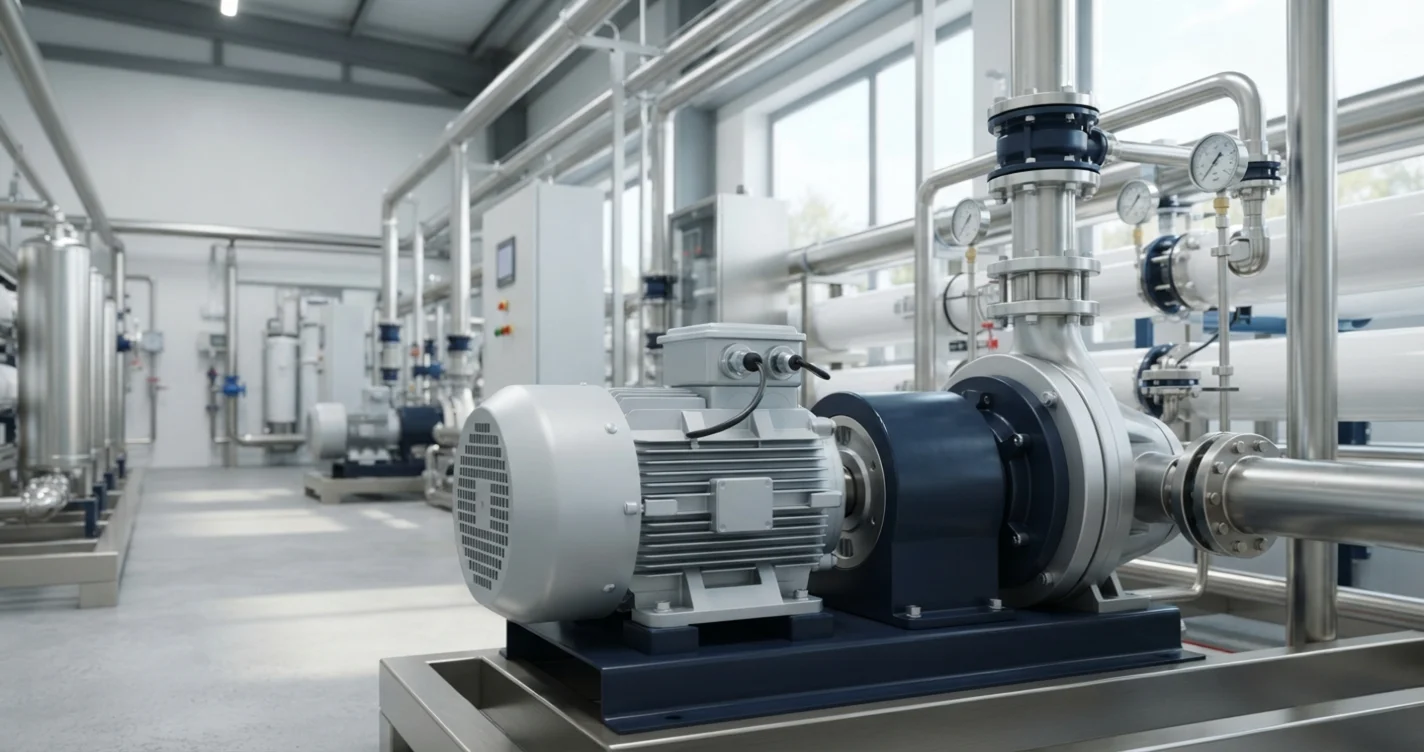
An Energy efficient RO plant motor can significantly impact your electricity bill because the motor powering the high-pressure pump is usually the largest source of power consumption in the entire RO system. Electricity is one of the major ongoing expenses of operating an RO plant. If you are planning a new installation or considering a retrofit, choosing between a conventional AC induction motor and a BLDC (Brushless DC) motor can have a meaningful effect on your long-term operating costs. However, the actual savings will depend largely on your plant’s specific operating conditions rather than one fixed figure that applies to every system.
This guide compares how BLDC and AC motors actually work in RO plant applications, what drives the efficiency difference between them, and what to weigh before deciding whether the switch makes sense for your specific setup — new plant or existing.
Why the Motor Matters So Much in RO Plant Energy Use
RO systems rely on high-pressure pumps to force water through the membrane at the pressure needed for effective filtration — and that pump runs continuously, often for many hours a day, sometimes around the clock in industrial settings. The motor driving that pump is typically the single largest electricity consumer in the entire treatment system, which is why even a modest improvement in motor efficiency compounds into meaningful savings over months and years of continuous operation.
How AC Induction Motors Work in RO Plants
Conventional AC induction motors have been the standard choice in RO plants for decades, largely because of their lower upfront cost and widespread familiarity among technicians and maintenance staff. They work by inducing a rotating magnetic field in the motor’s rotor through alternating current — a well-proven, mechanically simple design.
The trade-off is efficiency, particularly at partial load. AC induction motors are generally most efficient near their rated full-load capacity, but RO plants don’t always run at constant, maximum demand — flow requirements can vary by time of day or production schedule, and AC motors lose efficiency more noticeably when running below their optimal load point.
How BLDC Motors Work — And Why They’re More Efficient
BLDC motors operate using electronically commutated direct current rather than the induction principle. This eliminates the brushes and related friction losses found in traditional DC motor designs while also reducing some of the inherent inefficiencies associated with AC induction motors.
The key efficiency advantages typically include:
- Higher efficiency across a wider load range — BLDC motors tend to maintain better efficiency even when not running at full rated capacity, which matters for RO plants with variable demand.
- Reduced heat generation — more of the electrical energy input converts directly to mechanical output rather than being lost as heat, which also reduces cooling-related energy needs in some installations.
- Precise speed control — BLDC motors pair naturally with variable frequency control, allowing the pump to match output more closely to actual demand rather than running at a fixed speed regardless of need.
- Lower maintenance-related downtime — without brushes to wear down, BLDC motors generally require less frequent maintenance intervention over their service life.
BLDC vs AC Motor: Side-by-Side Comparison
Factor | AC Induction Motor | BLDC Motor
|
|---|---|---|
Upfront cost | Lower | Higher |
Efficiency at full load | Good | Better |
Efficiency at partial/variable load | Drops noticeably | Remains relatively high |
Maintenance needs | Standard, well-understood | Generally lower over time |
Speed control compatibility | Requires separate VFD for variable speed | Naturally suited to variable speed operation |
Typical use case | Continuous, steady-load operation on a budget | Variable-demand systems prioritizing long-term efficiency |
How Much Can You Realistically Reduce RO Plant Electricity Cost?
Claims of a fixed percentage savings — whether 30%, 40%, or 50% — should be treated as illustrative rather than guaranteed, since actual results depend heavily on your specific plant’s current motor efficiency, load profile, operating hours, and local electricity tariff structure. What’s consistently true across most RO plant retrofits is that:
- Plants currently running older, oversized, or poorly matched AC motors tend to see the largest efficiency gains from switching to BLDC.
- Plants with highly variable demand (rather than constant, steady-state operation) generally benefit more from BLDC’s partial-load efficiency advantage.
- The payback period for a BLDC retrofit depends on your current electricity tariff and daily operating hours — plants running longer hours at higher tariffs generally reach payback faster.
Rather than assuming a specific percentage applies to your plant, an energy audit comparing your current motor’s actual performance against BLDC alternatives gives a far more reliable estimate of what you could realistically save. For a broader look at what other Pakistani plants have achieved through comprehensive efficiency upgrades, our guide on cutting utility bills through energy-efficient water treatment design covers a range of approaches beyond motor selection alone.
New Installation vs Retrofit: Which Makes More Sense?
For a new RO plant, specifying BLDC motors from the outset is usually the more straightforward decision, since the incremental cost difference is smaller relative to total project cost, and the efficiency benefit accrues from day one.
For an existing plant with AC motors already installed, retrofitting to BLDC involves weighing the replacement cost against expected energy savings over the motor’s remaining useful life. This decision benefits from a proper energy audit rather than a general assumption — our guide on conducting an energy audit for water treatment plants walks through what that assessment should cover.
What to Check Before Switching to BLDC
Before committing to a BLDC motor upgrade, confirm:
- Compatibility with your existing pump and control system — not every pump is a drop-in fit for a BLDC motor without additional modification.
- Actual load profile data, not assumptions — a proper log of your plant’s demand variation over time gives a much clearer picture of expected savings than a generic industry figure.
- Supplier support and spare parts availability locally, since BLDC technology, while increasingly common, may have less widespread local technician familiarity than conventional AC motors in some areas.
- Total cost of ownership, factoring in both the higher upfront cost and the expected reduction in both electricity and maintenance costs over the motor’s service life.
Conclusion
An energy efficient RO plant motor — specifically BLDC over conventional AC — can meaningfully reduce RO plant electricity cost, particularly for plants with variable demand or older, inefficient motors currently in place. The exact savings percentage varies by plant, so a proper load and energy audit is a more reliable basis for decision-making than a single headline figure. Water Care Services Pakistan (WCSP) has supported industrial and commercial water treatment system design across Pakistan since 2007, and can help assess whether a BLDC motor upgrade makes sense for your specific plant’s operating profile.
Frequently Asked Question's
Not universally — BLDC motors generally offer better efficiency at partial and variable loads, but for a plant running at constant, steady full-load demand, the efficiency gap narrows. The right choice depends on your specific load profile, budget, and how long you plan to operate the equipment.
BLDC motors typically carry a higher upfront cost than comparable AC induction motors, though the gap has been narrowing as the technology becomes more widely available. Whether that premium pays back through electricity savings depends on your operating hours, tariff rates, and current motor efficiency.
In many cases, yes, though compatibility with your existing pump and control system needs to be confirmed first — not every setup is a straightforward swap. A proper technical assessment before purchase avoids compatibility issues after installation.
Generally less maintenance than AC motors over time, since BLDC motors don’t have brushes that wear down and need periodic replacement. However, local technician familiarity with BLDC systems can vary, so confirming service support availability is worth checking before switching.
Payback period depends on your electricity tariff, daily operating hours, and the efficiency gap between your current motor and a BLDC replacement. Plants running longer hours at higher electricity rates typically see faster payback than those with lighter, intermittent usage..