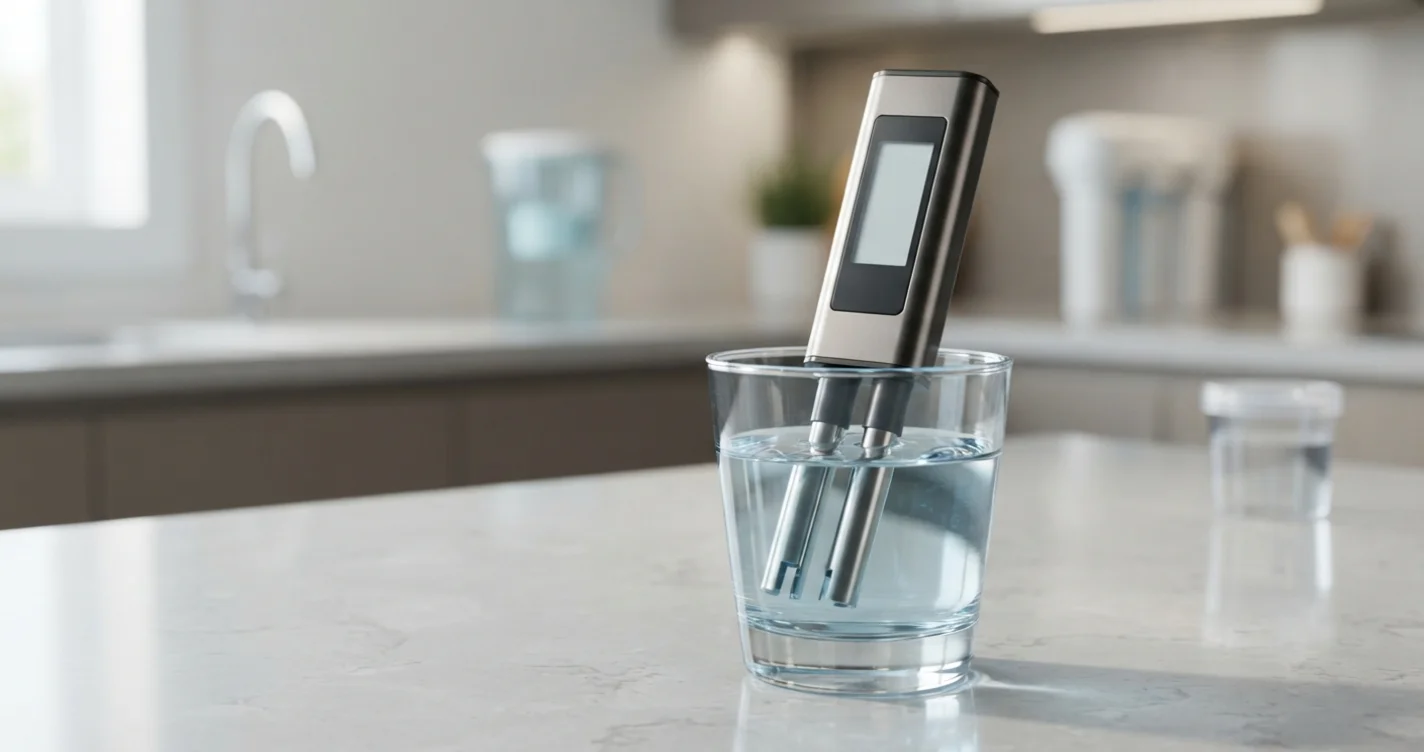
You’ve just purchased a TDS meter, tested your tap water, and a number appears on the display — but what does that reading actually tell you? Is 300 considered safe? Does 800 indicate a problem? Understanding your TDS Meter water quality reading correctly is important because much of the confusion and unnecessary concern comes from treating TDS as a simple pass-or-fail safety test, when in reality, it is only one part of the overall water quality picture.
This guide explains what TDS actually measures, what a safe TDS level for drinking water genuinely looks like, when a high or low reading should concern you, and where TDS meters fall short as the only tool for judging water safety.
What TDS Actually Measures
TDS stands for Total Dissolved Solids — the combined concentration of all inorganic and organic substances dissolved in water, measured in parts per million (ppm) or milligrams per liter (mg/L). This includes minerals like calcium, magnesium, sodium, and potassium, along with dissolved salts and some organic compounds.
A TDS meter measures water’s electrical conductivity, as dissolved ions allow electricity to pass through the water. The meter then uses this conductivity reading to estimate the TDS level. It is important to note that a TDS meter does not directly identify or count individual contaminants; instead, it provides an overall estimate of dissolved minerals and salts in the water.
What a “Safe” TDS Level Actually Means
This is where most confusion happens: TDS by itself isn’t a direct measure of water safety, and a moderate-to-high TDS reading doesn’t automatically mean the water is unsafe to drink.
TDS Level (ppm) | General Classification | What It Usually Means
|
|---|---|---|
Below 50 | Very low | Often over-purified water (e.g., pure RO permeate) with minimal minerals |
50–150 | Low | Generally considered good quality drinking water |
150–300 | Moderate | Commonly acceptable range for most municipal and groundwater sources |
300–500 | Fair | Still generally usable, though taste may be noticeably different |
500–1000 | Poor | Often considered the upper threshold for palatable drinking water |
Above 1000 | Very poor | Generally requires treatment before regular consumption |
These ranges are general guidance rather than strict safety cutoffs — a TDS reading of 400 ppm doesn’t automatically mean unsafe water, just as a reading of 80 ppm doesn’t automatically mean perfectly safe water. What actually determines safety is which specific dissolved substances are present, not just the total quantity.
Why TDS Alone Doesn’t Tell You If Water Is Safe
This is the most important thing to understand about TDS meters: they cannot distinguish between harmless minerals and harmful contaminants. A TDS meter reading the same number could reflect either:
- Water with mostly beneficial minerals like calcium and magnesium, which many people consider desirable for taste and nutrition, or
- Water containing dissolved contaminants like nitrates, certain heavy metals, or other harmful substances that also register as dissolved solids
A TDS meter simply cannot tell these apart. This is why relying on TDS alone to judge water safety is a genuine limitation — proper water safety assessment requires testing for specific contaminants (bacteria, heavy metals, nitrates, arsenic where relevant) rather than a single TDS number. Our guide on understanding the science behind water testing kits covers what a more complete water safety assessment actually involves.
When a High TDS Reading Should Get Your Attention
While TDS alone isn’t a complete safety indicator, certain patterns are worth investigating further:
- A sudden, significant increase in TDS from your normal baseline reading can indicate a change in your water source or possible contamination event worth investigating.
- Very high readings (well above 1000 ppm), particularly from borewell or groundwater sources, often warrant a fuller water quality test to identify exactly what’s contributing to the elevated reading.
- Noticeable taste, smell, or appearance changes alongside a high TDS reading are a stronger combined signal than the number alone.
- Water sourced from areas with known groundwater quality issues — some regions of Pakistan have documented concerns around arsenic or salinity in groundwater — should be tested more thoroughly regardless of what the TDS meter alone shows.
When a Very Low TDS Reading Is Also Worth Noting
It’s a common misconception that lower TDS always means better water. Extremely low TDS (well under 50 ppm) — typical of pure RO permeate with no post-treatment remineralization — has raised some discussion around whether very low-mineral water may lack beneficial minerals people would otherwise get from their drinking water. This isn’t typically a safety concern, but it’s worth knowing if you’re specifically choosing a water source for its mineral content, not just its purity.
Choosing the Best Water Filter for Home Use Based on Your TDS Reading
Your TDS reading is a useful starting point for deciding what kind of home water treatment actually makes sense:
- Low TDS with good taste and no known contamination concerns — basic filtration (activated carbon) may be sufficient for chlorine taste/odor removal without needing full RO treatment.
- Moderate to high TDS, particularly from groundwater or borewell sources — Reverse Osmosis is generally the more effective choice for meaningfully reducing dissolved solids.
- High TDS combined with known regional water quality concerns — a fuller water test alongside RO treatment is worth considering rather than relying on TDS reduction alone.
For a broader comparison of these options based on your specific water quality profile, our guide on Reverse Osmosis vs water filtration systems walks through how to match the right system to your actual water conditions.
Conclusion
A TDS meter is a genuinely useful first check for TDS meter water quality — quick, inexpensive, and a reasonable early indicator of your water’s overall mineral content. But it isn’t a complete safety test, and a safe TDS level for drinking water in Pakistan should be understood as general guidance rather than a strict pass/fail threshold. When your TDS reading raises questions — unusually high, suddenly changed, or from a source with known regional concerns — a fuller water quality test is the right next step rather than relying on the TDS number alone. Water Care Services Pakistan (WCSP) has supported water testing and treatment solutions across Pakistan since 2007, and can help interpret what your specific water quality results actually mean for your household.
Frequently Asked Question's
This varies significantly by city and water source, since groundwater and municipal supply mineral content differs regionally. Generally, readings in the range of roughly 150–300 ppm are commonly considered acceptable for most sources, though checking your specific local water authority’s data or getting your own water tested gives a more accurate baseline for your area.
Not necessarily — while very low TDS water (like pure RO permeate) is generally safe, some research and health guidance suggests that completely mineral-free water long-term may not provide the beneficial minerals people otherwise get from moderately mineralized drinking water. This is a separate consideration from safety, which zero TDS water generally does meet.
No. TDS meters only measure dissolved solids through electrical conductivity and cannot detect biological contaminants like bacteria or viruses, which don’t significantly affect conductivity in the same way dissolved minerals and salts do. A separate test is needed to assess microbiological water safety.
Minor fluctuations can occur due to plumbing, storage tank conditions, or slight variations in municipal supply. A significant or sudden change, however, is worth investigating further rather than dismissing as normal variation, particularly if it coincides with noticeable taste or appearance changes.
TDS is a useful starting point, but the best water filter for home use should also account for your specific water source, any known regional contamination concerns, and whether you want mineral retention versus maximum dissolved-solid reduction. A fuller water test gives a more complete basis for that decision than TDS alone.