Drilling a borewell is a major investment, and it is easy to view the drilling itself as the most important decision—choosing the location, determining the depth, and selecting the right contractor. However, borewell water testing before and after drilling is equally important, as groundwater quality can vary significantly even between neighboring properties. Discovering that a borewell produces unsafe or unusable water only after the investment has been made can be a costly mistake.
This guide explains what to check before committing to drilling, what a proper water test should assess, how groundwater quality testing services work in Pakistan, and what your test results could mean for the treatment system you may ultimately need.
.
Why Pre-Drilling Groundwater Assessment Matters
Groundwater quality in Pakistan varies significantly by region and even within the same neighborhood, depending on local geology, depth, and proximity to contamination sources like agricultural runoff, industrial discharge, or aging sewage infrastructure. Some areas have documented concerns around specific contaminants — for example, arsenic contamination has been identified in groundwater across several major Pakistani cities, and in some regions, arsenic and lead have been found together at levels requiring proper treatment before the water is safe for regular consumption.
A pre-drilling assessment, where feasible — checking existing nearby wells, regional groundwater data, or consulting with a hydrogeologist — can help set realistic expectations before you invest in drilling. It’s not always possible to know exact water quality until the well is actually drilled and tested, but understanding regional risk patterns helps you plan for the treatment system you’ll likely need rather than being caught off guard.
What to Test For After Drilling
Once a borewell is drilled, a proper water test should cover more ground than a basic TDS check. Key parameters worth testing include:
- Total Dissolved Solids (TDS) and hardness — baseline indicators of overall mineral content and whether the water will need softening or RO treatment.
- Bacteriological contamination (total coliform, E. coli) — critical for any water intended for drinking, since borewell water isn’t automatically free of biological contamination.
- Arsenic — particularly important in regions with documented groundwater arsenic concerns, since arsenic contamination isn’t detectable by taste, smell, or appearance.
- Nitrates — often linked to agricultural runoff or nearby septic systems, and a meaningful health concern at elevated levels, particularly for infants.
- Iron and manganese — don’t typically pose a direct health risk at moderate levels but affect taste, staining, and plumbing over time.
- pH level — affects both water taste and how effectively certain treatment processes (like antiscalant dosing) will perform.
- Fluoride — relevant in some regions of Pakistan where naturally elevated fluoride levels in groundwater have been documented.
Skipping straight to a basic TDS meter reading without testing for these specific parameters is one of the most common gaps in homeowner water assessment — TDS alone can’t tell you whether arsenic, bacteria, or nitrates are present.
How Groundwater Quality Testing Services Work
Proper groundwater quality testing services typically follow a structured process:
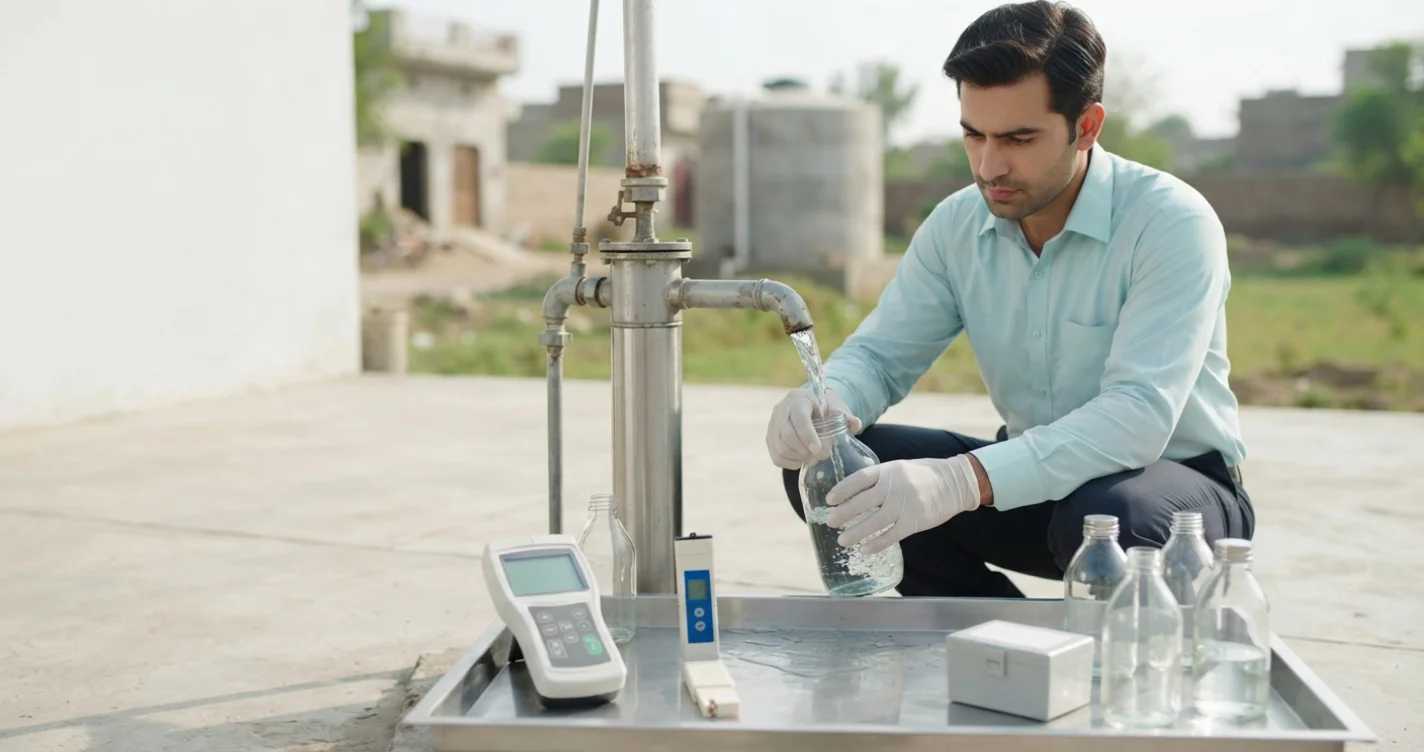
- Sample collection — either a certified technician collects the sample directly, or you’re provided with a proper collection kit and instructions to avoid contamination during sampling.
- Laboratory analysis — the sample is tested against a panel of parameters (as outlined above) using accredited lab methods rather than simple field test strips alone for parameters like bacteria and arsenic.
- Results interpretation — a proper testing service should explain what the results actually mean for your specific situation, not just hand over a list of numbers without context.
- Treatment recommendation — based on what’s actually present in your water, a tailored recommendation (softening, RO, arsenic-specific filtration, disinfection) rather than a generic one-size-fits-all system.
Field test kits can be useful for quick, preliminary checks — our guide on essential water testing kits for private well owners covers what these DIY options can and can’t tell you — but for parameters like bacteria, arsenic, and certain heavy metals, laboratory-grade testing gives far more reliable results than field kits alone.
Common Groundwater Issues in Pakistan by Region
While every borewell is different, some regional patterns are worth being aware of when planning:
- Coastal and low-lying areas — often face higher salinity and TDS due to seawater intrusion into aquifers.
- Areas near industrial zones — carry higher risk of specific chemical contamination depending on nearby industrial activity and discharge practices.
- Agricultural regions — more likely to show elevated nitrate levels from fertilizer runoff.
- Certain areas with documented arsenic presence — where arsenic and lead in groundwater have been identified as a specific regional concern requiring targeted treatment.
These are general patterns, not guarantees — the only way to know your specific borewell’s water quality is to actually test it, since conditions can vary even between wells drilled relatively close to each other.
What Your Results Mean for Treatment Choices
Once you have your test results, they directly inform what kind of treatment system makes sense:
Finding | Typical Treatment Response
|
|---|---|
High hardness, no other significant contamination | Water softener may be sufficient |
Elevated TDS with no specific contaminant flags | Reverse Osmosis system generally recommended |
Bacteriological contamination present | Disinfection (UV, chlorination, or chlorine dioxide) required alongside filtration |
Arsenic or heavy metals detected | Specialized arsenic-removal or RO-based treatment, since standard filtration doesn’t reliably remove these |
High nitrates | RO or ion exchange treatment, since boiling doesn’t remove nitrates and can actually concentrate them |
This is why testing before choosing a treatment system matters — installing a generic filtration setup without knowing what’s actually in your water risks under-treating a specific contaminant that a standard filter won’t address.
Conclusion
Borewell water testing in Pakistan isn’t a formality to skip before drilling or after — it’s the only reliable way to know what you’re actually working with, and it directly shapes what treatment system will keep your household’s water genuinely safe. Regional patterns like arsenic, salinity, or nitrate contamination offer useful context, but they’re not a substitute for testing your specific well. Water Care Services Pakistan (WCSP) has supported groundwater testing and treatment solutions across Pakistan since 2007, and can help homeowners interpret their results and choose the right treatment system based on what’s actually present in their water.
Frequently Asked Question's
As soon as possible after drilling and before regular use, since you’ll want a clear picture of water quality before committing to daily consumption or connecting it to household plumbing. Some parameters, like bacteriological contamination, can also change over time, so an initial baseline test is valuable for future comparison.
Field kits are useful for quick preliminary checks of parameters like pH and hardness, but for critical health parameters like bacteria, arsenic, and certain heavy metals, laboratory-grade testing gives significantly more reliable results. A combination — quick field checks plus periodic lab testing — is a reasonable practical approach.
Not always, but it’s genuinely common, since groundwater frequently contains higher mineral content, hardness, or specific contaminants compared to treated municipal supply. The only way to know for certain is to test your specific well rather than assuming based on general regional patterns.
Periodic retesting — commonly recommended on an annual basis, or sooner if you notice any change in taste, smell, or appearance — helps catch changes in groundwater quality over time, since conditions can shift due to seasonal variation, nearby land use changes, or aquifer-level factors.
Hardness comes from dissolved calcium and magnesium and primarily affects taste, scaling, and plumbing rather than posing an acute health risk. Arsenic is a toxic contaminant with serious long-term health implications even at relatively low concentrations, and unlike hardness, it can’t be detected by taste, smell, or a basic TDS reading — only specific laboratory testing identifies it.