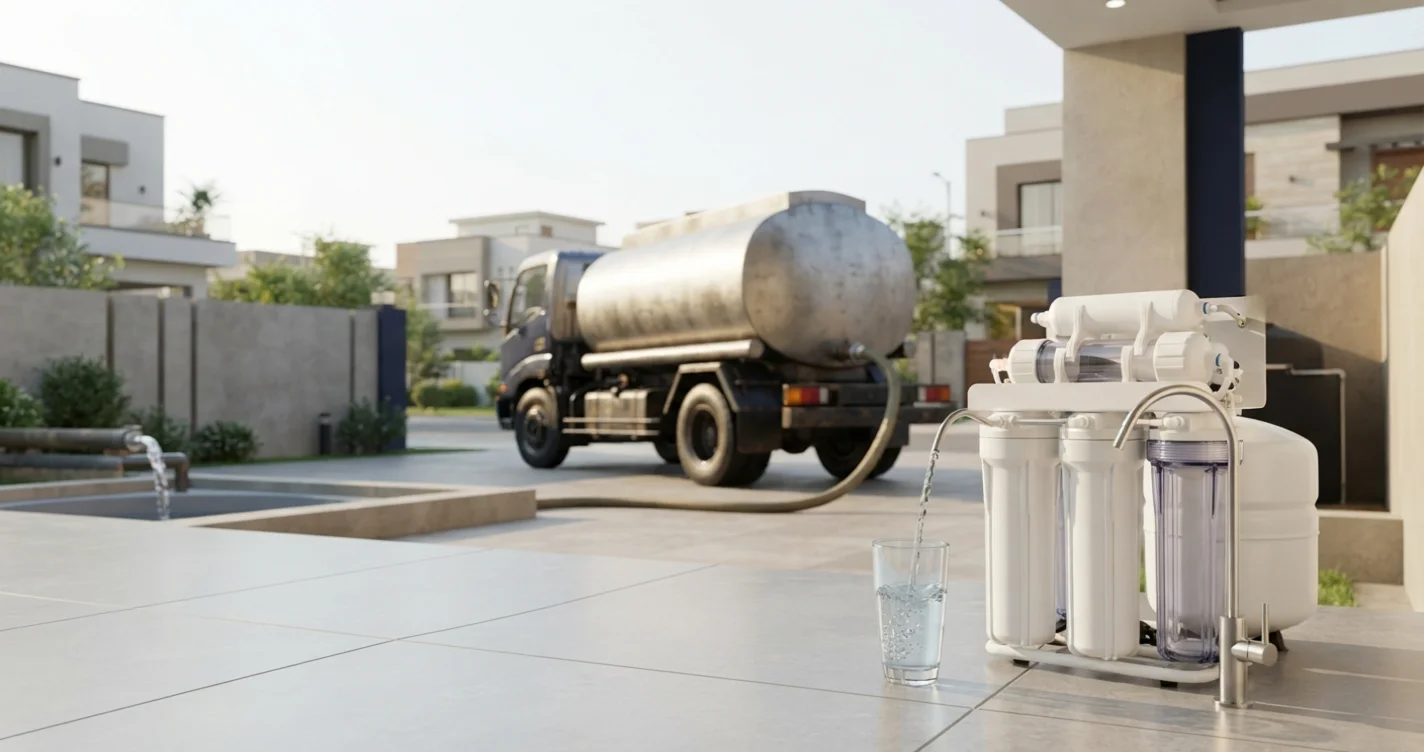
For many Karachi households, water tanker delivery is not simply a backup option—it is their main source of water, particularly in areas where the municipal supply is unreliable or inadequate. However, comparing water tanker vs RO plant cost requires looking beyond the upfront price of each option, since tanker expenses are recurring and can easily go unnoticed in a household budget until they are calculated over an entire year.
This guide explains the true long-term cost difference between depending on a water tanker and installing a home RO system. It also covers the factors that can affect the overall cost in either direction and which Karachi water supply solutions are most practical based on your household’s specific needs.
Why This Comparison Matters More in Karachi Than Elsewhere
Karachi’s water supply challenges are well documented — inconsistent municipal pressure, gaps in coverage in certain areas, and a large informal tanker market that has grown to fill that gap. For households already paying for regular tanker deliveries, treating that ongoing cost as “normal” rather than comparing it against a one-time RO system investment means missing a potentially significant long-term saving.
At the same time, not every household’s situation makes RO the automatically better choice — water quality, usage volume, and how reliably municipal supply reaches your specific area all affect which option actually costs less over time.
The Real Cost of Water Tanker Supply
Tanker costs are usually thought of per-delivery, but the honest comparison requires looking at annual totals:
- Per-tanker cost varies by tanker size, distance, and local market rates, and can fluctuate seasonally, particularly during periods of high demand or supply shortages.
- Delivery frequency depends on household size and consumption — a larger household or one without any municipal supply backup will need more frequent deliveries.
- Price volatility — unlike a fixed monthly utility bill, tanker pricing in Karachi has historically shown significant fluctuation, particularly during dry seasons or supply disruptions, making annual tanker costs harder to predict than a fixed treatment system’s operating costs.
- Quality inconsistency — tanker water quality isn’t always consistent between deliveries or suppliers, meaning some households layer additional filtration or testing costs on top of the tanker cost itself.
When these recurring, somewhat unpredictable costs are totaled over a full year, many households find the actual annual spend on tanker water is higher than they initially assumed when thinking about it delivery-by-delivery.
The Real Cost of a Home RO System
A home RO system has a different cost structure — front-loaded rather than continuously recurring:
- Upfront installation cost — the RO plant equipment itself, which our guide on choosing a trusted domestic RO plant company covers in more detail.
- Electricity — RO systems consume power to run the pump, though domestic-scale systems are relatively modest in this regard compared to industrial installations.
- Membrane and filter replacement — a periodic, predictable maintenance cost tied to usage volume and source water quality.
- Source water dependency — an RO system still needs a water source to treat; if your area has no reliable piped supply at all, an RO system alone doesn’t solve the sourcing problem, only the treatment problem.
This last point matters significantly for the Karachi context specifically: a home RO system assumes you have some water source reaching your property to treat — whether that’s municipal supply, a borewell, or occasional tanker deliveries used as raw input. It’s a treatment solution, not necessarily a substitute for having water reach your home at all.
Water Tanker vs RO Plant Cost: The Long-Term Comparison
Factor | Water Tanker Supply | Home RO System
|
|---|---|---|
Cost structure | Ongoing, recurring, variable | Upfront investment plus modest ongoing maintenance |
Price predictability | Lower — subject to market fluctuation | Higher — relatively stable operating costs |
Water quality consistency | Variable between deliveries/suppliers | Consistent, assuming proper source water and maintenance |
Solves supply gap | Yes — delivers water directly | No — requires an existing water source to treat |
Best suited for | Areas with no reliable water source at all, or genuinely occasional supplementary need | Households with an existing (even imperfect) water source needing quality improvement |
The key insight is that these two options aren’t always solving the same problem. If your household has zero reliable water reaching the property, tankers may remain necessary regardless of RO investment. If you have some water source but it’s poor quality, an RO system paired with that existing source is often the more cost-effective long-term choice compared to continuing to pay for tanker deliveries indefinitely.
When Tanker Supply Still Makes Sense
Water tankers remain the more practical choice in certain situations:
- Genuinely temporary needs (new construction, short-term rental, awaiting a permanent water connection)
- Areas with truly no accessible groundwater or municipal connection to treat as a source
- Very low, occasional usage where the fixed cost of installing and maintaining an RO system wouldn’t be recovered
When Switching to a Home RO System Makes Financial Sense
For households already spending consistently on tanker deliveries, and with some existing water access (even unreliable municipal supply or a borewell), the long-term math often favors RO investment:
- Predictable, generally lower ongoing costs compared to variable tanker pricing
- Consistent water quality rather than delivery-to-delivery variability
- Reduced dependence on an informal supply market subject to seasonal price swings
Our guide on the water treatment plant ROI calculator and expected payback period walks through how to estimate your specific break-even point based on your current tanker spending.
Karachi Water Supply Solutions Beyond the Tanker-vs-RO Choice
For some households, the most practical Karachi water supply solutions combine both approaches — using an RO system to treat whatever water source is available (municipal, borewell, or even tanker-delivered raw water) rather than treating it as a strict either-or decision. Our guide on Karachi Reverse Osmosis water solutions covers how RO systems are being used across different Karachi household and supply scenarios.
Conclusion
The water tanker vs RO plant cost comparison isn’t a simple either-or answer — it depends heavily on whether your household has an existing water source to treat, how much you’re currently spending on tanker deliveries annually, and how consistent your current water quality actually is. For most Karachi households with some form of existing water access, calculating actual annual tanker spend against the upfront and modest ongoing cost of a home RO system often reveals the RO investment pays for itself faster than expected. Water Care Services Pakistan (WCSP) has supported domestic and commercial water treatment solutions across Pakistan since 2007, and can help Karachi households calculate their specific long-term cost comparison.
Frequently Asked Question's
For households with an existing water source (municipal, borewell, or even occasional tanker use as raw input), the upfront RO investment often pays for itself within a reasonable period compared to continuing indefinite tanker spending, though the exact payback period depends on current tanker costs and usage volume. Calculating your specific annual tanker spend against RO system costs gives the clearest answer for your situation.
Only if you have an existing water source for the RO system to treat. If a property has no reliable water connection or groundwater access at all, an RO system doesn’t solve the sourcing problem — it’s a treatment solution, not a water-generation solution, so tankers may remain necessary as the water source itself.
Tanker water sourcing and handling practices can differ between suppliers, and quality isn’t always consistently verified delivery-to-delivery, which is why many households that rely on tankers still choose to filter or treat the delivered water before use rather than assuming consistent quality.
This depends on your current tanker spending and the RO system’s upfront and maintenance costs, but households with consistent, meaningful tanker spending often see payback within a reasonable timeframe. A proper cost comparison based on your actual current spending gives a far more accurate answer than a generic estimate.